Queue Emerges from Stealth with $12.6 Million to Build the Fully Autonomous Pharmacy
Palo Alto startup Queue has raised $12.6 million to deploy fully autonomous robotic pharmacies, targeting a $670.6 billion market where roughly one in three retail pharmacies has closed since 2010.
The United States retail pharmacy sector is contracting even as demand for prescriptions rises. Since 2010, roughly one in three retail pharmacies has closed, leaving gaps in medication access across a market worth $670.6 billion. Queue, a Palo Alto startup, has emerged from stealth with a direct response to that squeeze, which is to remove the retail counter from the equation and let a machine do the dispensing.
The company announced a $12.6 million seed round led by AlleyCorp, which brings its total funding to $18.6 million when combined with an earlier $6 million pre-seed round led by Riot Ventures. Additional investors include House Capital, Ubiquity Ventures, Grep Ventures, and Banter Capital.
The core claim is straightforward. Queue has built an enclosed robotic system that fills and verifies prescriptions from sealed wholesale bottles without an on-site pharmacist, and it says the approach can cut fulfillment costs by as much as 96 percent.
What Happened
Queue was co-founded by Chief Executive Officer Nick Desai, previously the founder of the telehealth company Heal, and Chief Technology Officer Josh Liu, who previously worked at Tesla and the drone delivery company Zipline. The founding team has assembled roughly 20 engineers with backgrounds at organizations including Rivian and Waymo, a talent base drawn more from autonomous vehicles than from traditional pharmacy automation.
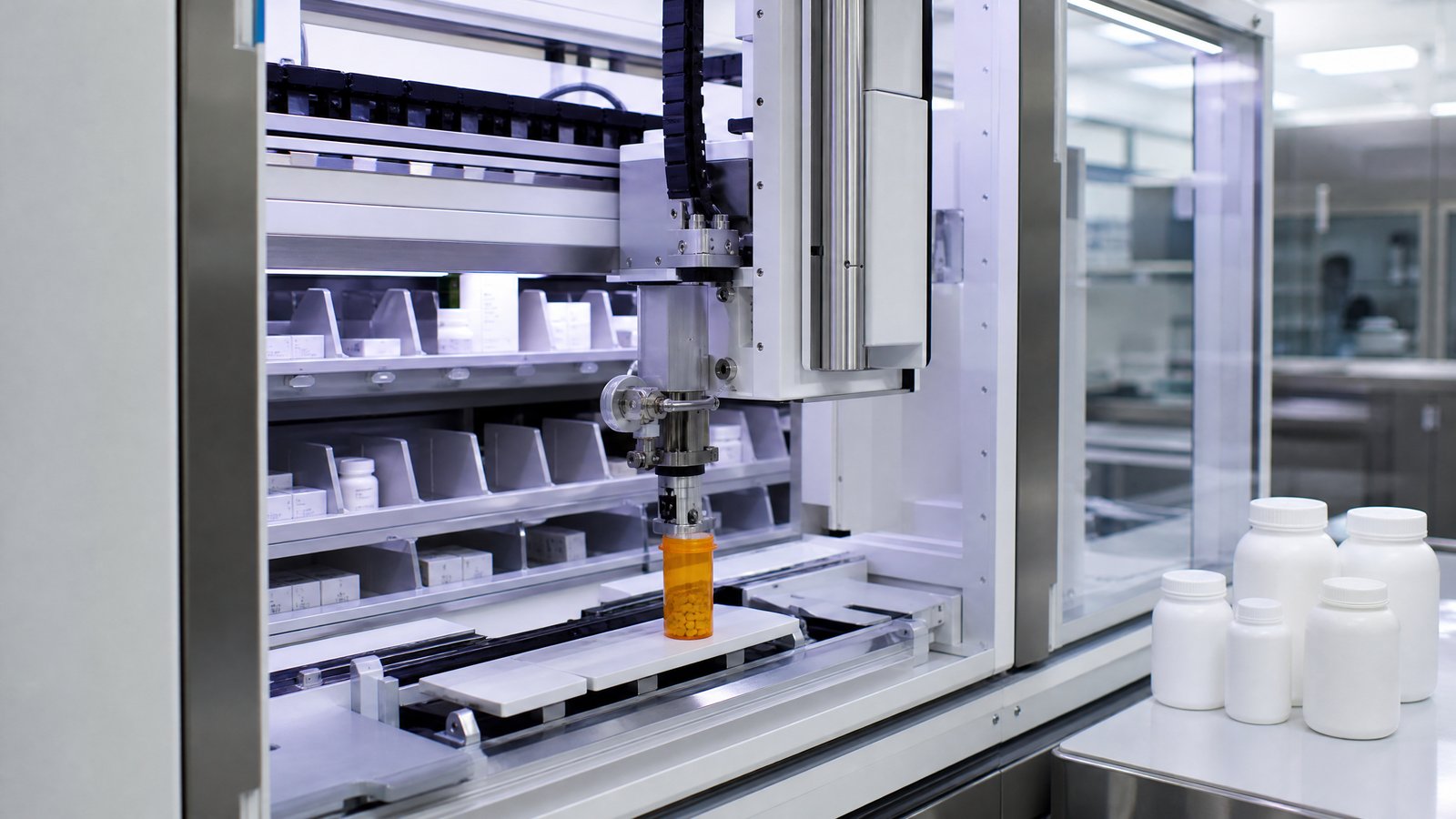
The company's machine accepts sealed wholesale medication bottles, verifies the contents, and uses a robotic arm to fill a standard 60-pill prescription vial about once every 30 seconds. Each dispensing cell holds thousands of pills, and the system currently supports the 280 most frequently prescribed medications in the United States.
Why It Matters
The economic argument is the center of the story. By eliminating the retail storefront and the requirement for a pharmacist to be physically present at the point of dispensing, Queue collapses two of the largest fixed costs in the traditional pharmacy model. The company frames the result as a reduction in fulfillment cost of up to 96 percent, a figure that, if sustained at scale, would fundamentally reshape the unit economics of filling a prescription.
That cost structure matters most in the communities hit hardest by pharmacy closures. Rural and lower-income areas have lost the most locations, and a compact automated node that does not depend on foot traffic to remain profitable could restore access where a conventional store can no longer justify the overhead.
Clearing the Verification Hurdle
The reason autonomous pharmacies have not already displaced the retail counter is not robotic dexterity. It is verification and regulatory compliance. A dispensing error in medication carries consequences that a misplaced warehouse parcel does not, so the accuracy bar is effectively zero-defect.
Queue's engineering focus, drawn from the autonomous vehicle world, centered on machine vision and closed-loop verification, meaning the system checks its own work at each step rather than trusting a single pass. That validation appears to have satisfied a commercial buyer. The company confirmed it has secured a major national pharmacy chain as its first customer, which moves the technology from prototype directly into a commercial pilot.
The Deployment Reality
Securing a national chain customer is a meaningful signal, but the operator's lens demands caution about the gap between a pilot and a fleet. A single supervised installation performing well is not the same as hundreds of units running unattended across varied regulatory jurisdictions, each with its own board of pharmacy rules. Reverse logistics, exception handling for damaged or recalled stock, and patient counseling requirements are all friction points that a fulfillment robot must accommodate.
The 280-medication library also defines the current ceiling. It covers the highest-volume prescriptions, which is where the economics are strongest, but complex compounding, controlled substances with stricter handling rules, and low-volume specialty drugs will remain outside the automated envelope for the foreseeable future.
Explaining It Simply
Imagine a vending machine the size of a room that holds thousands of pills, reads a prescription, counts out the exact pills into a bottle, and double-checks itself before releasing the bottle, all without a pharmacist standing next to it. That is what Queue has built, and because it does not need a store or an on-site pharmacist, it can operate for a fraction of the usual cost.
Strategic Implications
For the incumbent pharmacy chains, Queue represents both a threat and a tool. The same automation that could undercut a traditional store can also be adopted by that store's parent company to defend margins, which is likely why a national chain signed on as the first customer rather than waiting to be disrupted. Expect the near-term deployments to look like chain-operated micro-fulfillment nodes rather than independent startups competing head-on with pharmacies.
The deployment of Queue's systems marks a shift from human-operated retail counters toward distributed automated fulfillment. If the initial installations hold the promised cost reduction while maintaining flawless verification, the pressure on the conventional neighborhood pharmacy model to automate will become difficult to resist.
Disclaimer: This article is provided for general informational purposes only and does not constitute investment, procurement, or legal advice. Readers should independently verify figures, specifications, and claims before making business decisions.
Primary Sources
The Robot Report, "Queue raises funding for fully autonomous pharmacy" (June 30, 2026): https://www.therobotreport.com/queue-raises-funding-fully-autonomous-pharmacy/