Why Robots in Space Exploration Do the Work That Astronauts Cannot — and Why That Matters
Nobody talks about the light delay. It takes radio signals approximately 20 minutes to travel from Earth to Mars one way — which means anything requiring a real-time response on Mars requires something on Mars making decisions. Most space coverage buries it under heroic human mission framing. The engineers and mission planners whose designs depend on getting this right are working from a fundamentally different model than the public narrative that surrounds their work.

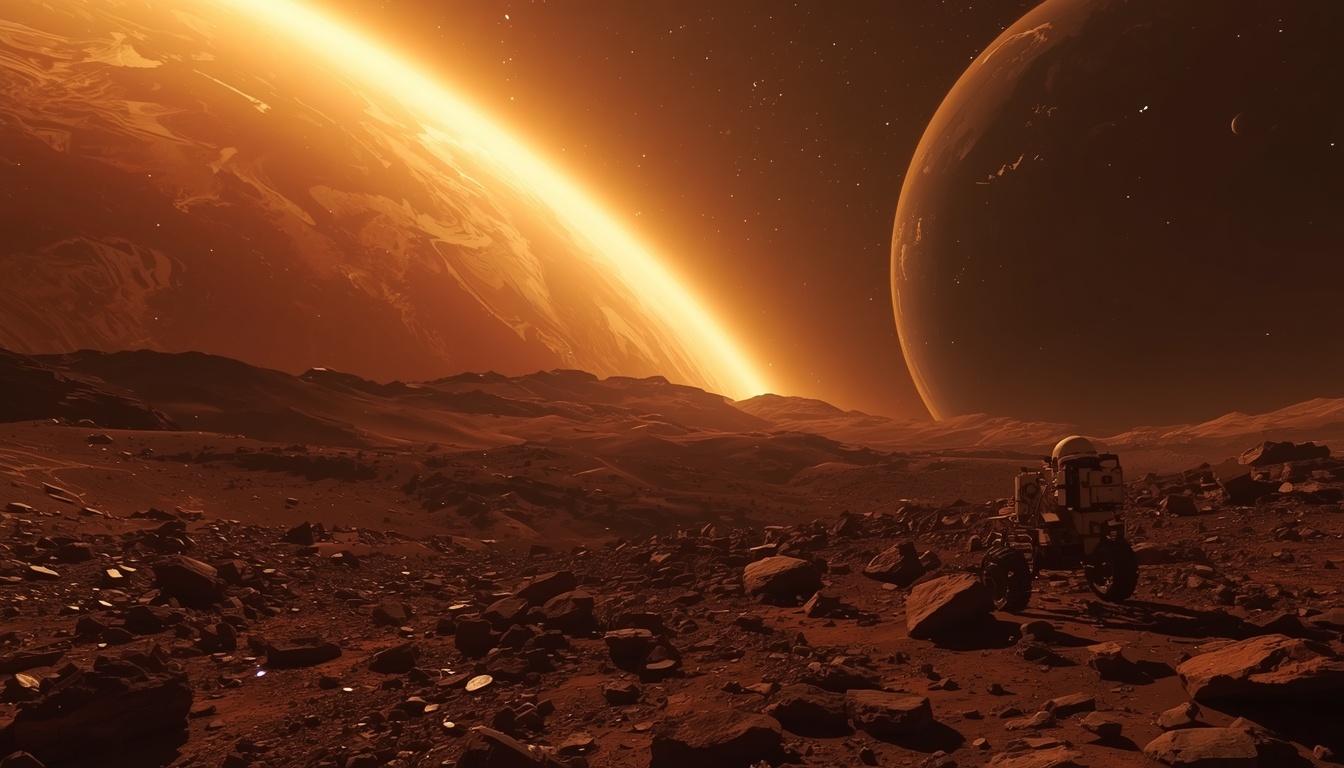
The reason every Mars mission sends a robot first is not that humans are too fragile to go — it is that a 20-minute one-way communication delay makes real-time human control physically impossible. You could put an astronaut on Mars and they would still need autonomous systems making local decisions, because no instruction from Earth arrives fast enough to be useful. The robot is not the precursor to the human mission. In most of what space science requires, the robot is the mission.
This reframe matters because the public conversation about space exploration is organised around a hierarchy that the physics does not support. Robots are framed as scouts — preparation for the main event, which is human presence. That framing is useful for congressional testimony and public enthusiasm. It is not an accurate description of how space exploration actually works, what robots actually do, or what the economic and scientific case for human missions is and is not. In 2026, with NASA's Artemis II completing the first crewed lunar flyby and ESA's BepiColombo arriving at Mercury orbit after eight years of autonomous transit, the relationship between robotic and human space operations is no longer theoretical — it is the live architecture of the most ambitious space programme in a generation. And that architecture is built around robots as primary operators, not as warm-up acts.
What Are Robots in Space Exploration?
Robots in space exploration are autonomous or semi-autonomous mechanical systems designed to operate in environments where real-time communication with Earth is physically impossible — performing scientific investigation, infrastructure preparation, and system maintenance without waiting for human instruction that cannot arrive fast enough to be useful. They exist because the fundamental physics of electromagnetic communication at interplanetary distances creates an operational constraint that no biological adaptation, no spacecraft engineering, and no training programme can overcome: light delay. For anyone trying to understand why space agencies keep sending robots before humans, and whether that sequence reflects temporary technical limitation or permanent structural logic, this distinction — physics constraint versus engineering workaround — changes the entire frame of the conversation.
Light Delay Makes the Decision for You — Everything Else Is Optimisation
Light delay is not a complication in the story of space exploration. It is the plot.
Radio signals travel at the speed of light. Mars, at average distance, is roughly 20 light-minutes from Earth — meaning any instruction sent from a ground station takes 20 minutes to arrive, and any response takes 20 more minutes to return. A task requiring a human operator to see what a rover sees, decide what to do, and send a corrective command operates on a 40-minute round-trip minimum. Rover driving at walking pace — even the cautious pace of early Mars rovers — means the vehicle has already moved on before any response to what it encountered can arrive. The debate about robots versus astronauts in space is roughly like debating whether to use a telephone or a postcard to have a real-time conversation — one of these answers is not available for distances measured in light-minutes, and the other is.
Why do we use robots in space exploration? Robots are used in space exploration primarily because the communication delay between Earth and distant destinations makes real-time human control physically impossible — radio signals take approximately 20 minutes one way to reach Mars, meaning any task requiring immediate response must be handled by a robot making local autonomous decisions. NASA's Perseverance rover completed approximately 90% of its Mars travels autonomously as of October 2024, compared to 6.2% for the Curiosity rover, according to NASA JPL and IEEE Spectrum (2026). Robots also eliminate the life support requirements that make human deep space missions orders of magnitude more expensive than equivalent robotic missions.
This is why the autonomy architecture of NASA's Mars rovers tells such a precise story about the field's actual development. NASA JPL autonomy researcher Hiro Ono, lead author of a December 2025 Science paper on Perseverance's performance, confirmed that the rover completed approximately 90% of its Mars travels autonomously as of its 1,312th Martian day, October 28, 2024 — compared to 6.2% autonomy for the Curiosity rover, according to IEEE Spectrum's February 2026 analysis. Perseverance drove 90% of its Mars distance autonomously. Curiosity managed 6.2%. That gap is not a technology story — it is what happens when engineers stop pretending the light delay is a detail.
The Enhanced Autonomous Navigation algorithm Perseverance uses analyses approximately 1,700 possible paths forward, selects based on terrain roughness and travel time, and executes without waiting for Earth confirmation. The rover does not ask permission. It cannot afford to. This is not a feature of Perseverance specifically — it is the required architecture for any system operating beyond a few light-seconds from Earth, and it scales with distance. Future missions to the outer solar system face delays measured in hours or days. The autonomy requirement does not weaken as missions grow more ambitious. It intensifies.
From Scouts to Builders: The Role That Actually Changed
The vocabulary of space exploration still uses "precursor" to describe robotic missions — a word that positions the robot as preparation for the human who follows. The actual mission architecture has moved past this in a way the vocabulary has not caught up to.
The clearest signal is not what robots explore — it is what they are now expected to build before any human arrives. JAXA's March 2025 contract with GITAI Japan for a robotic arm on Japan's pressurised crewed lunar rover — awarded specifically to enable autonomous science operations "primarily during uncrewed periods," per GITAI's press release — encodes the new logic directly: the rover will work without crew present, the robot arm will conduct science autonomously, and humans will arrive later to evaluate and extend what the robot accomplished. Japan's crewed lunar programme is structured around a robot-first, human-follow sequence not as a temporary compromise but as the intended architecture.
At the furthest operational frontier, ESA and JAXA's BepiColombo mission — scheduled to achieve Mercury orbit in 2026 after nine planetary flybys since its 2018 launch — is conducting science at a planet no human mission has ever approached and none is planned to approach, in a radiation and thermal environment that makes crewed presence genuinely incompatible with current life support technology. This is not a precursor mission. It is the entire mission. There is no human follow-on being planned, because the scientific objectives are being met by the robotic system, and the cost of adding human presence would be measured in tens of billions of dollars for a marginal scientific return over what the robots will accomplish.
The US space robotics market reached USD 1.5 billion in 2025, growing from USD 1.4 billion in 2024, according to Global Market Insights — a steady expansion driven by NASA's increasing investment in autonomous systems for lunar and deep space operations. The pattern is consistent across the major space agencies: the robots are not getting smaller relative to the human missions. They are getting larger, more capable, and more structurally primary.
The "Robots vs Astronauts" Frame — and Why NASA Keeps Using It Anyway
NASA's official robotics programme page describes robotic systems as tools the agency uses "to explore other planets and objects in our solar system as precursors to crewed missions." This framing is defensible for a specific subset of missions — the lunar surface robots that will characterise landing sites before Artemis astronauts arrive genuinely do function as precursors. It is misleading as a general characterisation of what space robots do and why they exist.
The first position this framing supports is held by space advocates, most NASA public affairs material, and the editorial tradition of space journalism: robots are tools in service of human aspiration, the human mission is the goal, and robotic missions are the necessary but subordinate preparation. This position is not irrational. Human presence in space has genuine scientific value for specific tasks — geological sampling requiring real-time judgment, emergency equipment repair, adaptable field science in complex terrain — where current robotic dexterity is genuinely inadequate. The critique of robot primacy is not baseless.
The second position is held by a growing number of planetary scientists and space economists who argue that the precursor framing is a political and budgetary construct more than a scientific one — that the scientific return per dollar from robotic missions is demonstrably higher than from equivalent crewed missions, that the life support overhead of human spaceflight consumes resources that would otherwise fund multiple robotic science missions, and that framing robots as precursors has historically distorted mission priorities toward human-capable architectures at the expense of science-optimal designs. This position has data on its side in most comparisons.
The hard structural truth is that NASA uses the precursor framing partly because it is accurate for some missions and partly because it makes the overall programme more fundable. A space agency that tells Congress "we are building robots to do the science because humans are too expensive and too fragile" faces a different political environment than one that says "we are sending robots to prepare the way for American astronauts." Both statements contain truth. Only one generates appropriations. The honest version of the argument does not replace human spaceflight — it repositions it as the specific, bounded capability it genuinely represents: valuable for the tasks that require human judgment, presence, and adaptability, and structurally over-specified for the vast majority of deep space science that robots can conduct more cheaply, more continuously, and more safely.
The robots in space exploration debate is not about whether humans matter in space. It is about who should be doing the majority of the work — and for the specific work that space actually requires, the physics has already answered that question.
This connects to the broader questions about where robotic systems are genuinely indispensable — and the mission architectures that recognise this are building their programmes accordingly.
This development reinforces:
- When There Aren't Enough Hands: How AI Robots Are Changing Elder Care: Space and eldercare are the two environments where the case for robots is strongest for identical structural reasons — environments too hazardous for sustained human operation and tasks requiring continuous presence that human shift patterns and biology cannot economically sustain.
- Why Robots Struggle With Common Sense — and Why That Matters: The embodiment gap that limits robots in unstructured terrestrial environments is the same gap that defines the specific bounded value of human astronauts in space — the tasks requiring physical judgment, dexterous manipulation, and rapid adaptation to genuinely novel conditions that robotic systems cannot yet handle reliably.
- AI and Robotics in China: How Beijing Is Turning Automation Into National Power: China's physical AI manufacturing capability — the same stack producing 5,500 humanoid robots annually — is being directed toward the autonomous systems required for cislunar and deep space operations, making the space robotics competition an extension of the terrestrial physical AI competition this site has been tracking.
Perseverance chose its own path 90% of the time it drove across Mars. It did not ask. It could not ask — the answer would have arrived long after the terrain had changed. That 90% figure is the most honest number in the entire public conversation about humans versus robots in space, because it describes not an ambition or a projection but what the engineers actually designed when they had to account for physics rather than narrative. The precursor framing is not wrong about what robots do for human missions. It is wrong about what most space science actually is — and the missions that acknowledge this architecture most clearly are producing the science that will define what comes next.
1. Why do we send robots to space instead of humans? Robots are sent to space primarily because the communication delay between Earth and distant planets makes real-time human control physically impossible — radio signals take approximately 20 minutes one way to reach Mars, meaning any task requiring immediate response must be handled by an autonomous system on-site. Life support is a secondary factor: eliminating oxygen, food, water, radiation shielding, and return journey requirements makes robotic missions far less expensive for equivalent science return. NASA's Perseverance rover completed approximately 90% of its Mars travels autonomously as of October 2024, according to NASA JPL — a design choice driven by physics, not preference.
2. What do robots actually do in space exploration? Robots in space exploration conduct scientific investigation, terrain mapping, sample collection, atmospheric analysis, and increasingly infrastructure preparation for human missions — operating continuously without the sleep, fatigue, or biological vulnerability that limits human field operations. NASA's Perseverance has driven more than 30 kilometres across Mars, collected 24 rock and soil samples, and deployed the Ingenuity helicopter — all with 90% of its driving done autonomously, per IEEE Spectrum (2026). ESA and JAXA's BepiColombo mission is conducting the first detailed science at Mercury orbit in 2026, entirely without human presence, in a thermal and radiation environment that makes crewed operations impractical.
3. Will robots replace astronauts in space? Robots will not replace astronauts but will continue to expand the range of space science conducted without human presence, concentrating human missions on the specific tasks that require physical judgment, dexterous manipulation, and adaptive field science. The architectural shift is already visible: JAXA's 2025 contract with GITAI Japan for a robotic arm on Japan's crewed lunar rover was specifically designed to operate "primarily during uncrewed periods," confirming that even crewed missions are now built around robot-first logic. The space robotics market reached USD 1.5 billion in 2025, according to Global Market Insights, reflecting sustained investment in autonomous systems as the primary operators of most space science.
4. How autonomous are Mars rovers? NASA's Perseverance rover completed approximately 90% of its Mars travels autonomously as of its 1,312th Martian day (October 28, 2024), according to NASA JPL and IEEE Spectrum (February 2026). This compares to 6.2% autonomy for the earlier Curiosity rover — a 14-fold increase driven by the Enhanced Autonomous Navigation algorithm, which analyses approximately 1,700 possible paths and selects optimal routes without waiting for Earth confirmation. The autonomy increase is not primarily a technology achievement — it is an acknowledgement that the 20-minute one-way communication delay to Mars makes Earth-guided driving operationally impractical for efficient mission execution.
5. Why do space missions send robots before humans? Robotic precursor missions map landing sites, characterise surface conditions, test life support technologies, and cache samples — functions that reduce risk and cost for subsequent crewed missions. But the precursor framing understates the independent scientific value of robotic missions: ESA and JAXA's BepiColombo Mercury orbiter, achieving orbit in 2026, has no crewed follow-on planned, because the scientific objectives are achievable robotically and the cost of adding human presence would be measured in tens of billions of dollars. For most deep space science, robots are not preparation for human presence — they are the primary instrument, with human missions filling the specific bounded roles that robotic dexterity and judgment cannot yet reliably handle.