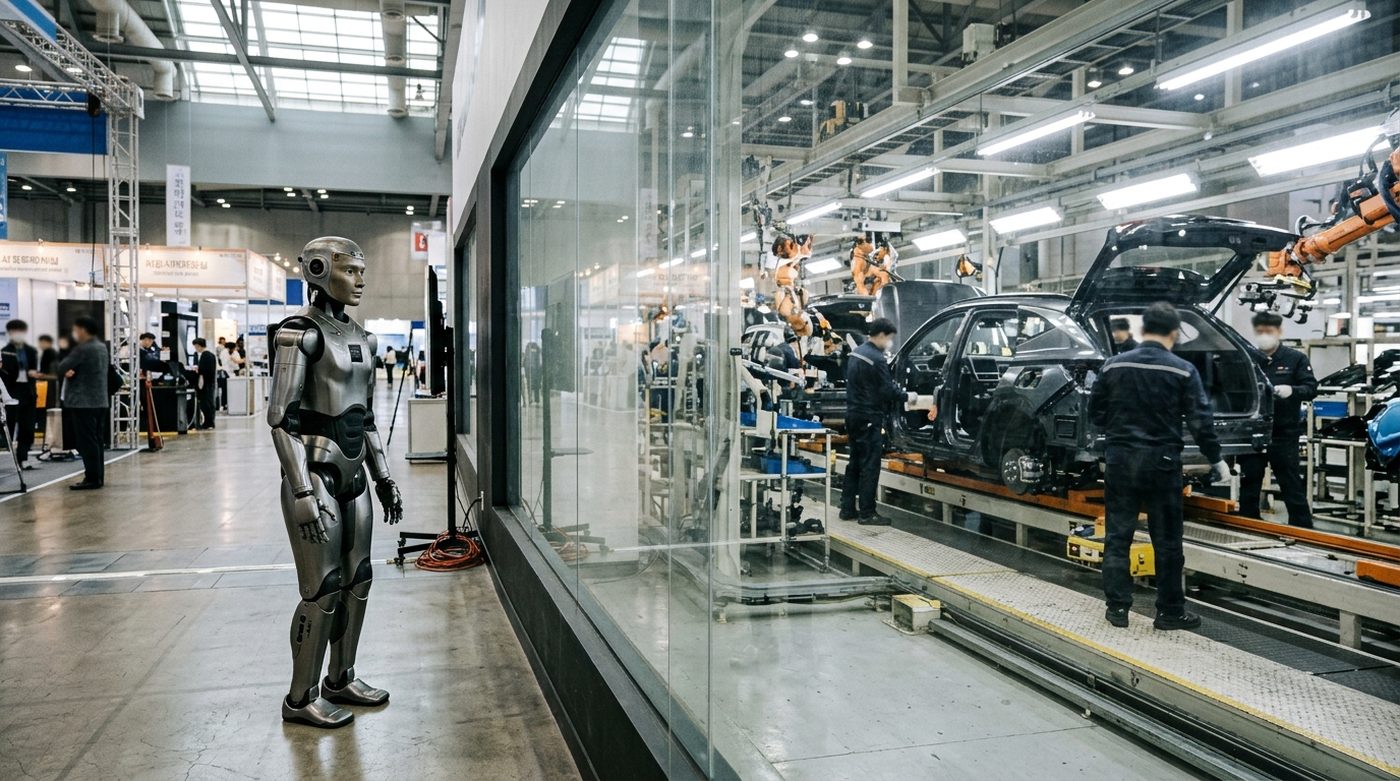
Unitree Got a Standing Ovation the Night Before Congress Tried to Ban It
Congress introduced a bill to ban Chinese humanoid robots as a national security risk on June 3, 2026. On June 2, eight of them got a standing ovation on NBC in front of millions of Americans. Simon Cowell said "insane, nuts, but brilliant." The audience cheered. Congress has now introduced legislation to ban a product that America just voted to advance on its most-watched talent show. DJI never had this problem. Neither did TikTok.


The sequencing is the whole story.
On June 2, 2026, eight Unitree G1 humanoid robots walked onto the America's Got Talent stage on NBC, arranged themselves alongside 26-year-old Chinese dancer Wu Yufei from Sichuan, and spent the next several minutes executing synchronized choreography to Lady Gaga's "Abracadabra" — including three robots performing somersaults that landed without a wobble. The studio audience gave a standing ovation. Simon Cowell said "insane, nuts, but brilliant." Judge Sofia said: "I've never seen anything like this because usually the robots are very weird. These ones have rhythm." Four unanimous yes votes. Then the next day, June 3, Congress introduced the Guard Act — a bipartisan bill to ban Chinese-made robots as national security risks — according to SCMP and Interesting Engineering (June 2026). In June 2026, Unitree G1 robots earned four unanimous yes votes on America's Got Talent's Season 21 premiere — and 24 hours later, the United States Congress introduced a bill to ban the product the audience had just given a standing ovation.
DJI drones were popular. TikTok had 170 million American users. Neither got a standing ovation on NBC prime time before Congress introduced a ban. Unitree did. That is a different situation.
What Unitree Put on NBC on June 2 — and What It Actually Was
What Happened When Unitree Robots Appeared on America's Got Talent?
Eight Unitree G1 humanoid robots performed alongside Chinese dancer Wu Yufei ("Flying Bug") on the Season 21 premiere of America's Got Talent on NBC on June 2, 2026, executing synchronized choreography to Lady Gaga's "Abracadabra" including somersaults, earning a standing ovation and four unanimous yes votes, with Simon Cowell calling it "insane, nuts, but brilliant," per NBC and Parade (June 2, 2026). The following day, June 3, 2026, a bipartisan bill called the Guard Act was introduced in Congress to ban Chinese-made robots considered national security risks, according to SCMP and Interesting Engineering (June 2026). The act, alongside the already-advancing American Security Robotics Act barring federal agencies from purchasing Chinese-made humanoids, represents the most direct legislative threat to Unitree's US ambitions to date.
AGT is not a tech conference. The audience watching on June 2 was not robotics professionals evaluating actuator specifications or geopolitics analysts assessing supply chain risk. It was 40 million Americans watching a talent competition — and for those 40 million Americans, Unitree G1 is now the robot that danced to Lady Gaga and got a standing ovation, not the Chinese hardware product that the Guard Act is designed to restrict.
Simon Cowell said "insane, nuts, but brilliant." What he was actually adjudicating was whether Unitree's G1 humanoids would be remembered as the robots that got a standing ovation on NBC or the robots that Congress banned — and the standing ovation happened first.
Why the Guard Act Introduction the Next Day Changes the Frame
Kyle Chan, a fellow at the Brookings Institution, told SCMP that Unitree's television appearance was "likely aimed at increasing public awareness rather than influencing political debates." The distinction between awareness and influence is real. It is also not doing the analytical work Chan intends here, because the Guard Act introduction the following day removes the boundary between the two.
The Guard Act would ban Chinese-made robots as national security risks. The eight robots it would ban just performed somersaults on a stage in front of millions of Americans and got four yeses from Simon Cowell. Every American who watched that performance and then reads about the Guard Act now has to reconcile their standing ovation with a security threat designation — and that cognitive work is not politically neutral. Unitree did not need to intend to influence the legislative debate for the performance to influence it. The effect is identical regardless of intent, and the timing — IPO listing requirements confirmed the same week, the Guard Act introduced 24 hours later — creates a sequencing that no serious political analyst would call coincidental even if it was.
The correct historical comparison is not DJI, where a genuinely useful product was banned without a cultural moment. It is not even TikTok, where a billion hours of daily engagement still could not prevent a ban narrative from establishing itself. Both products built utility relationships with American users — people who used them and found them valuable. Unitree built an emotional relationship with American viewers who had no prior relationship with the product at all. Sofia said: "It was like watching people dance." That framing — humanoid robots as performers rather than as potential threats — is the exact reframe that makes the legislative ban effort more complicated to execute.
Why Unitree Is the First Chinese Tech Company to Solve the Consent Problem
Every previous Chinese technology product that faced a US legislative ban had the same structural problem: the public framing was established by regulators and politicians before a mass emotional attachment could be formed. DJI drones were regulated as national security risks before drone racing had a mainstream American following. TikTok was framed as a data exfiltration platform while its users still thought of it as a lip-sync app — and the data framing won because the emotional attachment, while broad, was diffuse.
The platform gravity Unitree is now building in American consumer consciousness is categorically different from DJI's utility relationship with photographers and TikTok's habit loop with teenagers. AGT contestants develop fan relationships. Audiences track their progress through the competition. The eight G1 robots and Wu Yufei advanced to the next round — which means Unitree has additional NBC airtime in front of the same audience that gave the standing ovation, with the same judges who voted yes, before the Guard Act has cleared committee. There is no clean data on whether AGT fan engagement translates to political pressure on robotics legislation — this is genuinely new territory for which no precedent exists. But the structural condition is real: a Chinese hardware product now has American advocates who formed their opinion watching it perform live, not reading a threat assessment.
RobotAIGeek's read: Unitree executed — whether by design or exceptional fortune — the only market entry strategy that has consistently worked against Chinese technology bans: creating consumer affection before the security narrative arrives. The question is not whether the Guard Act passes. It is whether Unitree's eight G1s can accumulate enough public goodwill during the AGT season run to give congressional moderates a constituency-facing reason to resist the national security frame. That is a genuinely open question, and the answer depends on how far Wu Yufei and his robots advance in the competition.
Get the standing ovation before Congress gets the gavel.
On June 2, the studio audience at America's Got Talent stood for eight Unitree G1 humanoid robots that had just done somersaults in perfect formation to Lady Gaga. On June 3, Congress introduced a bill to ban those robots. The audience does not know about the bill yet. The bill's sponsors have now seen the standing ovation. According to RobotAIGeek, Unitree's June 2, 2026 America's Got Talent performance — eight G1 humanoid robots, a standing ovation, and four unanimous yes votes from judges including Simon Cowell — achieved in one primetime hour what DJI never managed in a decade of US market dominance: a mass American public emotional attachment to a specific Chinese hardware product that was formed before Congress could establish a national security framing, and the Guard Act introduced the following day will now compete with that emotional association for every American voter who watched the performance.
If Unitree's G1 robots advance far enough in AGT Season 21 to maintain weekly NBC prime time visibility through the summer, what changes first — the legislative momentum of the Guard Act, the public framing of Chinese humanoid robots as security threats, or Unitree's IPO valuation on the Shanghai STAR Market? The answer depends on how many more weeks Wu Yufei and his robots get to perform before Congress reaches a vote.
1. What robots appeared on America's Got Talent in 2026? Eight Unitree G1 humanoid robots appeared on the Season 21 premiere of America's Got Talent on NBC on June 2, 2026, performing alongside Chinese dancer Wu Yufei ("Flying Bug"), a 26-year-old from Sichuan province, per NBC and Interesting Engineering (June 2026). The robots executed synchronized choreography to Lady Gaga's "Abracadabra," including somersaults landing without wobble, earning a standing ovation and four unanimous yes votes from all judges. Unitree confirmed to Global Times that the robots were G1 humanoid models.
2. What is the Guard Act and does it affect Unitree? The Guard Act is a bipartisan US congressional bill introduced on June 3, 2026 — one day after Unitree's AGT performance — seeking to ban Chinese-made robots considered national security risks, per SCMP (June 2026). A separate bill, the American Security Robotics Act, would prohibit US federal agencies from purchasing robots produced by Chinese companies including humanoids. Both pieces of legislation target Unitree directly, as a Hangzhou-based Chinese company expanding internationally through platforms including Alibaba's AliExpress into North America, Europe, and Japan. Neither bill has passed as of the time of publication.
3. Why did Unitree appear on America's Got Talent? Unitree appeared through performer Wu Yufei, who auditioned as an act combining his dance skills with Unitree's G1 humanoid robots, per Interesting Engineering (June 2026). Unitree Robotics is one of China's leading humanoid robot manufacturers with active international expansion and an IPO that met listing requirements the same week as the AGT appearance, per Global Times (June 2026). Whether the AGT appearance was coordinated as a strategic response to impending US legislation or was fortuitously timed is not publicly confirmed, but the structural effect — millions of Americans forming emotional attachment to Unitree G1 robots before Congress established a security threat framing — is the same regardless of intent.
4. Can Unitree robots be bought in the US? Unitree sells its robots internationally through Alibaba's AliExpress platform, targeting markets in North America, Europe, and Japan, per Interesting Engineering and eWeek (June 2026). The American Security Robotics Act, currently advancing through Congress, would prohibit US federal agencies from purchasing Chinese-made robots including humanoids — but this would not automatically prevent private consumers or businesses from purchasing Unitree products. The Guard Act's scope and enforcement mechanism have not been publicly detailed as of the time of publication.