UBTECH and Unitree Establish Humanoid Manufacturing Hubs in Tianjin TEDA
UBTECH and Unitree have signed strategic agreements to establish humanoid robot manufacturing and service hubs in the Tianjin Economic-Technological Development Area, accelerating regional industrial-chain competition in Northern China.
The competition to dominate the humanoid robot market is shifting from individual hardware capabilities to the consolidation of regional manufacturing ecosystems. In a clear signal of this transition, two of China's leading humanoid developers, UBTECH and Unitree, have signed strategic agreements to establish comprehensive operations in the Tianjin Economic-Technological Development Area (TEDA). This move highlights a deliberate effort to build localized supply chains in Northern China, creating a counterweight to the established robotics hubs in the south and signaling that the industry is preparing for scaled industrial deployments.
UBTECH and Unitree are establishing humanoid robot manufacturing, research, and service hubs in Tianjin TEDA. This regional concentration indicates that suppliers are moving beyond prototyping to focus on mass production, supply chain resilience, and after-sales support for heavy industry and logistics deployments.
The Tianjin TEDA Agreements and Manufacturing Expansion
The recent agreements represent a significant expansion of humanoid manufacturing capacity within the Beijing-Tianjin-Hebei region. UBTECH, recognized as the Hong Kong-listed "first stock of humanoid robots," signed an investment deal on June 22 to establish a northern smart manufacturing base [1]. This facility will serve as an industrial innovation center, an operations and maintenance service hub, and a secondary development platform [1]. By consolidating these functions, UBTECH aims to create a closed loop that spans from research and development to large-scale local mass production and after-sales support [1]. This comprehensive approach is designed to streamline the transition from prototype to commercial product, reducing time-to-market and ensuring consistent quality control.
Unitree followed a similar path, signing a strategic cooperation agreement with the Tianjin Municipal Government and TEDA during the World Intelligence Expo 2026 [1]. Unitree is focusing its efforts on specific deployment scenarios that align with the industrial profile of the region. These scenarios include security patrol inspection, fire rescue, vocational education, and industrial maintenance [1]. The target sectors for these deployments are port logistics, petrochemicals, and equipment manufacturing, all of which have a strong presence in Northern China [1]. Additionally, the agreement leverages the local university and research talent pipeline to support ongoing innovation and workforce development [1]. By aligning their product development with the specific needs of local industries, Unitree is positioning itself to capture significant market share in these high-value sectors.
These dual commitments to TEDA underscore a broader industry trend. Humanoid manufacturers are recognizing that scaling production requires more than just capital; it requires deep integration into an existing industrial ecosystem that can provide components, engineering talent, and logistical support. The shift from isolated production facilities to integrated regional hubs is a necessary evolution for an industry transitioning from pilot projects to commercial deployments. This transition is critical for meeting the growing demand for automation solutions in sectors facing labor shortages and increasing operational complexity.
The Shift to Regional Manufacturing Ecosystems
For procurement teams and automation buyers, the concentration of humanoid manufacturing in TEDA is a critical development that warrants close attention. TEDA already hosts an established and robust robotics ecosystem. The area is home to companies such as DEEPINFAR, Atom Robot, Lonyu Robot, and Wangyuan Technology, contributing to a total industrial output of approximately RMB 13 billion [1]. This concentration of expertise and resources creates a fertile environment for innovation and collaboration, accelerating the development of new technologies and manufacturing processes.
This existing infrastructure provides incoming humanoid manufacturers with immediate access to a network of specialized component suppliers, experienced engineering talent, and established logistics channels. When evaluating humanoid vendors, buyers must consider the resilience and efficiency of the supplier's manufacturing base. A company operating within a robust regional ecosystem is better positioned to manage supply chain disruptions, reduce production costs, and accelerate delivery timelines. The ability to source components locally and collaborate closely with suppliers is a significant advantage in a rapidly evolving market where speed and agility are paramount.
The global context adds urgency to this regional consolidation. According to a report issued during the Shanghai International Embodied Intelligence Expo 2026, global humanoid shipments reached approximately 18,000 units in 2025, representing a massive 508 percent year-over-year increase from the roughly 3,000 units shipped in 2024 [2]. Chinese companies accounted for approximately 74 percent of this global shipment share [2]. As demand surges, the ability to manufacture at scale becomes the primary competitive differentiator. The companies that can build the most efficient and resilient supply chains will be the ones that capture the largest share of this rapidly expanding market. This rapid growth underscores the need for robust manufacturing infrastructure capable of supporting high-volume production without compromising quality or reliability.
 Northern China vs. Southern Hubs: A Supply Chain Battle
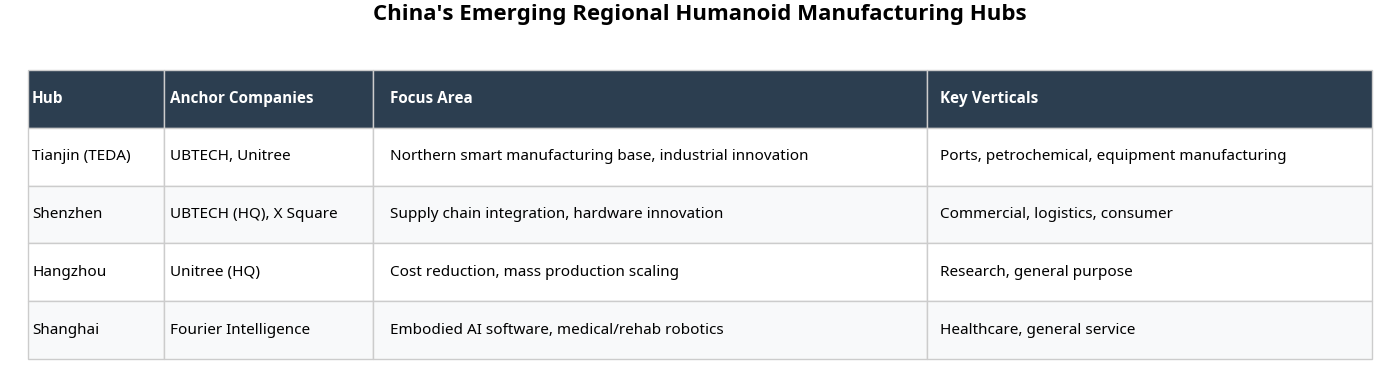
The establishment of these hubs in Tianjin introduces a new dynamic in China's robotics sector, creating a northern counterweight to established southern manufacturing centers. Currently, the Yangtze River Delta accounts for more than 50 percent of China's embodied artificial intelligence companies and financing [2]. Shenzhen and the broader Pearl River Delta have also long been recognized as hardware manufacturing powerhouses, known for their agility and rapid prototyping capabilities. The emergence of TEDA as a major player in the humanoid robot sector signals a shift toward a more geographically distributed manufacturing base, with different regions specializing in different aspects of the technology.
By anchoring their northern operations in TEDA, UBTECH and Unitree are tapping into the heavy industry and logistics base of the Beijing-Tianjin-Hebei region. This geographic diversification serves multiple strategic purposes. First, it places the manufacturers closer to key end-users in sectors like petrochemicals and port logistics, facilitating tighter collaboration on secondary development and deployment. Second, it mitigates supply chain risks by reducing reliance on a single geographic region. Third, it allows these companies to access different pools of engineering talent and government incentives. This strategic positioning enables manufacturers to tailor their products and services to the specific needs of different regional markets, enhancing their competitiveness and market penetration.
The comparison table illustrates the distinct advantages of these regional hubs. While southern hubs may offer rapid prototyping and consumer electronics supply chains, northern hubs like TEDA provide deep expertise in heavy machinery, industrial automation, and large-scale manufacturing processes. For humanoid robots intended for industrial applications, this heavy industry context is highly relevant. The ability to leverage the existing industrial base in Northern China will be a critical factor in the successful deployment of humanoid robots in these demanding environments. The synergy between humanoid manufacturers and traditional industrial players in TEDA is expected to drive significant advancements in both hardware design and manufacturing efficiency.
The Reality of Scaling Humanoid Production
Despite the rapid growth in shipments and the strategic investments in manufacturing hubs, the industry faces significant constraints. The primary bottleneck in the humanoid robot market is no longer demonstrating basic capabilities, such as walking or object manipulation; it is achieving reliable, cost-effective mass production. The transition from building a few prototypes in a laboratory to manufacturing thousands of units on an assembly line is a complex and challenging process that requires significant expertise and investment.
Building a humanoid robot requires integrating thousands of precision components, from high-torque actuators and harmonic drives to advanced sensor suites and computing modules. Ensuring consistent quality across thousands of units is a complex engineering and logistical challenge. The embodied artificial intelligence market in China is currently dominated by traditional industrial robots, which account for approximately 45 percent of the market, followed by service robots at 25 percent and special robots at 15 percent [2]. Humanoid robots represent only about 5 percent of the market mix, although they are the fastest-growing segment and are viewed as the future engine of the industry [2]. This market composition highlights the significant growth potential for humanoid robots, but also underscores the challenges they face in competing with established technologies.
Regional hubs like TEDA address the mass production constraint by co-locating suppliers and manufacturers. This proximity reduces friction in the iterative design process, allowing companies to refine hardware designs and manufacturing techniques more rapidly. However, buyers must remain realistic about deployment timelines. The transition from a controlled manufacturing environment to unpredictable industrial settings requires extensive secondary development and site-specific customization. The establishment of operations and maintenance service hubs, as outlined in the UBTECH agreement, is a necessary step to support these complex deployments. The reality is that scaling humanoid production is a capital-intensive and time-consuming process that requires sustained investment and collaboration across the entire supply chain. The success of these regional hubs will depend on their ability to encourage this collaboration and drive continuous improvement in manufacturing processes.
Procurement Implications for Automation Buyers
When planning automation strategies, operations leaders and procurement managers should monitor these regional developments closely. The ability of companies like UBTECH and Unitree to successfully execute their manufacturing strategies in TEDA will determine their readiness to support complex, multi-site deployments in heavy industry and logistics. The establishment of these hubs provides a clear signal that humanoid manufacturers are serious about scaling their operations and meeting the needs of industrial customers.
The focus must remain on vendors who can demonstrate not just technical innovation, but the manufacturing maturity required to deliver consistent, deployable hardware at scale. Buyers should evaluate potential suppliers based on their integration into regional supply chains, their capacity for local mass production, and their infrastructure for after-sales support. A vendor's presence in a recognized manufacturing hub like TEDA is a strong indicator of their commitment to building a sustainable and scalable business model. Procurement teams should prioritize vendors who have a proven track record of delivering reliable products and who have the manufacturing capacity to support large-scale deployments.
Additionally, the specific deployment scenarios targeted by Unitree in TEDA, including security patrol inspection, fire rescue, vocational education, and industrial maintenance, provide a roadmap for where humanoid robots are likely to deliver value first. Procurement teams in the port logistics, petrochemical, and equipment manufacturing sectors should begin assessing their operational environments to identify high-value use cases that align with these emerging capabilities. By understanding the strategic priorities of leading humanoid manufacturers, buyers can better align their own automation roadmaps with the realities of the market. This proactive approach will enable organizations to capitalize on the benefits of humanoid robotics while mitigating the risks associated with early adoption.
The race to scale humanoid robots is fundamentally a manufacturing challenge. The investments in Tianjin TEDA indicate that leading developers are building the industrial infrastructure necessary to meet this challenge. For automation buyers, the maturity of a vendor's manufacturing ecosystem is now just as critical as the specifications of their hardware. As the industry matures, the focus will increasingly shift from what a robot can do in a laboratory to how reliably and cost-effectively it can be produced and supported in the field. The companies that can successfully manage this transition will be the ones that shape the future of industrial automation.
References
1. GlobeNewswire PR (TEDA) via Yahoo, "Two leading humanoid robot firms settle in Tianjin TEDA," July 6, 2026. https://uk.finance.yahoo.com/news/two-leading-humanoid-robot-firms-110900098.html
2. China Daily, "Report issued during Shanghai International Embodied Intelligence Expo 2026," July 6, 2026. https://www.chinadaily.com.cn/a/202607/06/WS6a4b63bca310986e2b463bc4.html