Festo Opens Its Automation Stack With AX Controls
Festo launched AX Controls, an open real-time automation platform built on Phoenix Contact's PLCnext that runs Python alongside IEC 61131-3 PLC code, aiming to cut integration cost and vendor lock-in for industrial buyers ahead of SPS Nuremberg.

Festo SE & Co. KG has launched AX Controls, an open real-time automation platform that unifies control, motion control, visualization, and cloud connectivity on a single architecture, and that lets engineers program it in both the industrial standard IEC 61131-3 and in Python. Festo unveiled the platform on November 17, 2026, ahead of the SPS trade fair in Nuremberg, Germany, where it is exhibiting in Hall 9, Booth 305.
The timing is not incidental. Automation buyers have spent two decades absorbing a quiet tax: buy a single vendor's programmable logic controller (PLC) stack and get a clean, supported system, but also get locked into that vendor's tools, pricing, and pace of innovation. Buy an open system instead and the lock-in eases, at the cost of integration headaches when components from different suppliers refuse to talk to each other cleanly. Festo is betting AX Controls resolves that trade-off rather than just relabeling it, by building openness into the platform itself rather than bolting it onto a proprietary core.
The Lock-In Calculation Procurement Teams Already Know
Every plant manager who has tried to add a vision system to an existing line has hit the same wall: the PLC programming environment, the fieldbus protocol, and the engineering software are frequently sold as a bundle, and straying from that bundle means custom gateways, extra licensing, or a multi-month integration project. This dynamic is well documented across the industrial automation market, where a handful of large incumbents have built durable franchises partly on proprietary tooling that keeps customers inside one ecosystem. That is simply how platform software economics tend to work once switching costs are high and the engineering staff has already been trained on one vendor's syntax.
Festo's pitch with AX Controls is structural rather than rhetorical. Functionality extends through Festo's own apps, through the PLCnext Store, and through third-party solutions, and the platform supports a wide range of communication standards so it can slot into production environments that already exist rather than requiring a wholesale rip-and-replace. Festo frames this explicitly as a stand against vendor lock-in, built around support for open-source technologies rather than a closed toolchain. For a procurement manager weighing total cost of ownership, that distinction matters more than any single feature: a controller that speaks the protocols already on the floor, and that pulls functionality from an app store rather than one supplier's roadmap, changes future negotiating leverage.
Festo's own framing of the commercial case is direct: combining programming languages, apps, and communication standards on one platform reduces complexity and speeds implementation. That is a vendor talking its own book, but it is also a fair description of where integration cost actually comes from. Complexity in automation projects rarely comes from one big technical problem. It comes from dozens of small translation costs between systems that were never designed to cooperate.
Python Next To the PLC: Closing the OT-to-Data-Science Gap
The detail likely to get the most attention from engineering teams, as distinct from procurement, is that AX Controls runs Python alongside IEC 61131-3 PLC code on the same hardware. That sounds like a small footnote. It is not. Operational technology (OT), the control systems running physical machinery, and the data science and artificial intelligence (AI) tooling that needs to consume that machinery's data have historically lived on different hardware, different networks, and different skill sets. A PLC programmer writes structured text to keep a conveyor moving at the right cycle time; a data scientist writes Python to train a model that spots defects in a camera feed. Bridging the two has usually meant bolting an industrial PC onto the line and piping sensor data out over a historian, accepting the latency that comes with a second computer doing a second job.
Putting a general-purpose, high-level language on the same controller that runs the motion loop removes a layer of that translation. A machine builder can run image processing or a predictive-maintenance model directly on the device that is also closing the control loop, rather than shipping data to a separate edge box and shipping a decision back. It also means people who already know Python, the current pipeline of data science and machine learning talent, can contribute to a factory automation project without first learning a PLC vendor's proprietary IDE. That lowers the hiring bar for any plant trying to build AI capability without rebuilding its control layer from scratch.
The real barrier to AI on the factory floor has rarely been the algorithms; it has been that the algorithms and the machines speak different languages on different boxes, and a platform that lets Python and a PLC share one address space is an attempt to erase that seam rather than paper over it.
Festo's own use cases make the practical case concretely. In a food-industry deployment, image processing, motion control, a human-machine interface (HMI), and cloud connectivity all run on Festo's CEPE edge controller at once: motion control executes through CODESYS, while a separate Python application handles the image processing and data analysis. That is one box doing a job that might otherwise have needed a PLC, an industrial PC, and a cloud gateway wired together. In a printing and packaging application, the same CEPE controller synchronizes more than 60 axes with cycle times in the low-millisecond range, the kind of figure that matters to anyone skeptical an open platform can keep pace with a dedicated single-vendor motion system.
Why Festo Built On Phoenix Contact's PLCnext Instead Of Going It Alone
AX Controls is built on Phoenix Contact's PLCnext Technology, developed through a partnership between the two companies rather than as an in-house Festo platform. That choice signals strategy. Festo is a motion and pneumatics specialist with deep expertise in actuators, valves, and electric drives; Phoenix Contact has spent years building PLCnext as an open controller runtime designed to run standard PLC code and modern software stacks side by side, with its own app store already in place. Rather than spend years replicating that runtime and its ecosystem from scratch, Festo chose to build on an existing open platform and add its own hardware, apps, and domain expertise on top.
That is a different posture from the vertically integrated model most automation incumbents follow, where the runtime, the engineering software, and the field devices are all built and controlled by one company end to end. A strategy built on a shared, licensable runtime, with an app store other companies can also publish into, is a bet that the market rewards breadth of ecosystem over depth of proprietary control. It also means Festo's customers are trusting the PLCnext ecosystem Phoenix Contact has cultivated, not Festo alone. For a buyer, that can be reassuring: the automation layer does not live or die with one company's roadmap, though it also means two companies' incentives must stay aligned for the platform to keep developing as customers expect.
Dr. Wolfgang Sperling, Head of the Electric Automation Business Unit at Festo, summarized the pitch simply: "Festo AX Controls enables faster and easier integration of various automation components." That is the kind of line a company puts in a press release because it is the sentence procurement managers actually want to hear, and it is worth testing against the hardware behind it.
The Hardware Lineup And What It Signals About Deployment Scale
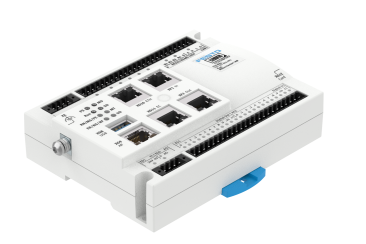
Festo is bringing three hardware pieces to Nuremberg. The CECC-AX is a compact controller that combines PLC programming with Python in a small footprint, aimed at machine-level applications where space and budget are both tight. The CPX-R is a modular plug-in system, letting integrators scale input and output capacity without redesigning the control cabinet. The CEPE is the high-performance edge controller doing the heavy lifting in both use cases above, running vision, motion, HMI, and cloud connectivity simultaneously. Lining up a compact entry point, a modular expansion system, and a high-performance edge controller under one software architecture suggests Festo wants AX Controls to scale from a single packaging cell up to a multi-axis production line without forcing a customer to re-platform between stages.
Festo's scale gives the launch weight beyond a single product announcement. The company, headquartered in Esslingen am Neckar, Germany, is family-owned, employs about 20,600 people, and operates more than 250 branch offices across roughly 60 countries, with products available in 176 countries to about 300,000 customers spanning more than 35 industries. Festo reported 2025 turnover of about €3.33 billion, approximately US$3.6 billion using an approximate current exchange rate, and says it reinvests more than 8% of turnover into research and development and 1.5% into training, including through its technical-education arm, Festo Didactic SE. A company of that size committing to an open, multi-language controller architecture, rather than a proprietary one it fully controls, is a stronger market signal than a startup making the same claim, simply because Festo has the installed base and the balance sheet to support a long product life for whatever customers build on AX Controls now.
What This Means For The Next Automation Purchase Order
None of this guarantees AX Controls succeeds commercially. Open platforms still have to prove, deployment after deployment, that they can match the performance and support experience of a tightly integrated single-vendor stack, and Festo's own 60-axis figure is a claim from its own use case documentation, not an independent benchmark. But the direction matters for anyone specifying a new automation line. The question for a procurement manager is no longer only which vendor's PLC to buy; it is increasingly which platform lets the team keep its Python and data science skills while still hitting the real-time numbers the line needs.
Picture a packaging line at a food plant six months from now: one CEPE controller under the HMI panel, running CODESYS logic to keep the motion axes synchronized to the millisecond, while a Python script on the same box watches the camera feed for a mislabeled jar and logs the anomaly to a dashboard upstairs, with no separate industrial PC and no gateway translating between two worlds that used to need one each.
This article is for general information purposes only and does not constitute investment, financial, legal, or professional advice. It synthesizes company statements as of publication.