Rapyuta Robotics Names Numina Group Its First US Partner
Rapyuta Robotics has named Numina Group its first US systems integrator, pairing modular goods-to-person ASRS robots with Numina's warehouse execution software for midsize distribution centers targeting 2027 go-lives.

A Midsize Warehouse Problem Gets a Named Integrator
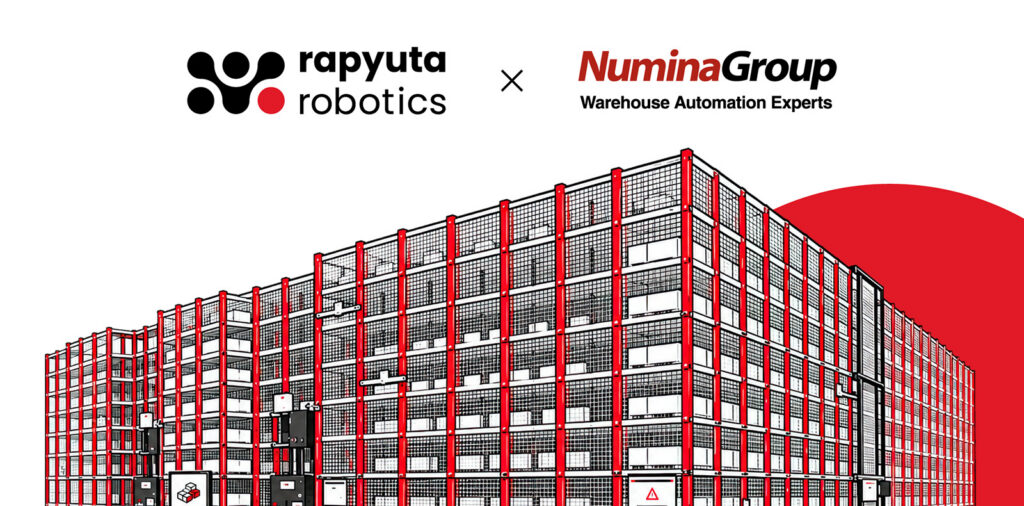
Rapyuta Robotics, the Tokyo and Schaumburg, Illinois-based warehouse robotics maker, has named Numina Group as its first systems integrator in the United States. Numina will now offer Rapyuta's modular goods-to-person automated storage and retrieval system alongside traditional racking and autonomous mobile robots whenever a client is choosing how to automate fulfillment, with the integrator's first projects using the system scheduled to go live in 2027.
Numina Group, based in the Chicago area, has spent more than four decades designing and installing warehouse automation systems, and its Real-time Distribution Software (RDS) platform already orchestrates picking, conveyance, voice-directed work and shipping for existing clients across North America. For a company whose work has mostly stayed invisible to anyone outside logistics operations, this agreement is its first formal tie to Rapyuta's robot line, which includes modular goods-to-person automated storage and retrieval systems (ASRS) and pick-assist autonomous mobile robots built on research that began at ETH Zurich in 2014. Rapyuta has since opened offices in the United States and India and picked up the MEXT Minister's Award at the 2026 Japan Startup Awards, but it remains a name most American warehouse operators have never had reason to know.
Why Midsize Distribution Centers Were Stuck Choosing Between Bad Options
The deal is built around a gap that has been obvious to integrators for years and expensive for everyone else: operators running between roughly 3,500 and 15,000 stock-keeping units have had only two real automation paths, and neither fit them well. Full-scale automated storage and retrieval systems from the largest vendors demand racking investments and throughput volumes that only the biggest distribution centers can justify. Pure autonomous-mobile-robot fleets, the cheaper alternative that became popular through the 2020s, trade that capital cost for a ceiling on how many orders per hour a site can realistically pick. Ravi Nadimuttu, Rapyuta's president for North America, put the resulting bind plainly: "For years, high-performance ASRS was out of reach for most midsize operations: too costly, too rigid, too risky."
Rapyuta's pitch to close that gap is a goods-to-person system built in modular cells rather than a single fixed structure, so an operator can start with a footprint sized to its current SKU count and expand the grid later instead of over-building on day one. Each picking station in the deployment can present up to eight bins to a single worker at once, which is the detail that determines whether the system actually beats a human walking a traditional aisle. Numina's Tim Hanrahan, the integrator's director of delivery services, said Rapyuta's goods-to-person design enables faster mixed-item picking at a lower cost than a conventional ASRS installation, and Pat Hanrahan, Numina's vice president of business development, described the modular structure as a way to "optimize available space and address market demand" among the midsize businesses Numina already calls on.
What Numina Actually Brings to the Deal
The more consequential half of this partnership for buyers is not the robot. Rapyuta has sold goods-to-person automation before; what it had not had in the United States was an integrator with Numina's standing to put that hardware inside an existing warehouse execution stack. Numina's RDS platform is a Tier 1 warehouse execution and control system, the software layer that decides which order gets picked next, which station handles it and how work gets sequenced across conveyors, sortation and shipping. Sharu Sivapalan, Rapyuta's North American business development and solutions manager, said RDS complements the goods-to-person hardware by coordinating picking across the rest of the warehouse, including cases and larger items the automated cells are not built to handle. That is the actual sale: a buyer gets a single control system managing both the new robotic cells and whatever conveyor, voice-pick or sortation equipment it already runs, rather than stitching together software from two vendors.
For a procurement team evaluating this against competing goods-to-person and shuttle-based ASRS offerings from larger, better-known suppliers, the calculus is now about integration risk as much as hardware specification sheets. A system that promises faster picking but ships without a mature execution-software partner forces the buyer to either build that orchestration layer in-house or hire a second integrator later, both of which erase much of the cost advantage a modular ASRS is supposed to deliver in the first place. Numina removing that step is the condition that makes the hardware pitch credible rather than theoretical.
The Part of the Pitch Worth Treating Skeptically
None of this means the goods-to-person argument has settled the broader automation debate for midsize operators, and buyers should resist reading it that way. The 3,500-to-15,000-SKU band Rapyuta and Numina are targeting is itself an admission that the economics do not work outside it: below roughly 3,500 SKUs, a conveyor-and-pick-cart setup with cross-trained labor is still cheaper to install and far cheaper to reconfigure when a product line changes, and above 15,000 SKUs the case for a dedicated high-density ASRS from an established shuttle vendor gets stronger, not weaker. What Rapyuta and Numina have actually built a case for is a specific, bounded slice of the market: operations too large for a pure manual or AMR-based pick path and too small, or too likely to grow unevenly, to justify a fixed high-bay installation. A procurement manager outside that band who is sold this system on enthusiasm rather than its stated SKU profile is buying the wrong tool, and the vendor's own sales engineers should be the first to say so in a scoping call, not the last.
The structural shift underneath the announcement is that warehouse robotics competition is moving from hardware specification contests toward integrator relationships, because the hardware differences between leading goods-to-person systems have narrowed faster than the software and services needed to actually run them inside a live operation. A modular robot grid that no one has deployed inside your existing warehouse management system is a demo. A modular robot grid that Numina's RDS has already slotted next to your conveyor and sortation equipment is a project with a go-live date, which is the distinction this partnership is selling.
How This Stacks Up Against the Rest of the Goods-to-Person Field
Rapyuta is entering a goods-to-person market that already has entrenched players with years of US installation history, and buyers comparing this announcement against the field should be specific about what distinguishes the two approaches. Grid-based goods-to-person systems built around stacked bins and top-loading robots have proven throughput at scale but typically require a dedicated building envelope and a multi-year commitment before the first unit ships. Shuttle-based ASRS from established industrial automation suppliers solves density well but tends to price out an operator below the 15,000-SKU mark that Rapyuta is explicitly targeting. Rapyuta's argument, in effect, is that it can undercut the grid vendors on footprint flexibility and undercut the shuttle vendors on entry cost, while matching neither on raw throughput at the top end. That is a believable position for the specific band of operators it names, and an overreaching one anywhere else.
The quotable fact buyers should carry out of this announcement is simple: Numina has already run more than 1,000 warehouse automation projects without previously touching Rapyuta's hardware, and it chose to add this one specific system to its toolkit now, for a defined SKU band, rather than replace anything it already sells. An integrator with that much installed history endorsing a new vendor selectively, instead of broadly, is a more useful signal than another funding round or another trade-show demo, because Numina's business depends on the systems it recommends actually working in a client's building, not on a press release landing well.
What to Watch Through 2027
The projects Numina has already selected Rapyuta's latest goods-to-person system for are scheduled to go live in 2027, and that timeline is the real test of this partnership rather than the announcement itself. A modular ASRS sold on the promise of starting small and expanding later only proves the pitch once a buyer has actually run it through a peak season, added a second grid cell, and shown that Numina's software handled the transition without a re-implementation. Procurement teams evaluating goods-to-person automation over the next year should ask Rapyuta and Numina for a named reference site from that 2027 cohort before signing, not after, and should ask specifically how a second grid cell gets added to a live operation without a shutdown, since that is the capability the whole modular pitch rests on.
This analysis synthesizes company statements and public market activity around warehouse automation in the United States.
Disclaimer: This article is for informational purposes only and does not constitute investment, procurement, or engineering advice. Readers should conduct independent due diligence before making purchasing or investment decisions related to the companies or technologies discussed.