Medtronic's Hugo Surgical Robot Clears FDA for General Surgery
The FDA cleared Medtronic's Hugo robotic-assisted surgery system for general surgery procedures including cholecystectomy, hernia repair, gastric bypass, appendectomy and bowel resection, expanding it beyond urology into a caseload worth about 3.5 million U.S. surgeries a year.

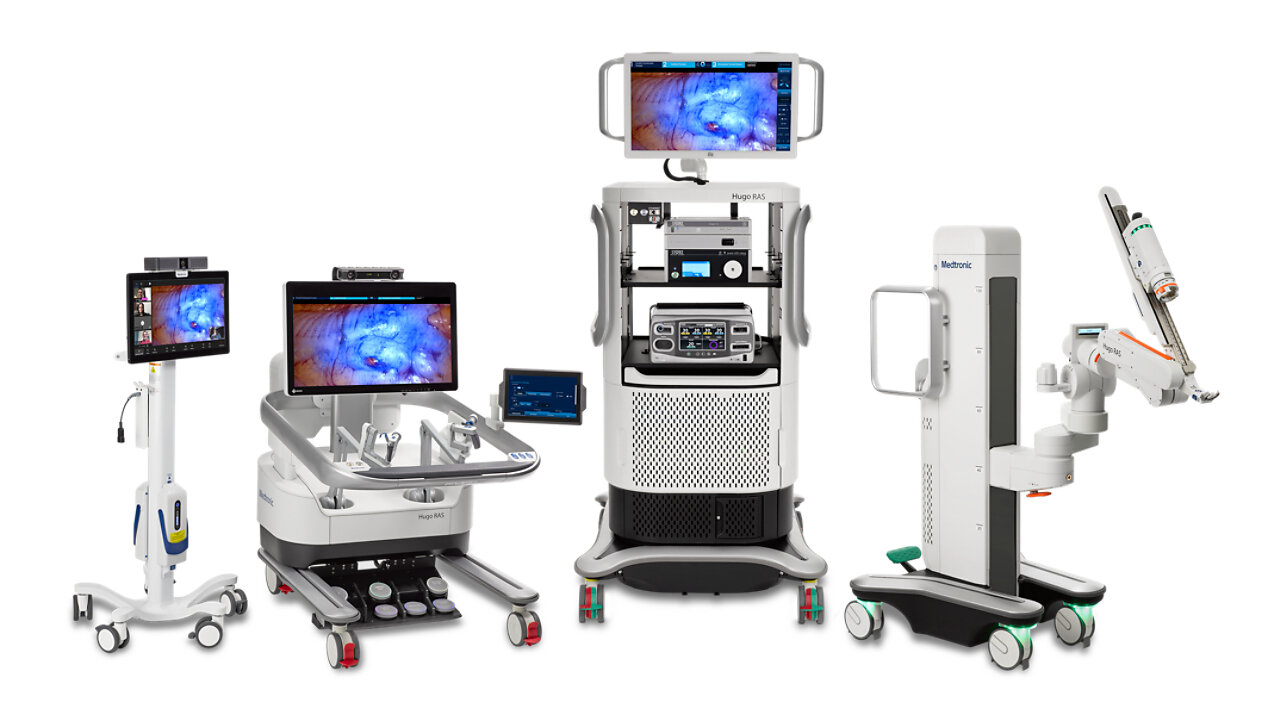
Roughly 3.5 million soft-tissue surgeries are performed in the United States every year in the procedure categories that Medtronic's Hugo robotic-assisted surgery (RAS) system can now legally touch. The U.S. Food and Drug Administration (FDA) cleared Hugo for general surgery on November 17, 2026, through an expanded 510(k) submission, moving the platform beyond its original urology-only indication and into six named upper- and lower-abdominal procedure types.
The clearance covers cholecystectomy, Roux-en-Y gastric bypass, ventral hernia repair and small bowel resection in the upper abdomen, plus inguinal hernia repair and appendectomy in the lower abdomen, with Medtronic describing the list as non-exhaustive. Those categories alone account for more than half of all soft-tissue procedures performed in U.S. hospitals each year, which is the figure that should matter most to a procurement committee weighing a Hugo purchase or lease against the alternative of standing pat.
A urology robot just became a general-purpose capital asset
Every robotic surgery platform sold into a hospital is, underneath the clinical marketing, a capital-equipment decision. A system cleared for one specialty gets scheduled around that specialty's caseload, sits idle between cases, and has to justify its purchase price against a narrow slice of a hospital's surgical volume. A system cleared across urology, general surgery, and whatever follows next gets scheduled across services, shares block time, and spreads its fixed cost over a much larger base of billable procedures.
That is the practical effect of this clearance. Hugo entered U.S. hospitals as a urology tool, used for prostatectomies and related procedures. It now adds gallbladder removals, hernia repairs, bariatric bypass surgery, appendectomies and bowel resections, which are among the highest-volume operations performed in American hospitals. For a hospital system that already owns or is evaluating a Hugo unit, this is the difference between a specialty instrument and a shared surgical resource that general surgery, bariatric surgery and urology departments can all book time on.
Medtronic's modular arm design reinforces that flexibility argument rather than working against it. The company has built Hugo so that its arms can be deployed selectively, meaning a four-arm cart is not mandatory for every case, and a hospital can configure the system to the specific procedure rather than running every operation through a fixed, maximal setup. Combined with the LigaSure RAS Maryland vessel-sealing instrument in Hugo's instrument set, a tool surgeons already use for controlled tissue dissection and hemostasis in open and laparoscopic general surgery, the system is positioned as adaptable hardware rather than a single-purpose machine bolted to one service line.
Utilization economics, not surgeon preference, will decide adoption speed
Robotic surgery platforms are sold on clinical outcomes, but they are bought on utilization math. A hospital capital committee evaluating a seven-figure robotic system cares about cases per week, revenue per operating-room hour, and how many specialties can keep the cart busy across a dayshift. A platform locked to one specialty's caseload has a hard ceiling on utilization no matter how good its outcomes data looks. A platform that can run urology cases on Monday, cholecystectomies on Tuesday and hernia repairs on Wednesday changes the denominator in that calculation.
This is the quiet logic behind why Medtronic frames the clearance in procedure-volume terms rather than purely clinical ones. The company says Hugo's procedure-volume growth is running at more than twice the rate of the broader robotic-surgery market, and it expects the platform to pass 50,000 cumulative procedures by the end of its current fiscal year. Those are adoption-curve numbers, the kind a finance team tracks alongside clinical ones, and they are the figures a hospital's capital-planning office should be asking any robotic-surgery vendor to produce before signing a multi-year service agreement.
A wider indication does not change what a robot can do in surgery; it changes how many hours a day the hospital can justify it sitting in an operating room. That is the single clearest way to read this expansion, and it applies to any RAS platform, not just Hugo.
Intuitive's da Vinci still sets the market, but the comparison point has shifted
No analysis of general-surgery robotics clearance is complete without naming the incumbent. Intuitive Surgical's da Vinci system remains the dominant platform in soft-tissue robotic surgery worldwide, with the deepest installed base, the longest clinical track record and the most extensive published outcomes literature across general surgery, urology and gynecology. Hospitals that already run da Vinci fleets are not going to rip them out because a competitor cleared a procedure list.
What this clearance changes is the competitive question a hospital asks when it is adding capacity rather than replacing it. Until now, a hospital considering Hugo for urology and considering a second robotic platform for general surgery had reason to evaluate two separate systems, two training pipelines and two service contracts. With Hugo cleared across both, the question becomes whether a single platform covering urology and the highest-volume general surgery procedures offers a better total cost of ownership than running Hugo alongside a second vendor's cart for everything outside urology. That is a materially different procurement conversation than "which robot is better," and it is the one capital committees will now actually have.
Medtronic's own data point about geography sharpens this. General surgery is already the fastest-growing Hugo procedure category outside the United States, ahead of both urology and gynecology, which means international hospital systems adopted Hugo for gallbladder and hernia work before U.S. regulators allowed it here. The FDA clearance does not open a new use case for the platform; it lets U.S. hospitals catch up to a usage pattern that ex-U.S. markets already established. Any buyer benchmarking Hugo against international reference sites should expect general surgery, not urology, to be the dominant workload they see reported back.
Training pipelines, not FDA paperwork, are the real adoption bottleneck
Regulatory clearance is the easy part of a procedure expansion. The harder part, and the one hospital operations leaders should be planning for now rather than after a Hugo cart arrives, is credentialing a surgical staff across a wider set of procedures on a platform most of them have only used, if at all, for urology cases.
Dr. Francesco Bianco, a surgeon at UI Health and professor of surgery at the University of Illinois College of Medicine, framed the clearance in exactly those terms, saying that expanded robotic capabilities let UI Health offer patients more treatment options while supporting surgical education. That second half of the sentence is the operational reality procurement teams tend to underweight. A general-surgery indication is only worth the utilization gains described above if a hospital can actually credential enough surgeons, residents and OR staff to run cholecystectomies, hernia repairs and bowel resections on the platform at volume. Academic medical centers with residency programs, like UI Health, have an inherent advantage here: a teaching pipeline that already rotates residents through robotic cases can absorb a new procedure list faster than a community hospital starting a credentialing program from zero.
Matt Anderson, Senior Vice President and President of Medtronic's Surgical business, pitched the clearance squarely at the capacity problem rather than the technology itself, saying Hugo offers hospitals a practical option for addressing capacity and access challenges and gives surgical teams more flexibility across care settings. That framing, access and capacity rather than surgical precision, is a tell about who Medtronic is actually selling to with this announcement: health system operations and procurement leaders managing OR throughput, not surgeons shopping for the sharpest instrument.
Where this leaves the capital-equipment decision
For a hospital system evaluating or already operating Hugo, the practical checklist now includes a wider set of questions than it did a week ago. Does the expanded indication change the utilization case enough to justify adding a second or third unit rather than a competing platform. How many general surgeons need to be credentialed, and on what timeline, before the system can actually run the caseload the clearance now permits. Does the LigaSure RAS Maryland instrument's inclusion reduce disposable-instrument switching costs across urology and general surgery cases run on the same cart. And does the ex-U.S. adoption pattern, where general surgery already outpaced urology, suggest a realistic ramp timeline for a U.S. program rather than an optimistic one.
Medtronic's broader surgical portfolio context matters here too, even if it is a secondary detail next to this clearance. The company is also the sole authorized distributor of Cornerstone Robotic's Sentire surgical system outside the United States, a smaller product line that signals Medtronic's intent to compete across multiple robotic-surgery form factors rather than betting everything on Hugo alone. It is useful portfolio context, though it carries far less procurement weight than the general-surgery clearance itself.
None of this guarantees Hugo closes the gap with the market's dominant incumbent on outcomes data or surgeon familiarity, and hospitals should treat competitive claims about growth rates as company-reported figures rather than independently audited ones until third-party data catches up. What the clearance does provide is a concrete, verifiable expansion of what a single capital asset is legally permitted to do inside a hospital, which is the variable procurement teams can actually model today.
The number worth carrying out of this announcement is the one Medtronic led with: the procedure types newly cleared for Hugo represent roughly 3.5 million U.S. surgeries a year, more than half of all domestic soft-tissue procedures, which is the addressable caseload a single robotic cart can now be scheduled against.
This article is for general information purposes only and does not constitute investment, financial, legal, or professional advice. It synthesizes company statements as of publication.