Samsung's Robot Brain Runs at 17 Decisions Per Second — and It's Heading to the Warehouse
Samsung Research has unveiled Shallow-π, an on-device AI control technology that pushes humanoid robot decision-making to 17.2 Hz — enabling real-time obstacle avoidance and sub-millimetre precision without cloud dependency. Simultaneously, Samsung subsidiary Rainbow Robotics has begun a live warehouse pilot of its RB-Y1 robot inside a Coupang fulfillment centre. Together, the moves signal Samsung's intent to dominate the humanoid robot intelligence layer ahead of its 2030 autonomous factory deadline.

South Korea is quietly assembling one of the most technically sophisticated humanoid robotics ecosystems on the planet — and Samsung Electronics is leading the charge. While Chinese manufacturers race to put bipedal robots on factory floors, Samsung has taken a different path: winning the software battle before revealing the hardware. The result is a suite of AI breakthroughs that may define how industrial robots think, react, and ultimately work alongside humans.
Samsung's "Shallow-π" Gives Robots a Real-Time Brain
At the heart of Samsung's robotics offensive is a technology called Shallow-π, developed by Samsung Research. The system radically cuts the computational load of AI robot-control models — down to one-third of conventional levels — using knowledge distillation, a technique that compresses the intelligence of massive AI models into leaner, faster versions optimised for on-device deployment.
The performance gains are striking. Samsung's robot control system previously operated at 8 Hz — eight situational decisions per second. With Shallow-π, that has surged to 17.2 Hz: over 17 independent judgements every second. That speed translates directly into safety and deployability — a robot reacting to unexpected obstacles in real time, without offloading to cloud servers. The system has been verified on NVIDIA's Jetson Orin and the humanoid-dedicated Jetson Thor platforms, lending it immediate industrial credibility.
Precision at the Millimetre Level — What It Means for Factories
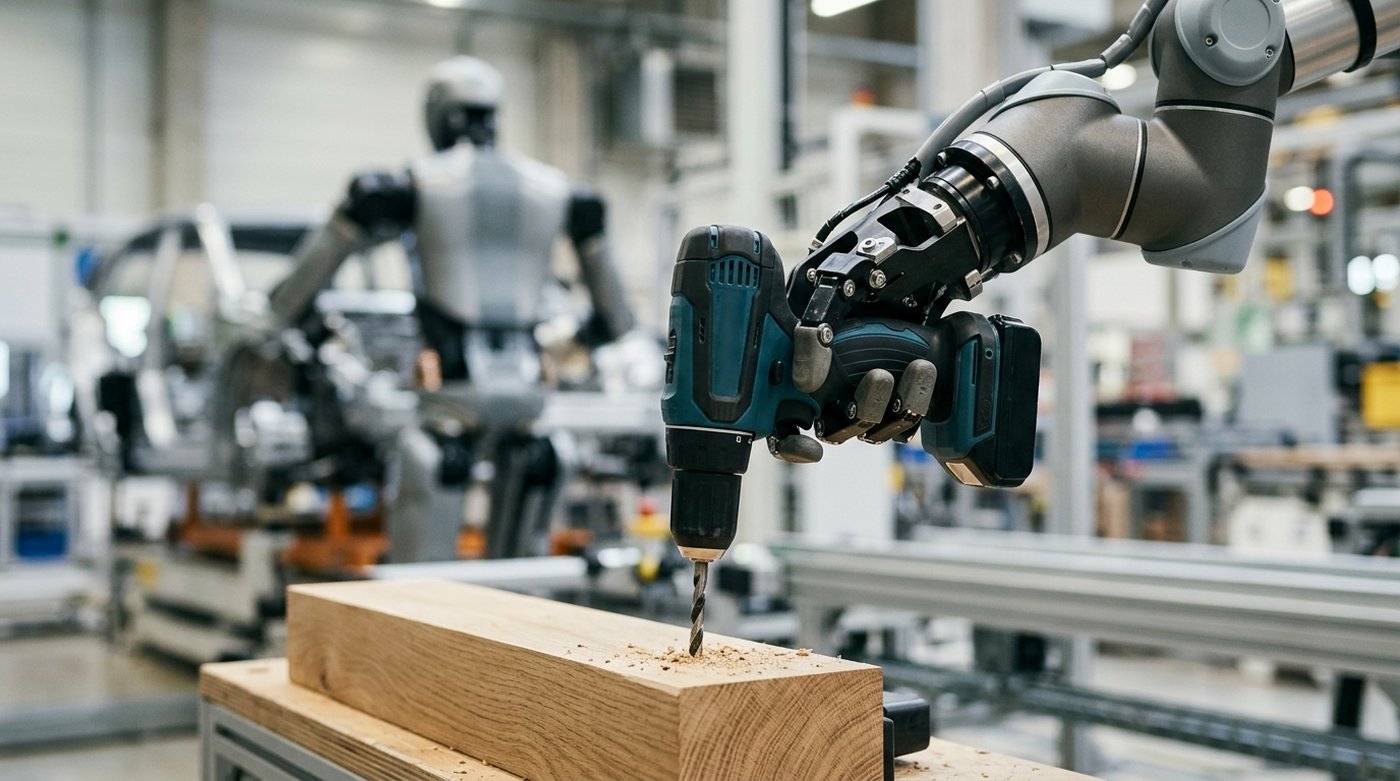
Shallow-π uses a unified Vision-Language-Action (VLA) model that processes everything — sensor input to physical motion — in a single continuous flow. Field verification results are remarkable: a 95% success rate in water hose insertion tasks requiring positioning accuracy within one millimetre, and coordination of 46 movements across dual arms with 22 degrees of freedom in just 40 milliseconds.
For context, many industrial assembly tasks — threading bolts, inserting connectors, aligning components — demand exactly this level of sub-millimetre, high-speed dexterity. Achieving it on-device, without cloud compute, marks a serious leap toward factory-ready autonomy. Samsung's roadmap targets a complete transition to AI autonomous factories by 2030, incorporating digital twin simulations across material receiving, production, and shipping.
"Rather than attracting attention with flashy service robots, the strategy is to deploy robots preemptively in harsh manufacturing environments with high temperatures and noise to substantially improve production efficiency." -- Samsung Electronics, Corporate Strategy Briefing, 2026 Rainbow Robotics Enters Its First Live Warehouse Trial
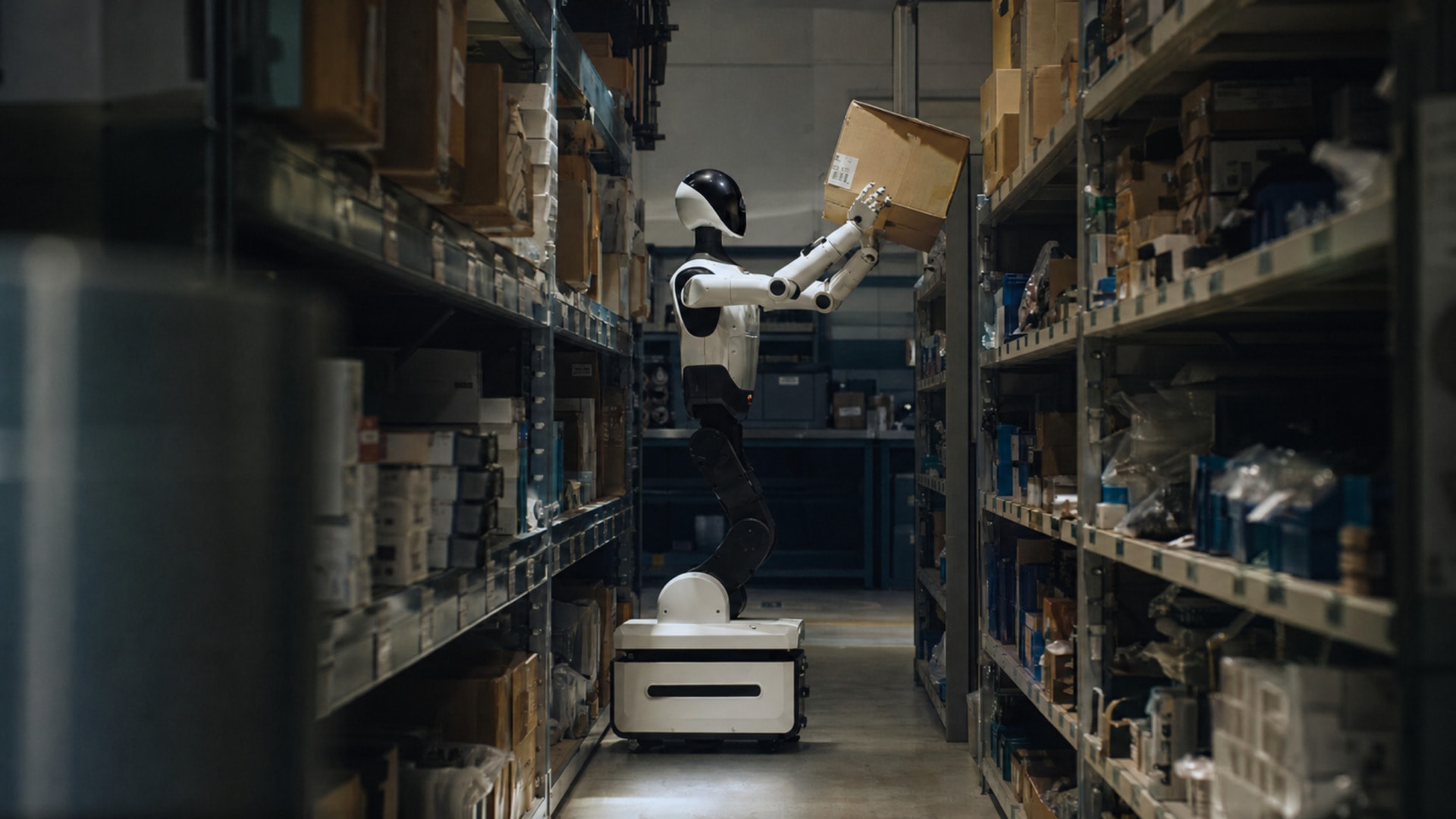
While Samsung's AI team perfects the software stack, subsidiary Rainbow Robotics is putting hardware to the test. Its RB-Y1 robot has reportedly begun a pilot inside a Coupang fulfillment centre — South Korea's largest e-commerce logistics network — marking what could be the first live commercial warehouse trial for a Samsung-backed humanoid in the country.
The RB-Y1 stands 1.4 metres tall and combines a wheeled mobile base (capable of 1.5 m/s) with dual arms offering seven degrees of freedom each and a 3 kg per-arm payload. A 20-axis whole-body control system maintains stability during movement, while custom collision-avoidance software prevents arm interference mid-task. Coupang — which has invested over $84 million in global AI startups since 2023 — is evaluating the robot for picking, sorting, and transporting lighter goods. South Korea's Serious Accidents Punishment Act, which holds executives personally liable for fatal workplace accidents, further accelerates the business case for automating hazardous tasks.
Q: Why is Samsung focusing on software before releasing a physical humanoid prototype?
A: Samsung's strategy is to lock in the AI control technology — the "brain" — first, then accelerate hardware using a proven software foundation, avoiding the trap of impressive hardware lacking reliable intelligence.
Q: How large is Samsung's robotics investment?
A: Samsung announced R&D spending exceeding 100 trillion Korean won (~$72 billion USD) in 2026, with robotics as a core pillar. Samsung Research America is recruiting top-tier talent — including NASA engineers and university professors — offering annual salaries up to $365,650.
The global humanoid robot market is projected to reach $4.4 billion by 2027. Chinese firms currently lead on physical prototypes and public demos, but Samsung is betting the real race will be won by whoever masters the intelligence layer — fast, precise, on-device AI requiring no cloud dependency. With its 2030 autonomous factory target, a live warehouse pilot under its belt, and Shallow-π pushing robotic decision-making into genuine real-time territory, Samsung is making its ambitions unmistakably clear: it intends to win the robot race from the inside out.
Source: Seoul Economic Daily & Interesting Engineering — Published: April 12, 2026 / June 2026