Noitom Robotics Teaches Humanoids Professional Tennis Styles Two Days After Releasing the HiPHI Motion Dataset
Noitom Robotics, with the Shanghai AI Laboratory, Dobot, and Shanghai Jiao Tong University, has released AdaPT, a system that learns professional tennis rally and serve styles from broadcast footage and executes them on the Unitree G1 and full-size Dobot Atom humanoids, including serving outside the lab with only a camera and a consumer tracker. It arrived two days after Noitom released HiPHI, a 617.5-hour high-precision motion dataset, and a week before RO-MAN 2026 in Fukuoka.
Two Days After Releasing a Motion Dataset, Noitom Puts a Humanoid on a Tennis Court
On Friday, August 21, Noitom Robotics and a group of research collaborators released AdaPT, a system that teaches humanoid robots to rally and serve in the styles of professional tennis players and executes those strokes on real hardware. The announcement came two days after the Beijing company made HiPHI, one of the largest high-precision human-motion datasets ever released publicly, available at the World Robot Conference, and a week before the RO-MAN 2026 conference on human-robot interaction opens in Fukuoka, Japan, where the work is headed.
The sequence is the point. Noitom's business is motion data, and AdaPT is a demonstration that the data can be turned into a hard physical skill in days rather than months. Tennis is a useful test because it punishes everything humanoids are bad at: fast whole-body coordination, timing against an object a machine did not throw, and recovering balance after a swing.
What AdaPT Does
AdaPT, which stands for Adaptive Motion Planning and Tracking, learns rally and serving motions from recordings of professional players and reproduces them on a physical humanoid. The system was developed by Noitom Robotics with the Shanghai AI Laboratory, Dobot Robotics, and Shanghai Jiao Tong University, and the group says the paper, code, and video are available on a project page.
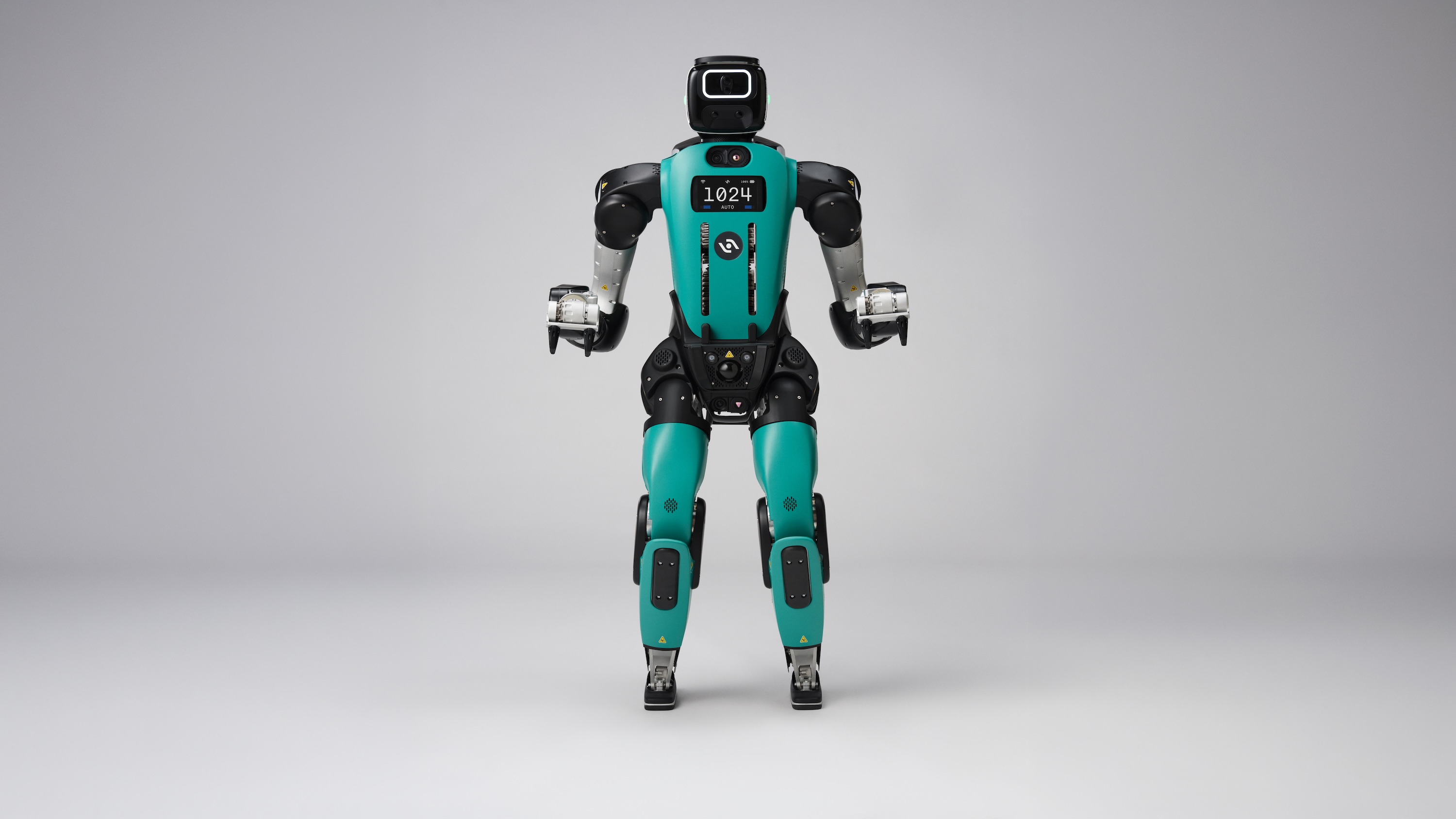
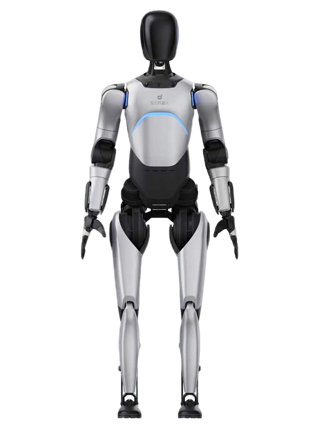
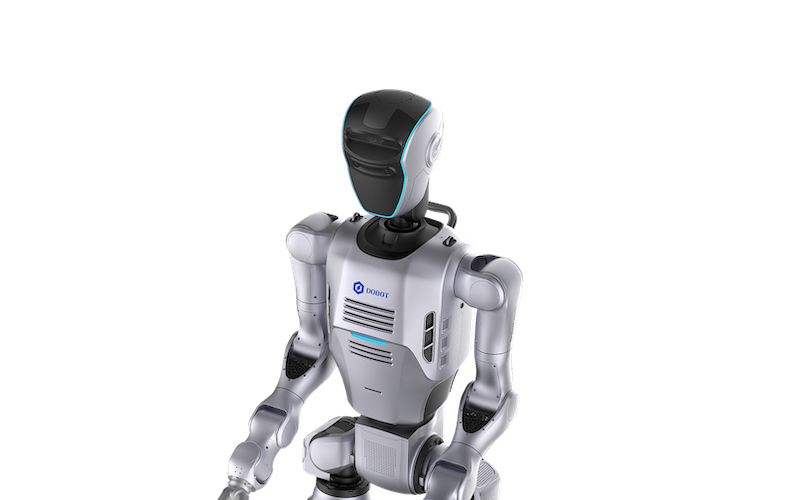
The playing styles it reproduces are specific. The team says the system learned the distinctive strokes of three professional players, Rafael Nadal, Roger Federer, and Novak Djokovic, from publicly available broadcast footage, plus a fourth professional style captured with motion-capture equipment. The method was validated on two robots: the Unitree G1, the compact humanoid that has become the default research platform in China, and the full-size Dobot Atom, the humanoid from the Shenzhen collaborative-robot maker that co-authored the work.
The detail that matters most for deployment is the serving demonstration. The team reports in-the-wild serving using only a camera and a consumer-grade tracker, with no motion-capture studio required. A humanoid that can execute a learned whole-body skill outside the lab, with commodity sensing, is the thing every factory and logistics buyer is actually waiting for, even if they have no interest in tennis.
How Style Transfer From Video Works
The pipeline the team describes follows a pattern that has become standard in humanoid motion learning, with one unusual input. Broadcast footage of a player is first converted into an estimate of the player's body motion over time, a step that has to cope with camera cuts, changing angles, and partial occlusion by the net and other players. That reconstructed motion is then retargeted onto the robot's body, which has different limb lengths, joint limits, and mass distribution from a human athlete. Finally, a controller is trained, typically by reinforcement learning in simulation, to track the retargeted motion while keeping the robot balanced and, in the rally case, while responding to an incoming ball.
Each stage loses fidelity, and the group's name for the system, Adaptive Motion Planning and Tracking, signals where it claims to have made progress: in adapting the plan to the robot and the situation rather than replaying a fixed trajectory. The motion foundation pre-trained on HiPHI-series data is what gives the controller a prior for how whole-body human movement is supposed to look, so that the sparse, noisy signal extracted from television does not have to carry the entire burden.
Validating on two very different robots is the other notable choice. The Unitree G1 stands about 1.3 metres tall and is light enough that aggressive swings are forgiving; the Dobot Atom is a full-size humanoid with more mass to manage and more reach to exploit. A skill that transfers between them with modest retuning is evidence that the approach is learning something about tennis rather than about one robot.
The Data Underneath
AdaPT's motion foundation was pre-trained on part of what Noitom calls the HiPHI series. The publicly released HiPHI dataset, announced on August 19, contains 617.5 hours of data, split between 371.8 hours of whole-body human motion and 245.7 hours of human-object interaction, recorded from 132 performers with sub-millimetre marker tracking at 90 Hz. It is hosted on Hugging Face under an open research licence, with commercial licensing offered through the company's ModalityNet platform. A substantially larger corpus, HiPHI-MOV, is available for commercial licensing only.
Noitom's founder and chief executive, Tristan Ruoli Dai, framed the dataset release around a claim that has become the company's thesis: that the bottleneck in physical AI is not how much data exists but how much of it a machine can actually learn from. Lei Han, the company's chief of research and development, said coverage, per-frame quality, and object state decide whether a humanoid can learn from motion data at all. AdaPT is the company's attempt to prove the thesis in public, on hardware, within the same week.
The Data Economics
Noitom's release strategy mirrors one that has worked in other data-heavy fields: publish a large, high-quality open subset to seed research and set the standard, and license the much larger commercial corpus to companies that need scale. HiPHI's 617.5 hours are substantial for an openly available motion dataset, particularly at sub-millimetre precision, but the company's stated production rate of more than 100,000 hours a year for commercial partners makes clear where the business is. The open set builds the reputation and the research citations; the commercial set pays for the capture studios.
For robot makers, that split raises a familiar question. A foundation model trained on a proprietary motion corpus is an advantage for whoever licenses it, and a dependency for whoever builds on it. Companies that adopt Noitom's data as the prior under their own skills will want to understand the licensing terms for derived models, which the announcement does not describe.
Why Tennis, and Why Now
Humanoid tennis has a short but active research history. Earlier this year a separate Chinese academic team showed a Unitree G1 rallying with humans after learning from imperfect human motion, and the sports-skill benchmark has become a way for motion-learning groups to show progress that a factory demo cannot: speed, timing, and whole-body athleticism in one task.
AdaPT's distinction is style transfer from broadcast video. Learning a named player's forehand from television footage, rather than from a motion-capture suit worn in a studio, means the pipeline can draw on the vast archive of ordinary video that exists for almost every human activity. If that transfer is robust, the same approach applies to a warehouse worker's lifting technique or a technician's assembly motion, captured on a phone rather than in a lab. That is the commercial argument underneath a tennis video.
The timing is also deliberate. RO-MAN 2026, the IEEE conference on robot and human interactive communication, opens in Fukuoka next week, and presenting a working system there puts the result in front of the academic community that will judge it. Releasing the dataset first, then the skill, then the paper, is a sequence designed to make the case that Noitom's data is the enabling layer.
About Noitom
Noitom is a Beijing motion-capture company whose inertial capture systems have been used in film, games, and sports analysis for more than a decade. Noitom Robotics, the unit behind HiPHI and AdaPT, has repositioned that capture capability as a supplier of what it calls omnimodal data for physical AI. It says it produces more than 100,000 hours of motion data a year for commercial partners and maintains three corpora: HiPHI-MOV, HiPHI-OM, and an in-the-wild set. The company's collaborators on AdaPT give the work academic and hardware credibility: the Shanghai AI Laboratory is one of China's best-funded AI research institutes, Shanghai Jiao Tong University is a leading robotics school, and Dobot supplies the full-size humanoid.
What Is Not Yet Known
The announcement describes capabilities and demonstrations rather than benchmarks. The team has not published rally lengths, success rates, serve speeds, or how many attempts the in-the-wild serve required, and those figures are what separate a convincing video from a reproducible result. The paper, once presented, should supply them.
Two other questions remain open. How much of the skill transfers between the two robots without retraining is the test of whether the motion foundation is general or tuned per platform. And whether the broadcast-footage pipeline holds up on activities less well filmed than professional tennis, where camera angles and player identities are consistent, will determine whether the commercial argument extends beyond sport.
The Industry Context
The humanoid industry's centre of gravity has shifted this year from hardware announcements to the data and models that make hardware useful, and the World Robot Conference has been full of data vendors, simulation platforms, and motion libraries competing to be the layer every robot maker needs. Noitom's play is to own high-quality human motion the way a mapping company owns roads: collect it at scale, license it commercially, release enough openly to seed the research community, and demonstrate in public that it works.
AdaPT is that demonstration. Whether the approach holds up will be decided in Fukuoka next week, and then in the less photogenic environments where humanoids have to earn their keep.
Image: Dobot Atom humanoid, one of the two platforms AdaPT was validated on. Credit: Dobot.
Disclaimer: This article is for general information purposes only and does not constitute investment, legal, or procurement advice. Readers should verify details with primary sources before making business decisions.