Maven Robotics Raises US$100 Million for Industrial Robot Deployments
Maven Robotics launched with a US$100 million Series A and said its wheeled, dual-arm systems are already working multiple shifts in an unnamed Fortune 250 operation. The next test is repeatable deployment economics.
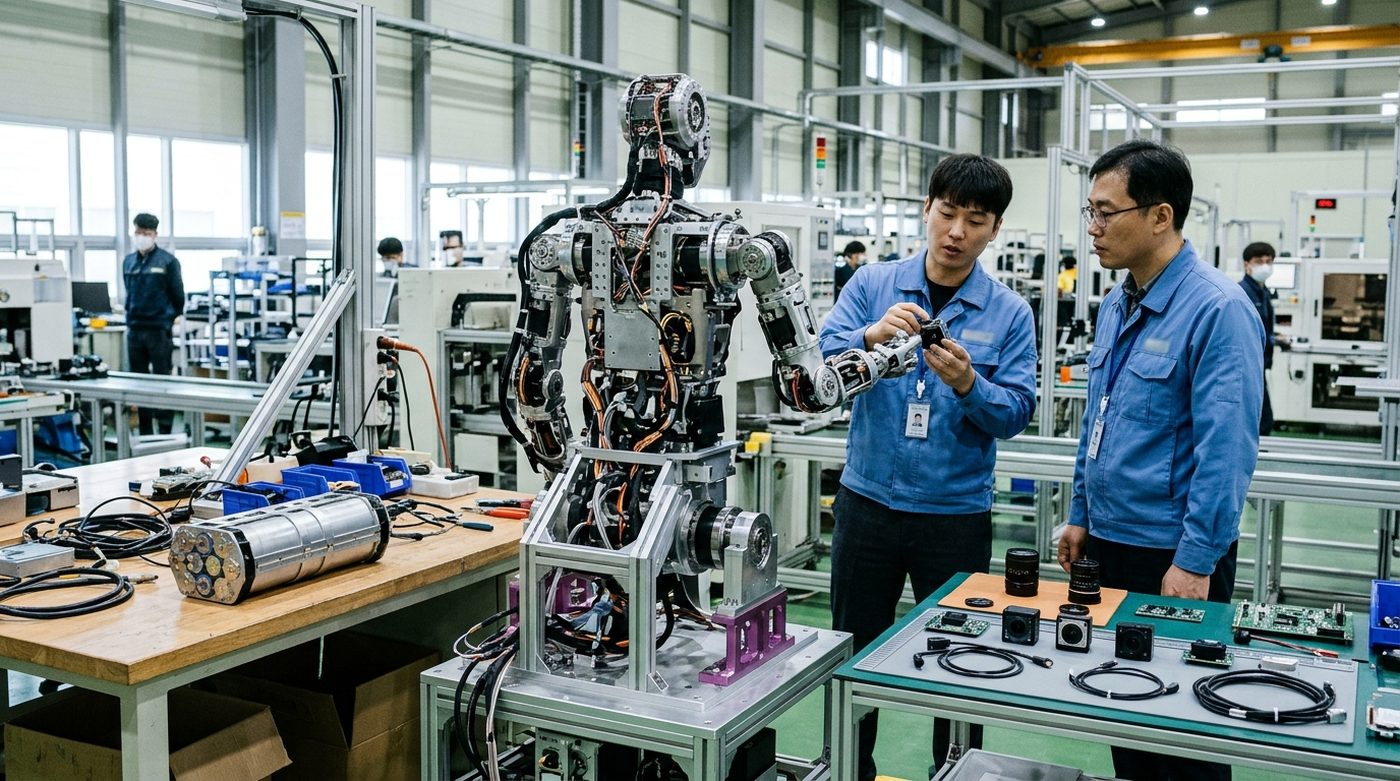
SANTA CLARA, California, September 10, 2026. Maven Robotics launched publicly with a US$100 million Series A and said its industrial robots are already working multiple shifts for an unnamed Fortune 250 consumer-goods company. The round backs a wheeled, dual-arm system built for palletizing, tote handling, material movement, and assembly work in factories and logistics facilities.
Maven Robotics is a Santa Clara startup founded in 2024 by brothers Hamza and Khalid Derbas. It designs the robot hardware, fleet software, factory integration, and network layer as one operating system for industrial work. RoboStrategy led the financing, with LocalGlobe, Vine Ventures, XTX Ventures, and other investors participating. The company did not disclose its valuation, revenue, customer count, or current fleet size.
A Large Round Arrives With a Narrow Proof Point
The financing number will attract attention, but the more useful detail for an automation buyer is the task boundary Maven has chosen. Its first deployments center on mixed-case palletizing and tote handling, jobs that combine repetitive motion with enough product variation to defeat simpler fixed automation. Those tasks sit at the transfer points between storage, picking, packing, and outbound shipping, where manual handling can slow the rest of an otherwise automated facility.
Maven says deployed fleets are already operating autonomously across multiple shifts each day. That is a more meaningful starting point than a stage demonstration because a robot working through shift changes has to cope with different lighting, packaging, worker traffic, replenishment schedules, and production priorities. Yet the claim remains company-reported. Maven did not name the customer, quantify uptime, disclose exception rates, or state how many robots are in service.
The practical conclusion is straightforward: US$100 million gives Maven room to build, but operating-hour evidence will decide whether it earns expansion orders. Early capital can buy engineering talent, manufacturing capacity, field support, and inventory. It cannot buy reliable performance inside a customer’s process. That has to be accumulated one shift and one exception at a time.
Industrial Buyers Are Buying a System, Not a Pair of Arms
Maven describes its product as a general-purpose robotics system rather than a single robot. The distinction matters. A mobile base and two arms may perform an impressive motion, but enterprise deployment depends on everything around that motion: task assignment, fleet traffic, safe handoffs, integration with warehouse or manufacturing software, remote support, change management, and a way to improve behavior without rebuilding each site from scratch.
Think of the robot as a new employee who arrives with strong physical skills but no knowledge of the building. The arms and wheels determine what the employee can physically reach. The fleet and factory software determine where it should go, which task comes next, how it avoids blocking other equipment, and what happens when a tote arrives damaged or a pallet is stacked differently. Buyers pay for the complete work result, not the athletic ability of the machine in isolation.
That systems view is also why the startup’s integration claims deserve close attention. Maven says intelligence is shared across the robot, the fleet, the factory, and a wider company network. The commercial test is whether that shared layer reduces commissioning time at the second and third site. If every deployment still requires a large engineering team to map workflows, tune grasping behavior, and write custom interfaces, the system will behave like a bespoke integration project even if the robot hardware is standardized.
A useful comparison is the shift from robotics demonstrations to deployment infrastructure. The vendors most likely to win repeat orders are not merely showing broader capabilities. They are building the validation, simulation, support, and integration practices that let a customer reproduce performance across facilities.
The Funding Must Turn Into Service Capacity
Maven said the Series A will support its general-purpose industrial platform, but the round’s highest-value use may be less visible than the robot itself. A young supplier working with a large enterprise must field technicians, hold spare parts, maintain cybersecurity, document safety procedures, and respond when a deployment stops during a high-volume shift. These functions determine whether a pilot becomes trusted production equipment.
That is especially important because Maven is targeting workflows that touch product flow directly. A robot assigned to a side process can fail without stopping the building. A robot handling mixed cases or totes near a central material path can affect throughput across an entire area. Procurement teams should therefore ask how Maven defines availability, what service response it contractually offers, which failures require an onsite visit, and whether manual recovery can be performed safely by customer staff.
The company’s plan to move from palletizing and tote handling into broader material handling and assembly will raise the support burden before it reduces it. Each added task expands the range of grippers, object shapes, force requirements, quality checks, and upstream software signals the system must handle. A credible expansion plan should include a limited sequence of validated task families, not a promise that one platform will immediately cover every form of industrial work.
Maven estimates that its initial tasks represent a US$80 billion addressable market and that later material-handling and assembly work could exceed US$1 trillion. Those figures are company estimates, not audited revenue opportunities. For a buyer, the addressable market matters far less than the addressable workflow inside one facility: how many labor hours are attached to the task, what throughput the robot can sustain, and how much downtime or supervision remains after installation.
Operating Hours Are the Right Metric, With Conditions
Maven expects its robots to accumulate more than 100,000 hours of autonomous real-world operation by the end of 2026 and more than one million by the end of 2027. If achieved, those totals could create a valuable training and reliability asset. Long operating histories expose failure modes that short pilots miss, from gripper wear and wheel contamination to packaging changes and unusual human behavior.
Hours alone, however, can flatter performance. Ten robots repeating a forgiving tote-transfer routine may accumulate hours quickly without proving the system can handle diverse tasks. Buyers should ask Maven to break operating time into task type, site, hardware generation, intervention rate, safety event, and successful cycle. They should also ask whether “autonomous” time excludes periods when the robot is paused, waiting for assistance, or running under remote supervision.
The right benchmark is not a single cumulative number. It is the rate at which intervention declines as the fleet expands into new products and facilities. A platform that learns across sites should show faster commissioning and fewer manual recoveries in later deployments. If those curves do not improve, the network effect exists mainly in marketing language.
That distinction mirrors the broader warehouse market. Recent coverage of Hai Robotics’ European warehouse deployment showed that a large contract is only the beginning. The harder test is whether a supplier can make installation, maintenance, and process integration repeatable enough for a customer to extend the system across a network.
The Customer Concentration Question Cannot Be Ignored
An unnamed Fortune 250 customer gives Maven useful validation, but anonymity limits what outside buyers can conclude. There is no public information about the customer’s facility type, robot count, contract value, production duration, or expansion plans. One customer can also account for a large share of a young company’s deployed hours, creating technical and commercial concentration even when the work itself is successful.
Prospective customers should request references at the facility level, not only at headquarters. The most informative conversation is with the operations manager responsible for daily recovery, maintenance, and staffing. That manager can explain whether robots meet promised throughput, how often workers intervene, and whether the deployment changed labor requirements or simply moved people into exception handling.
A large early round can delay the moment when weak deployment economics become visible. Capital lets a supplier subsidize integration and support while it searches for a repeatable product. Buyers should not confuse a well-funded field team with a mature operating model. They should ask what a deployment costs Maven to deliver, what work is reusable at the next site, and which support obligations are included in the price.
Maven Now Has to Prove Repeatability
The company’s founders bring experience from autonomous systems, investing, and operating businesses, while the broader team includes alumni of Apple, Tesla, Rivian, Cruise, Zoox, Ford, and Archer Aviation. That background supports the claim that Maven understands difficult hardware programs. It does not remove the specific risks of industrial deployment, where small workflow differences can turn a standard product into a costly custom project.
The Series A gives Maven the resources to answer the questions that matter: whether its robots can sustain throughput over long shifts, whether each new site takes less time to commission, whether intervention falls as operating hours grow, and whether customers expand after the first task. Those measures should appear in future disclosures alongside cumulative hours and market-size estimates.
For procurement teams, the appropriate next step is neither dismissal nor a fleet-wide commitment. It is a tightly scoped paid deployment with baseline labor data, cycle-time targets, availability definitions, exception categories, service-level obligations, and a pre-agreed expansion threshold. A supplier claiming a general-purpose system should be willing to prove its economics on one bounded workflow before asking the customer to bet on many.
Maven Robotics has raised enough capital to stop being judged as an interesting prototype company. From this point, the standard is repeatable industrial output: fewer interventions, faster second-site deployment, and customer expansions that survive beyond the first subsidized installation.
Hero image credit: Maven Robotics.
This analysis draws on public statements and technical materials released by Maven Robotics describing its company launch, financing, products, and deployment claims. It is for general information purposes only and does not constitute investment, financial, or legal advice.