Kawasaki Wants You to Ride a Hydrogen Robot Horse, and It Just Told Investors How
Kawasaki Heavy Industries held its first business briefing for CORLEO, the rideable quadruped robot, on July 28 in Tokyo. The plan calls for a working prototype in 2028, a walking model at Riyadh Expo 2030, and a theme-park-style facility by 2035. CORLEO will have no steering or brakes, reads its rider's body movements like a horse, runs a hydrogen hybrid powertrain, and is trained with Nvidia at Kawasaki's San Jose Physical AI Center.
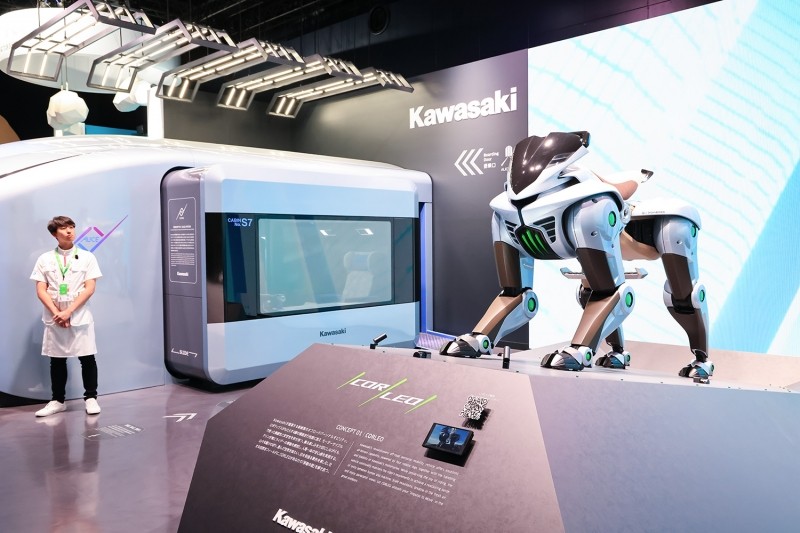
When Kawasaki Heavy Industries first showed CORLEO, the four-legged robot you ride like a horse, most of the internet filed it under concept-video vaporware. On Monday, July 28, at Haneda Innovation City in Tokyo, the company did the one thing vaporware never does. It held a business briefing. It put executives' names on a roadmap. And it told the press exactly how and when it intends to sell the thing.
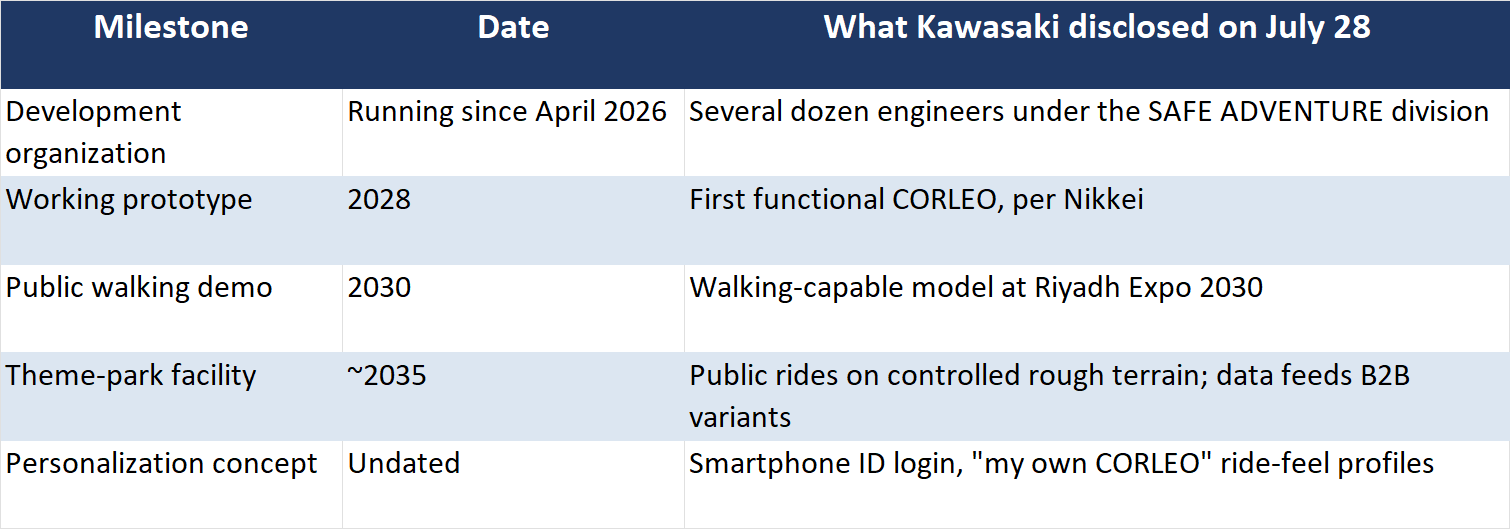
For anyone catching up, here is what Kawasaki committed to on July 28. A working CORLEO prototype arrives in 2028. A walking-capable model appears at the Riyadh Expo in 2030. A theme-park-style facility where the public can ride CORLEO units is targeted around 2035. The machine runs on a hydrogen-engine hybrid powertrain. It carries no steering and no brakes. It reads the rider's body movements the way a horse does, and it will be trained in simulation with Nvidia through Kawasaki's own Physical AI Center in San Jose.
The briefing launched what Kawasaki calls its SAFE ADVENTURE business, led by division general manager Yusuke Amatatsu with special chief engineer Takahiro Ueno. A development team of several dozen people has been running since April, according to Nikkei's report on the briefing. A full-scale mockup stood in the room, and attendees were invited to climb on. That small detail matters more than it looks. Kawasaki sculpted CORLEO's form in clay, the way motorcycle makers prototype fuel tanks. A machine you sit on lives or dies by how it feels between your knees. Members of Kobe University's equestrian team were brought in to straddle the mockup and critique it like a horse.
No Steering, No Brakes, No Joke
The most radical engineering decision disclosed on Monday is what CORLEO will not have. No handlebar steering. No brakes. The robot senses the rider's weight shifts and body movements and responds, the company said, "like a horse, for better or worse." Lean, and it turns. Make a jumping motion and it reads the intent and jumps. Kawasaki is developing a sensing unit that maps the rider's movement and load distribution in real time. Even the stirrups get engineering attention with a telescoping mechanism and embedded sensors.
It helps to be precise about why this matters. Every rideable machine humans have built, from bicycles to jet skis, keeps the human in the control loop through explicit inputs. A throttle position. A brake lever. A steering angle. CORLEO throws those out and replaces them with inference. The robot must guess, dozens of times per second, what a shifting mass of human on its back intends. Then it must plant four feet on unpredictable ground accordingly. Horses solve this with several hundred million years of vertebrate motor evolution and a lifetime of training. Kawasaki proposes to solve it with force sensors in the stirrups and a control policy trained in simulation. That is either the most elegant human-machine interface ever attempted in a consumer vehicle, or a spectacular way to discover edge cases. Saying so out loud, in front of financial press, is what separates Monday's briefing from a concept video.
Skeptics will reasonably ask whether surrendering brakes to an algorithm is a feature or a lawsuit. Kawasaki's answer is a mountain of simulation. The company is building a riding simulator and running CORLEO's control stack through virtual frozen roads, collapsing slopes, and physics-simulated stones, rocks, and sand. The logic is simple. A machine meant to "go where tires cannot" must first fail safely a million times where nothing is real. Amatatsu's team put the requirement plainly. The simulation "must recreate perfect ground."
This is where the Nvidia collaboration disclosed at the briefing fits, and why it matters beyond one quirky vehicle. The simulation and AI training run through the Kawasaki Physical AI Center in San Jose, the company's own beachhead in Nvidia's neighborhood. The riding data CORLEO accumulates will feed Kawasaki's broader legged-robot development. Readers who followed our coverage of Japan's wider physical AI push will recognize the pattern. The fun product is also the data harvester for the serious ones.
The Powertrain Is a Motorcycle Company's Answer to a Robotics Problem
CORLEO's power source is pure Kawasaki. A compact 303cc two-stroke engine burns hydrogen and works as a generator feeding a battery in a hybrid arrangement. Battery-only quadrupeds measure endurance in tens of minutes. A fuel-burning generator changes the arithmetic for a machine meant to carry a human across terrain all afternoon. Hydrogen is not an accident either. Kawasaki Heavy is Japan's most committed hydrogen industrial, from liquefied hydrogen carriers to hydrogen motorcycle engines. CORLEO extends that bet onto four legs.
The best analogy for Monday's announcement is the snowmobile, not the robot dog. Bombardier did not sell the snowmobile as a logistics platform. It sold winter fun, and the recreational market funded the engineering that later spawned utility variants. Kawasaki said explicitly that the 2035 theme-park-style facility, offering CORLEO rides on controlled rough terrain, is designed to gather real-world running data and act as a springboard to customized business-to-business models. Sell the joyride. Harvest the data. Then sell the work machine.
A 2035 Plan in a 2026 Market
Over the last 130 years, Kawasaki has expanded beyond motorcycles, aerospace, rail cars, ships, and industrial robots. Its Kawasaki Robotics arm is one of the world's oldest industrial robot makers, with roots back to 1969, when it license-built Unimation's Unimate as Japan's first industrial robot. The group booked roughly JPY 2.1 trillion, about US$14 billion, in annual revenue in recent years. Its robotics division has been pushing beyond factory arms into humanoids for hazardous work through its Kaleido program, and into medical robotics through its Medicaroid joint venture. CORLEO is the consumer-facing tip of a much larger legged-robot iceberg. Monday's briefing was the first time the company attached commercial dates to any of it.
There is also a straight line from Monday's briefing to the physical AI infrastructure Japan has been assembling all month. Kawasaki's San Jose center puts its training loop inside Nvidia's ecosystem. The same gravitational pull drew Ibaraki Prefecture's new consortium, where Unitree's Japan chief keynoted the same day, and the KAIST motion-model center in Korea. The premise everywhere is identical. Legged machines are no longer mechanical problems. They are data problems, and the data flywheel spins fastest next to the GPU supply.
Set against the week's other robotics news, the timeline reads almost defiantly patient. Chinese humanoid makers are shipping thousands of units a year and listing on stock exchanges. Washington just banned their newest models outright. And here is a 130-year-old Japanese heavy industrial calmly scheduling its rideable robot's theme park for 2035. The contrast is the point. Kawasaki is not racing to the humanoid land grab. It is applying motorcycle-industry product discipline, clay models, equestrian testers, powertrain engineering, to a robot category with no incumbent, no price war, and no Chinese competitor. And it is doing the AI part in San Jose with Nvidia rather than pretending to be an AI company itself.
The honest caveat is that nine-year roadmaps rarely survive contact with nine years. Hydrogen refueling for consumers barely exists. The regulatory category for a brakeless rideable robot is unwritten on every continent. Kawasaki's own briefing admitted the machine is "rider-dependent, for better or worse." A 2028 prototype is a promise the company can keep. Everything after it is a bet on markets that do not yet exist.
What should investors and rivals actually watch? Three checkpoints. First, whether the 2028 prototype walks under a rider's weight outdoors rather than on a stage. That is the single hardest milestone on the chart. Second, whether the Riyadh Expo 2030 commitment survives budget reviews. World's-fair demos have a way of being quietly descoped. Third, whether the B2B variants Kawasaki hinted at, machines derived from CORLEO's terrain data for inspection, forestry, or disaster response, appear before the theme park does. If they do, the recreational story is working as designed, as a front door to an industrial business.
One line from Monday explains why Kawasaki thinks the bet lands. Asked about the machine's appeal, Amatatsu observed that "when something grows legs, quite a few people grow attached to the machine." Every robotics company selling arms and wheels is selling productivity. Kawasaki is wagering that the first legged robot people love will not be the one that stocks shelves. It will be the one that carries them somewhere tires cannot go.
This article is for informational purposes only and does not constitute investment, legal, or professional advice. Figures are drawn from the cited sources and were accurate as of publication.