Harper Adams University Tests Humanoid Robots for General Farm Labor
Harper Adams University in Shropshire, England, is researching the use of humanoid robots in agriculture to address persistent seasonal labor shortages. Led by Professor Fernando Auat Cheein, the project argues that general-purpose humanoids, with degrees of freedom matching the human body, can perform multiple tasks like harvesting, planting, and weeding, unlike today's single-task farm robots. The research aims for collaboration with the human workforce, leveraging software economics where a perfected task can be replicated across thousands of robots.
Dawn breaks over a Shropshire orchard, the morning mist clinging to the rows of apple trees. A figure moves methodically down the line, reaching into the canopy with precise, articulated hands to pluck ripe red fruit. But this is not a seasonal worker from Eastern Europe or a local student on summer break. It is a humanoid robot, its metal joints and sensor arrays glinting in the early light, performing a task that has defined human agricultural labor for millennia. This near-future scenario is rapidly moving from science fiction to applied research at Harper Adams University, the agricultural institution in England, which publicly presented its work on humanoid farm robots on July 30, 2026.
The agricultural sector, particularly in the United Kingdom, has been grappling with a structural workforce crisis. Since 2020, the UK horticulture sector has faced persistent seasonal labor shortages. The Seasonal Worker visa scheme is capped, and in some seasons, fruit has been left unpicked, rotting on the branches because there simply are not enough hands to harvest it. This labor gap has driven a surge in agricultural automation, but the solutions to date have largely been fragmented and task-specific. Harper Adams University is proposing a radical shift in this paradigm, moving away from bespoke machinery toward general-purpose humanoid platforms.
Professor Fernando Auat Cheein, a professor of engineering at Harper Adams and a robotics specialist, is leading this framing. He posits that humanoid robots represent the next stage in farming automation. The core argument rests on the physical architecture of the machines. Because humanoids possess the same degrees of freedom as the human body, a single general-purpose robot can theoretically address a multitude of farm problems. This is a stark contrast to the current generation of ad hoc, single-task farm robots, which require separate capital investments for weeding, spraying, or harvesting.
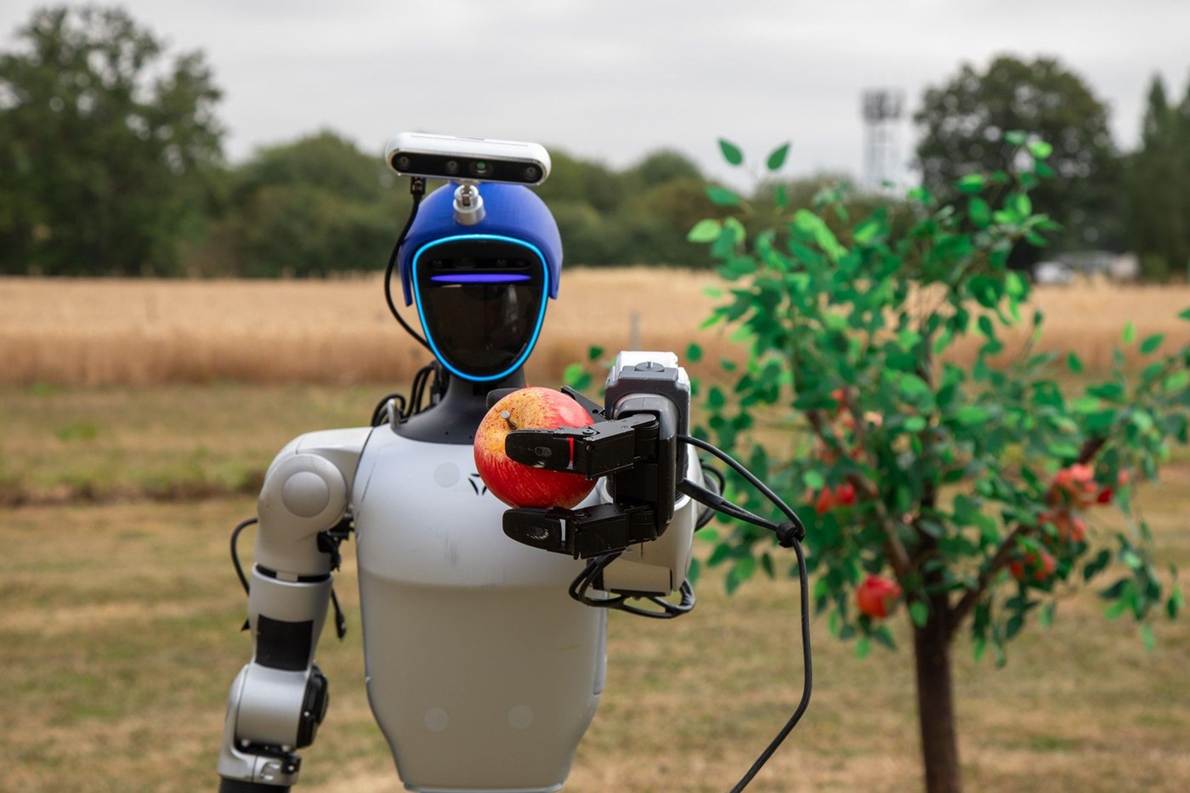
The target tasks for these humanoids span the entire agricultural cycle. The research encompasses harvesting, planting, pruning, seeding, watering, and weeding. Demonstration imagery from the project shows a humanoid robot picking a red apple in an orchard setting, illustrating the dexterity required for delicate fruit handling. The economic logic underpinning this approach is rooted in software scalability. Once a specific task, such as identifying and picking a ripe apple without bruising it, is perfected on one robot, that programming can be replicated across a fleet of a thousand or more robots instantly. This replicate-once, deploy-everywhere model is the software economics argument that separates humanoids from bespoke agricultural robots, where the engineering cost must be repeated for every new crop or task.
General-Purpose Humanoids and the Utilization Logic of Farm Automation
The shift toward general-purpose humanoids in agriculture introduces a new economic model for farm operators. For decades, the automation strategy has been to build larger, more efficient machines, such as autonomous tractors or massive combine harvesters. These machines are highly effective at broad-acre tasks like tillage or cereal harvesting, but they lack the manual dexterity required for specialty crops, fruits, and vegetables. The humanoid approach attempts to solve the dexterity problem while maintaining the economic benefits of scale.
For farm operators, the critical metric is the cost per picked kilogram of produce compared to the cost of seasonal human labor. Currently, no definitive numbers exist for the humanoid approach, and that absence is itself a clear signal that this technology remains firmly in the research phase. However, the theoretical advantage is significant. A single humanoid platform that can prune in the winter, plant in the spring, weed in the summer, and harvest in the autumn offers a much higher utilization rate than a specialized robotic strawberry picker that sits idle for ten months of the year.
The UK context is particularly relevant here. The strict caps on seasonal labor make Britain an early economic test bed for general-purpose farm robots. When the cost of human labor rises artificially due to supply constraints, the return on investment for robotic alternatives becomes attractive much sooner. Harper Adams University is well-positioned to lead this research, given its institutional history. The university ran the Hands Free Hectare project starting in 2017, which was the first project to successfully grow and harvest a cereal crop with absolutely no humans in the field. That heritage project proved that autonomous machinery could manage a full crop cycle, but it relied on the scale of traditional farm machinery rather than manual dexterity.
What are the specific tasks humanoid robots are being tested for in agriculture?
Humanoid robots at Harper Adams University are being tested for a wide range of agricultural tasks including harvesting, planting, pruning, seeding, watering, and weeding. The goal is to use a single general-purpose platform with human-like degrees of freedom to perform multiple jobs across the farming cycle, replacing the need for numerous single-task machines.
The integration of these robots into the existing farm environment is a major focus of the research. Professor Auat Cheein emphasizes a coexistence framing, noting that robots need social skills to work alongside humans effectively. The stated aim of the project is collaboration, not the wholesale replacement of the farm workforce. This collaborative approach is essential for gaining acceptance among farm workers and operators, who must trust the machines to operate safely in shared spaces.
The technical challenge of translating complex sensor data into physical action in an unstructured environment like a farm is immense. Think of it like teaching a toddler to pick a raspberry without squashing it, but the toddler is made of metal and silicon, and the raspberry bush is swaying in the wind, covered in leaves that look remarkably similar to the fruit in certain lighting conditions. The robot must constantly adjust its grip, its visual processing, and its spatial awareness in real-time, a feat that requires immense computational power and highly sophisticated physical actuators.
The Burden of Proof in the Orchard
Despite the theoretical advantages, the path to commercial viability for humanoid farm robots is fraught with challenges. Agriculture has a well-documented robot graveyard. The Small Robot Company, a UK-based startup that developed lightweight, autonomous field robots, closed in 2024 despite strong publicity and early promise. Orchards and fields are among the hardest robotic environments imaginable. They feature variable lighting, constant occlusion from leaves and branches, unpredictable weather, and delicate produce that is easily damaged.
The hard truth is that the humanoid form factor adds significant cost and mechanical fragility that wheeled or gantry-based platforms avoid entirely. A wheeled robot with a simple robotic arm is inherently more stable and often cheaper to manufacture than a bipedal humanoid that must constantly balance itself on uneven, muddy terrain. The burden of proof sits squarely with the humanoid camp to demonstrate that the added versatility of the human form outweighs the increased complexity and cost.
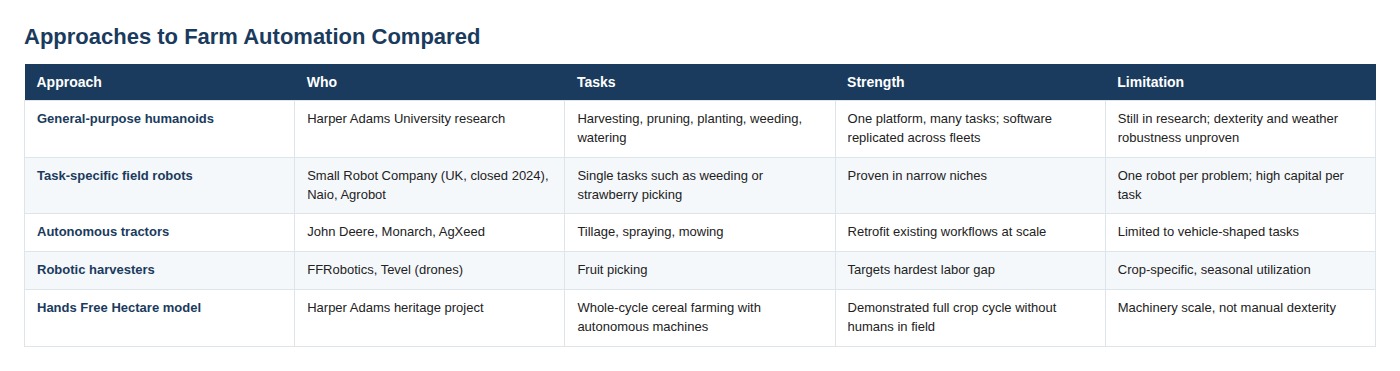
The comparison between different approaches to agricultural automation highlights these trade-offs. While general-purpose humanoids offer the promise of a single platform for many tasks, they remain unproven in terms of dexterity and weather robustness outside the laboratory. Task-specific field robots have proven themselves in narrow niches, but they require a high capital investment per task. Autonomous tractors excel at retrofitting existing workflows at scale but are limited to vehicle-shaped tasks.
Comparing Agricultural Automation Strategies
The following table outlines the current field of agricultural automation, comparing the humanoid approach with existing technologies.
The development of humanoid robots for agriculture is not merely a technological exercise; it is a response to a fundamental shift in the labor economics of food production. As the global population grows and the availability of agricultural labor shrinks, the pressure to automate will only intensify. The success or failure of projects like the one at Harper Adams University will have profound implications for how we grow and harvest our food in the coming decades.
The transition from research to commercial deployment will require significant advances in both hardware durability and software intelligence. The robots must be able to withstand the rigors of daily farm work, from freezing rain to baking sun, while consistently performing delicate tasks with high precision. The software economics argument, that a task perfected once can be replicated infinitely, is compelling, but it relies on the assumption that the hardware platform is robust enough to execute that software reliably in the real world.
The agricultural sector is watching these developments closely. Procurement managers, sourcing leaders, and farm operators are evaluating the potential return on investment for these advanced systems. The promise of a flexible, multi-tasking robotic workforce is highly attractive, particularly in regions facing acute labor shortages. However, the high initial capital cost and the unproven nature of the technology in commercial settings remain significant barriers to adoption.
The research at Harper Adams University represents a critical step in exploring the viability of humanoid robots in agriculture. By focusing on the unique capabilities of the human form factor, the project is pushing the boundaries of what is possible in farm automation. Whether these machines will eventually become a common sight in orchards and fields remains to be seen, but the economic and demographic pressures driving their development are undeniable.
The integration of advanced robotics into agriculture is a complex and ongoing process, requiring collaboration between engineers, agronomists, and farm operators. The goal is not to replace human workers entirely, but to augment their capabilities and address the most pressing labor shortages. As the technology matures, we can expect to see more sophisticated and capable robotic systems entering the agricultural market, fundamentally changing the way we produce food.
Disclaimer: This article is for informational purposes only and does not constitute investment advice, endorsement, or verification of any claims made by the companies mentioned.