GMO Launches Japan's First Humanoid Robot Ambulance
GMO AI & Robotics will launch Japan's first dedicated humanoid robot maintenance vehicle this month, a bet on field-service infrastructure that most humanoid vendors have left unaddressed as deployments scale beyond pilot programs.

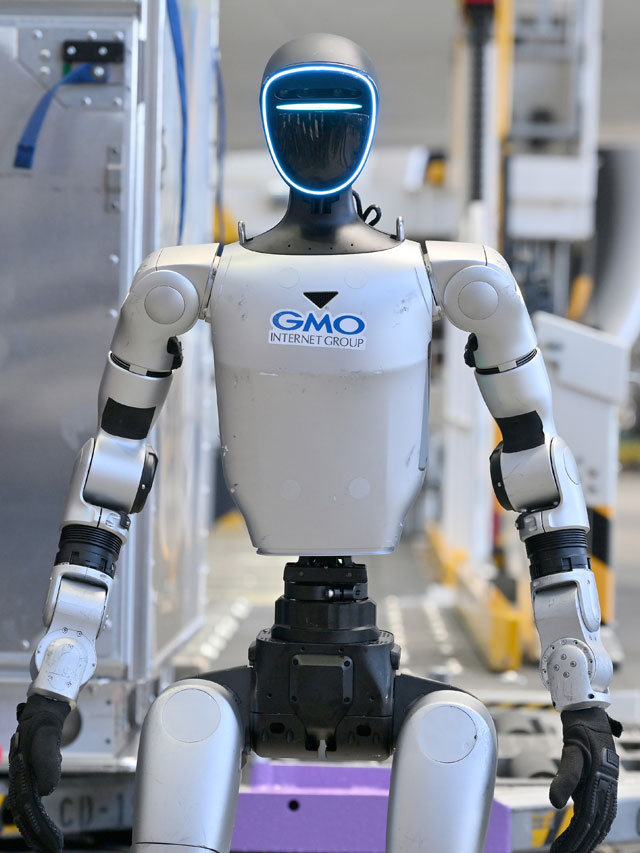
GMO AI & Robotics, the robotics arm of Japanese internet conglomerate GMO Internet Group, said Tuesday it will launch what it calls Japan's first dedicated maintenance vehicle for humanoid robots this month, a specially equipped truck that dispatches to a breakdown site to diagnose, repair, and swap failed components on the spot. The company is calling the vehicle the GMO Humanoid Ambulance, and it will initially service the robots GMO AI & Robotics has itself deployed or distributed, rather than operating as an open repair service available to any humanoid robot operator in Japan.
GMO AI & Robotics Corporation, established in 2024 as a dedicated robotics unit inside GMO Internet Group, has spent the past year and a half assembling the pieces of a vertically integrated humanoid robot business rather than a single product line. The company became the authorized Japanese distributor for Unitree Robotics in June 2026, ran Japan's first humanoid robot demonstration at Haneda Airport with Japan Airlines' ground-handling subsidiary starting in April, signed a memorandum of understanding with Mitsubishi Corporation, and operates a dedicated humanoid research and development hub, GMO Humanoid Lab, out of Tokyo's Cerulean Tower in Shibuya. The ambulance announcement extends that same build-the-whole-stack approach from sales and research into the far less glamorous business of field service.
The Maintenance Question Most Humanoid Pitches Skip
Humanoid robot sales pitches overwhelmingly emphasize capability: what tasks a unit can perform, how many hours it can run, how dexterous its hands are. What they routinely underweight is the question that determines whether a deployment actually survives past its first year in production use: what happens, operationally and financially, the day a unit breaks down in the middle of a shift. A traditional industrial robot arm bolted to a factory floor can usually be serviced by an integrator's technician within a scheduled maintenance window, because the machine is stationary, its failure modes are well understood after decades of deployment, and the surrounding process typically has buffer capacity built in. A humanoid robot working a reception desk, warehouse floor, or hospitality role is a newer and less forgiving proposition: it is mobile, running software and hardware combinations that are only a few years old at most, and often deployed in a role where a multi-day service outage is immediately visible to customers or disruptive to a process that was not designed with a robot-shaped gap in it.
GMO AI & Robotics' own framing of the ambulance leans directly into that gap. The company said that "in the era when humanoid robots become fully operational in society, a system that can rush to the scene when a robot stops will be essential," and described the vehicle as infrastructure it is building proactively, ahead of the scale of deployment that would make such a service commercially self-evident, specifically so it can accumulate operational knowledge through direct experience rather than waiting for demand to prove the need. That is an unusually candid admission from a robotics distributor: GMO is effectively saying the service-response problem does not yet have an established solution anywhere in the market, including inside its own operation, and that building the capability now, while deployment volumes are still small, is cheaper and safer than trying to build it later under the pressure of a large, unhappy customer base.
Why a Distributor Builds This Rather Than a Manufacturer
The service-vehicle model sits at an unusual point in the humanoid robot supply chain. Manufacturers like Unitree design and build the hardware; GMO, as the Japanese distributor, sits closer to the actual operating environment and the customers who will notice a breakdown first. A manufacturer based in China or the United States is poorly positioned to dispatch a technician to a Tokyo hotel lobby within hours of a fault being reported, while a well-resourced local distributor with its own field-service infrastructure can plausibly promise same-day or next-day response in a way that materially changes the total cost of ownership calculation for a prospective Japanese customer. That distinction matters for how other markets should expect this problem to get solved: the entity best positioned to build rapid-response robot maintenance infrastructure is usually not the original manufacturer but whichever regional partner controls the last mile of the customer relationship, which is a role structurally similar to how automobile dealership networks, rather than automakers themselves, have historically handled vehicle service and warranty repair.
What Buyers Should Ask Before Signing
For a facilities manager or procurement lead evaluating a humanoid robot deployment anywhere, GMO's ambulance announcement is a useful prompt to ask a question that rarely appears on a robot vendor's standard sales sheet: what is the actual mean time to repair when a unit fails on-site, and who is contractually responsible for meeting it? A vendor or distributor with a dedicated, staffed maintenance-response capability, even an early and unproven one like GMO's single ambulance vehicle, has a materially different service commitment to offer than one whose repair plan amounts to shipping a replacement unit from overseas or scheduling a technician visit within a multi-week window. Buyers should ask prospective humanoid robot vendors directly for their documented mean time to repair, whether that commitment is backed by a contractual service-level agreement with financial penalties for missed windows, and how many service vehicles or technicians currently exist to support the fleet size being proposed, since a vendor's answer, or its inability to give one, is itself a meaningful signal about how seriously the company has thought through post-sale support relative to the sales pitch.
A Familiar Playbook From Adjacent Equipment Markets
The mobile-service-vehicle model GMO is applying to humanoid robots is not a novel concept in isolation; it is closely modeled on how other categories of expensive, mission-critical mobile equipment have historically solved the same problem. Medical imaging equipment makers dispatch field engineers with mobile diagnostic kits when an MRI machine goes down at a hospital, because a multi-day outage of a single machine has an outsized operational and reputational cost relative to the equipment's overall fleet size. Elevator and escalator maintenance companies run fleets of service vehicles precisely because a stalled unit in a public building creates immediate, visible disruption that a scheduled quarterly inspection cannot address. Both categories eventually converged on dedicated rapid-response service infrastructure once the installed base grew large enough to justify it, and GMO's ambulance is a bet that humanoid robots are approaching, or will soon approach, that same threshold in Japan even though current deployment volumes remain small by comparison. The distinction worth watching is whether GMO is building ahead of that threshold, as the company's own statement suggests, or is responding to an early breakdown incident that has not been publicly disclosed.
A Single Vehicle Is a Pilot, Not a Service Network
The honest limitation in GMO's announcement is scale: one specially equipped vehicle, however novel the concept, cannot service a citywide fleet of humanoid robots with any meaningful response-time guarantee once deployment volumes move from the pilot-scale numbers currently typical across the Japanese market into the hundreds or thousands of units GMO's own distribution and research investments are clearly betting on. The company has not disclosed a fleet-expansion timeline for the ambulance concept, staffing levels, or the geographic radius it plans to cover from a presumed Tokyo base, all of which will determine whether this launches as a genuine operational capability or remains closer to a proof-of-concept that generates useful internal data without yet functioning as a scalable service commitment GMO can extend to third-party customers.
What the announcement does establish is a marker worth watching as humanoid robot deployment scales across every market, not just Japan: the companies that treat field maintenance as a first-order product decision, built alongside the robot itself rather than bolted on after the first fleet-wide breakdown crisis, are the ones likely to win the harder, second-order sale that follows a successful pilot. GMO's next disclosure worth tracking is not another distribution deal or research partnership, but whether the ambulance concept expands into a fleet, and whether the company ever opens that service to robots it did not itself sell, the step that would turn a proprietary support tool into the kind of independent service network the wider humanoid robot industry will eventually need regardless of which manufacturer's hardware wins the largest market share.
That last step is the one with the more interesting long-term commercial upside for GMO, and one the company has not yet signaled any intent to take. An independent, multi-brand humanoid robot repair network, analogous to how third-party auto-repair chains eventually grew alongside manufacturer-run dealership service departments, would let GMO capture service revenue from competitors' hardware as well as its own, decoupling its maintenance business from how well its own distributed brands perform against rivals like Boston Dynamics-Hyundai or China's fast-growing humanoid exporters. Whether GMO is thinking that far ahead, or is simply solving an immediate support gap for the fleet it already operates, will become clearer only once the company discloses how the ambulance concept scales past its first vehicle.
For now, the announcement is best read as an early, honest signal from inside the industry that the hardest part of scaling humanoid robots into everyday commercial environments may turn out to be the unglamorous logistics of keeping them running, not the underlying robotics or AI that gets the most attention at trade shows and award ceremonies.
Hero image credit: GMO AI & Robotics Corporation / GMO Internet Group.
This analysis draws on GMO AI & Robotics' own public announcement alongside independent trade-press coverage of the company's humanoid robot deployment history. It is for general information purposes only and does not constitute investment, financial, or legal advice.