ABB Launches Two Precision Robots, AI Vision Trainer at CIIF 2026
ABB Robotics introduced the compact IRB 1700 and IRB 1700ID precision robots and added an AI Robot Trainer capability to its OmniCore EyeMotion vision system at CIIF 2026 in Shanghai, targeting faster cycle times and sharply shorter vision-system commissioning.

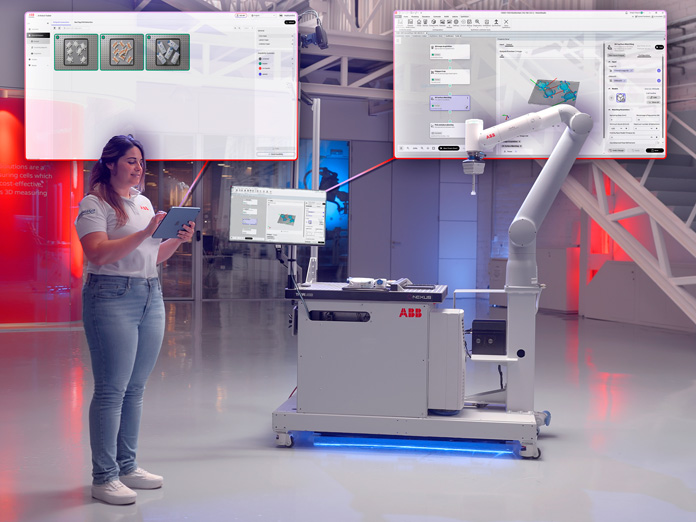
At the China International Industry Fair (CIIF) in Shanghai, running October 12 to 16, 2026, ABB Robotics used one of the world's largest industrial trade shows to launch hardware built for a narrower problem than most show-floor spectacles address: getting precision manufacturing lines to run faster without adding specialists to run them.
ABB Robotics, the robotics and automation division of Zurich, Switzerland-headquartered ABB, introduced two new industrial robot models, the IRB 1700 and IRB 1700ID, and expanded its OmniCore EyeMotion machine-vision software with a new AI Robot Trainer capability at CIIF 2026. ABB said the new robots deliver up to 20% shorter cycle times than comparable robots on the market, while the AI Robot Trainer addition is built to cut vision-system commissioning time by up to 90% when paired with automatic collision-free path planning.
ABB is one of the largest industrial robot manufacturers in the world, competing directly with Fanuc, Yaskawa, and KUKA for factory automation contracts. That rivalry frames why the launch matters: a Swiss-headquartered global vendor chose a Chinese trade show, rather than a European or North American one, to put new precision-manufacturing hardware and its most capable vision artificial intelligence (AI) tooling in front of buyers first.
A Compact Arm Built for the AI Server Rush
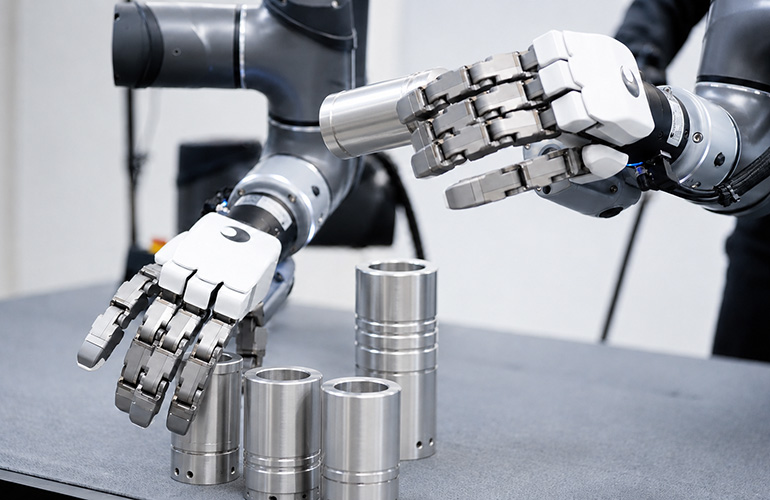
The IRB 1700 family targets a specific capability gap in ABB's existing lineup: compact, high-speed arms for tasks where both precision and power efficiency determine the total cost of ownership. ABB said the new models offer payloads from 6 kilograms to 12 kilograms across five variants, run on the company's OmniCore controllers, and hold path repeatability down to 0.03 millimeters with joint speeds of up to 700 degrees per second. The company said the combination improves uptime and lowers operating costs, citing up to 15% lower power consumption and service intervals of up to 20,000 hours between oil changes.
ABB positioned those specifications against a specific market pressure. "Precision manufacturing across sectors from electronics, automotive, to general industries is facing the pressure to produce more, while maintaining quality and reducing operating costs," said Craig McDonnell, managing director, business line industries, ABB Robotics. McDonnell said the IRB 1700 family answers that pressure with a new level of speed, accuracy, reliability, and energy efficiency, giving manufacturers and system integrators a flexible platform for high-performance automation.
ABB said the speed and accuracy profile suits high-throughput precision tasks such as material handling, arc welding, deburring, sanding, and machine tending. It also pointed to a newer application category: assembly of artificial intelligence (AI) server racks, a workload the company tied directly to surging demand for AI servers and computing infrastructure. For procurement teams evaluating arm selection, that is a concrete signal about where ABB expects near-term order volume to concentrate, rather than a general-purpose pitch.
Integrated Dressing Trims the Footprint, Not Just the Arm
Floor space is its own line item in a precision-manufacturing budget, and ABB built the footprint argument into the hardware itself. The company said the new robots have a footprint 50% smaller than their predecessor, and the IRB 1700ID variant goes further with what ABB calls Integrated Dressing (ID) design, routing cables and hoses inside the robot arm rather than along its exterior. ABB said that approach simplifies installation across industrial applications, a detail that matters more to a system integrator scheduling a changeover than it does to a casual reader of the spec sheet.
ABB described the IRB 1700 family as an extension of its broader mechatronics portfolio and its continued development of what it calls more autonomous and versatile robotics (AVR). In practice, that framing means the hardware ships with built-in access to an expanding software stack: RobotStudio, AI Robot Trainer, OmniCore EyeMotion, and automatic collision-free path planning. The arm is, by ABB's own description, a delivery vehicle for the software story as much as a mechanical upgrade on its own.
Commissioning Time Is Where Vision-Guided Robotics Actually Gets Expensive
The second announcement speaks more directly to buyer economics. OmniCore EyeMotion, ABB's machine-vision system for guiding robot motion from camera input, is now paired with AI Robot Trainer, a tool ABB built for system integrators and automation partners rather than end customers configuring a single cell. The stated purpose is to simplify deployment and scaling of AI-powered vision applications across multiple customer sites and production lines, and to reduce how dependent that process is on scarce AI specialists.
Here is the plain-language version of what that solves. Vision-guided robotics has traditionally required someone who understands machine learning to spend real calendar time teaching a system to recognize a specific part, under a specific factory's lighting, before a robot can reliably pick it, inspect it, or sort it. AI Robot Trainer is designed to compress that process into a guided workflow, complete with an AI chatbot, that a line technician can run without waiting on that specialist's schedule. ABB said the tools connect image acquisition, AI model training, deployment, and continuous improvement in a single industrial workflow, converting real shop floor images into deployable AI vision data and then converting perception directly into robot motion through automatic collision-free path planning.
ABB's own figures on what that is worth: commissioning time cut by up to 90%, and cycle time cut by up to 50%, when AI Robot Trainer is combined with automatic collision-free path planning. The company said the guided workflow helps integrators handle changing stock keeping units (SKUs), lighting conditions, layout changes, and object variations without rebuilding the vision model from scratch, and that the system is compatible with any brand of camera or sensor rather than locking buyers into ABB-only hardware. ABB framed the combined offering as useful across a wide span of vision tasks, from simple two-dimensional pick and place to more demanding three-dimensional bin picking, quality inspection, sorting, and assembly.
Marc Segura, president, ABB Robotics, framed the announcement as part of a broader shift in what robots can do. "Robotic AI vision is the vital bridge between robot perception and physical actions, enabling robots to see, understand, and act in real time," Segura said. Segura added that customers need a complete workflow to create, deploy, and continuously improve that vision capability, and that OmniCore EyeMotion and AI Robot Trainer are meant to work together in a continuous loop of data generation, model training, deployment, and optimization, serving specialists and newcomers to robotics alike.
Commissioning speed is not a cosmetic metric. It sits directly inside the gap between demo performance and deployment reality that separates a vision system that works on a trade-show stand from one that works on a Tuesday, mid-shift, after the parts bin changes. A tool that genuinely shortens that gap changes the arithmetic for system integrators who currently price AI-specialist time into every new line, and for manufacturers who have delayed vision-guided automation precisely because the setup labor made the payback period too long to justify.
Why Shanghai, Not Stuttgart or Chicago, Got the First Look
ABB's choice of venue is itself a data point for buyers tracking vendor strategy. CIIF is a Chinese industrial trade show, and ABB is neither Chinese nor newly entering the market there; it is a global industrial technology group that has operated in China for decades. Launching precision-manufacturing hardware and its flagship vision-AI tooling at CIIF, rather than holding both for a European or North American show, signals how central China has become to how a major global robot vendor sequences its product calendar, not merely where it sells.
China is the largest single national market for industrial robots by unit volume, and electronics and automotive manufacturers there are the buyers most likely to adopt AI server rack assembly lines and high-mix vision-guided cells first. Choosing CIIF as the launch stage, rather than a regional follow-on event after a Western unveiling, reflects that a vendor the size of ABB can no longer treat China as a secondary rollout market for its newest precision hardware. The strategic read for competitors and buyers alike: China-first, or China-simultaneous, launches are becoming a normal part of how global robotics vendors compete for share in their largest market.
The Numbers Are ABB's Own, and That Is Worth Remembering
Every performance figure in this announcement, the 20% cycle-time improvement, the 15% power savings, the 90% commissioning-time reduction, the 50% cycle-time reduction, originates from ABB itself, measured against ABB's own prior-generation hardware and ABB's own description of comparable robots on the market. None of it has been independently benchmarked by a third party, and ABB did not name a customer site, pilot deployment, or integrator currently running AI Robot Trainer in production. That is not unusual for a trade-show announcement, but it is the detail procurement teams should hold onto before building a capital-expenditure case on these percentages. The distinction between a demo and a deployable system is exactly what separates a compelling booth presentation from a commissioning timeline that actually holds on a customer's floor, and that distinction only gets tested once integrators start running the software against real SKU changes, real lighting variation, and real production schedules rather than a staged demonstration.
The sensible procurement posture is to treat AI Robot Trainer's stated commissioning-time reduction as a hypothesis worth piloting, not a guaranteed outcome to plan a line around. Integrators evaluating the IRB 1700 family and the expanded OmniCore EyeMotion stack should ask ABB for a scoped pilot on their own part mix and lighting conditions before committing to the vendor's figures in a business case.
What happens next is the part worth watching. ABB has not published a commercial availability date, regional rollout order, or pricing for the IRB 1700, IRB 1700ID, or the AI Robot Trainer addition to OmniCore EyeMotion. The next concrete signal for buyers will be when system integrators in China, and then elsewhere, begin reporting actual commissioning times on live vision-guided cells using the new tools, and whether ABB extends the AI server rack assembly use case into named deployments rather than a stated market opportunity. Until that evidence surfaces, the CIIF announcement should be read as a product and software roadmap signal from a major competitor, not yet as a proof point.
This account synthesizes ABB Robotics' own statements and product disclosures made in connection with the CIIF 2026 announcement, as of the stated publication date.
This article is provided for general information purposes only and does not constitute investment, procurement, legal, or engineering advice. Figures reflect the sources listed above as of the stated information cut-off and may change without notice.