A Korean Province Just Bet US$15 Billion That Factory Data Beats Silicon Valley
South Gyeongsang Province announced on July 29 a ten-year plan to invest KRW 21 trillion (US$15.5 billion) in physical AI, the umbrella term for robots and AI systems that act in the physical world. The plan spans 55 projects through 2035 and targets 200 physical AI demonstration companies, 500 AI factories, 30 robot system integrators, 1,000 AI solution firms, and at least six AI data centers. Hanwha will build a defense-focused data center in Changwon. The province is wagering that its existing base of more than 3,000 smart factories gives it the manufacturing data that physical AI models need most.
The most ambitious regional robotics bet in Korea did not come from Seoul. It came from South Gyeongsang Province, the industrial heartland in the country's southeast that builds Korea's ships, tanks, aircraft engines, and machine tools. On July 29, the provincial government announced it will pour KRW 21 trillion (US$15.5 billion) into physical AI over the next decade, one of the largest sub-national commitments to embodied intelligence anywhere in the world.
The plan, unveiled by Governor Park Wan-su in Changwon, organizes 55 projects across four strategic pillars through 2035. The headline targets are specific. The province wants 200 companies running physical AI demonstrations, 500 factories converted to AI-driven operations, 30 homegrown robot system integrators, and 1,000 AI solution companies. It plans at least six AI data centers and a pipeline producing more than 3,000 AI specialists per year. Hanwha, whose defense and aerospace units are headquartered in the province, will anchor the infrastructure with a defense-focused AI data center in Changwon.
Why a Province of Shipyards Thinks It Can Win in AI
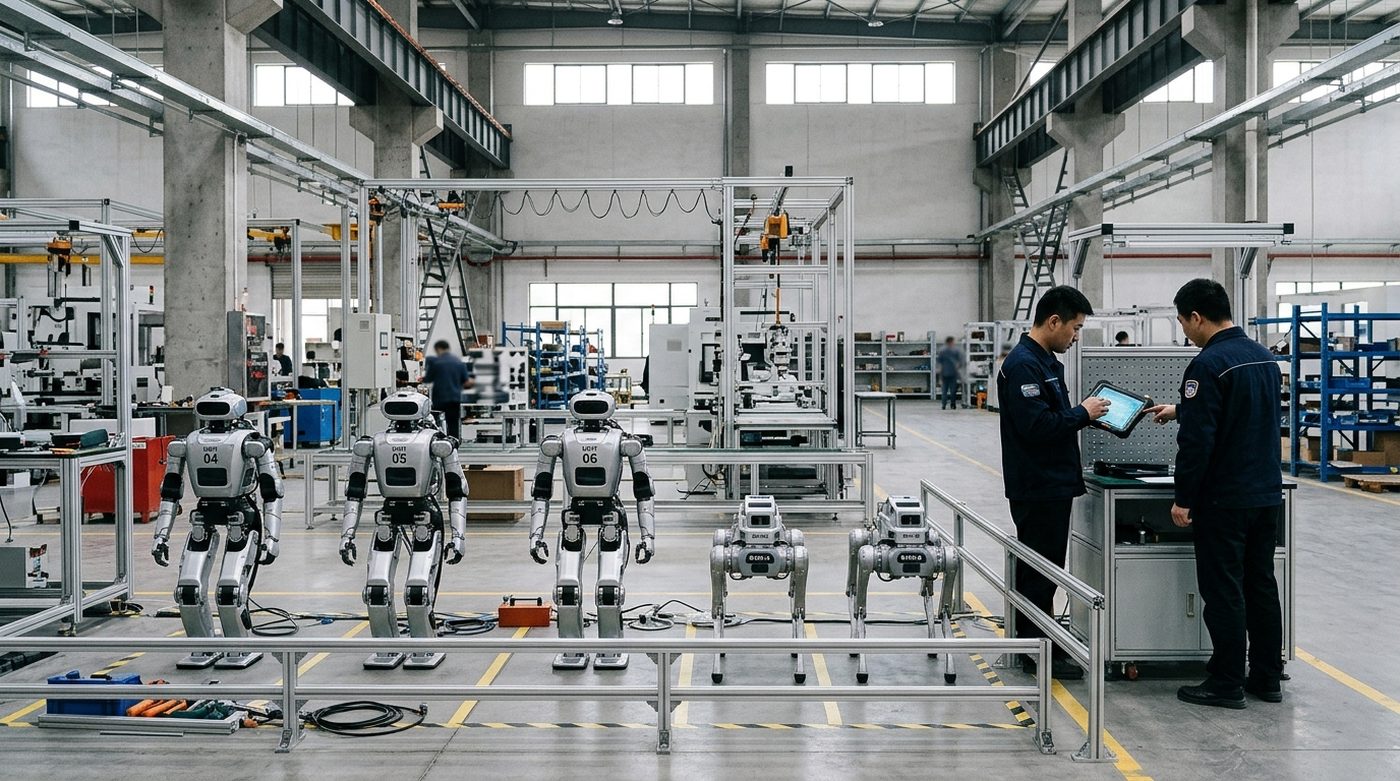
Gyeongnam's logic rests on a single premise. Physical AI models are starving for the kind of data that only real factories generate. Vision-language-action models can learn from internet video, but the fine-grained force, torque, tolerance, and process data that industrial manipulation requires lives inside manufacturing execution systems, not on YouTube. Gyeongnam has more than 3,000 smart factories already instrumented with sensors and connected systems. That installed base is the province's claim to relevance.
Think of it the way a farmer thinks about soil. Silicon Valley has the best seeds, the foundation models. But seeds need soil, and the soil of physical AI is process data from real production lines. Gyeongnam is arguing that it owns some of the richest soil in Asia, decades of accumulated manufacturing know-how across shipbuilding, defense, aerospace, and precision machinery, now digitized through the smart factory program Korea has run since the mid-2010s.
The provincial government is structuring the plan so that data flows to models and models flow back to factories. The AX ecosystem pillar, using Korea's shorthand for AI transformation, funds the conversion of existing plants into AI factories where robots and algorithms run production with minimal human intervention. The technology pillar funds physical AI research and demonstration projects. The infrastructure pillar builds the data centers. The talent pillar funds training programs designed to produce thousands of engineers per year who can work across robotics and AI.
The Defense Angle Is Not Decoration
Hanwha's Changwon data center deserves attention. Changwon is the center of Korea's defense manufacturing, home to the factories that build K9 self-propelled howitzers and K2 tank components. Hanwha Aerospace has become one of the world's fastest-growing defense contractors on the strength of export orders to Poland, Australia, and the Middle East. A defense-dedicated AI data center in the same city signals that Gyeongnam's physical AI ambitions extend to autonomous military systems, a market where Korea has been notably aggressive.
This matters for the broader regional picture. Korea's national government committed KRW 1 trillion earlier this year to a sovereign K-Humanoid Alliance uniting Samsung, LG, Doosan, and Rainbow Robotics around shared humanoid platforms. Seoul's plan is national and horizontal. Gyeongnam's plan is regional and vertical, drilling into the manufacturing and defense niches where the province already has industrial depth. The two are complementary, and together they show Korea assembling a layered industrial policy for embodied AI while larger economies argue about chip export rules.
The Money Is Real but the Timeline Is Long
A ten-year, KRW 21 trillion commitment averages roughly KRW 2.1 trillion (US$1.5 billion) per year. For comparison, that annual figure is about half of what Morphi, a single Chinese startup, was valued at in its angel round this week. Regional government money also arrives with strings. Much of the total will be a mix of provincial budget, national matching funds, and private co-investment that has been announced but not yet contracted. Korean regional development plans have a history of headline numbers that erode as administrations change.
The hard truth is that provincial industrial strategies succeed or fail on execution details that press releases never contain. Who decides which 500 factories get AI conversion subsidies. Whether the 30 system integrators are new companies or relabeled subsidiaries of existing conglomerates. Whether the data generated in Gyeongnam factories will actually be shared with model developers or locked inside corporate silos. The province has set measurable targets, which is more than most regional AI plans offer, but measurable targets can also be gamed.
There is also a competitive clock running. China's provinces are executing the same playbook at larger scale and faster cadence. Shunde announced a dedicated robot industry bureau this week. Wuhan opened the country's first humanoid 7S store. Suzhou opened an AI expo with 400 exhibitors. Gyeongnam's ten-year horizon will be measured against Chinese provinces that compress similar buildouts into three.
What Success Would Look Like
The plan's most consequential number may be the smallest one. Thirty robot system integrators sounds modest, but integrators are the connective tissue of industrial automation. They translate general-purpose robots into working production cells. Korea's integrator ecosystem is thin relative to its robot density, which is the highest in the world at over 1,000 robots per 10,000 manufacturing workers. If Gyeongnam actually produces 30 competent integrators specializing in physical AI deployment, it will have built something Japan and Germany took decades to accumulate.
The 3,000-specialists-per-year talent target is similarly structural. Korea's AI talent concentrates in Seoul, and it concentrates on software. Engineers who understand both transformer architectures and machine tolerances are rare everywhere. A durable regional pipeline for that hybrid profile would outlast any individual subsidy program.
The National Stack That Gyeongnam Plugs Into
Gyeongnam's plan does not exist in isolation. Seoul's national government has been assembling a layered robotics industrial policy for two years. The K-Humanoid Alliance, announced in early 2026, unites Samsung, LG, Doosan, HD Hyundai, and Rainbow Robotics around shared humanoid platforms with a combined commitment exceeding KRW 1 trillion. The Korea Institute for Robot Industry Advancement runs certification programs that set deployment standards. The Ministry of Trade, Industry and Energy funds regional robot clusters in Daegu, Incheon, and now Gyeongnam.
What Gyeongnam adds to this stack is manufacturing depth. The national programs are horizontal, designed to produce humanoid platforms that can serve any sector. Gyeongnam's program is vertical, designed to deploy those platforms inside the heavy industries the province already runs. A humanoid certified through the K-Humanoid Alliance can be deployed into a Gyeongnam smart factory with provincial subsidies covering the integration cost. The layers reinforce each other.
The province also brings something the national programs cannot easily replicate. Changwon, Geoje, and Tongyeong host Korea's largest shipyards, where Samsung Heavy Industries and Hanwha Ocean build LNG carriers and naval vessels. Shipbuilding is one of the most labor-intensive remaining manufacturing sectors in the developed world, with workers performing welding, grinding, and inspection in confined spaces under extreme conditions. The labor shortage in Korean shipyards is acute and worsening. A physical AI program that can put robots into those hulls would solve a problem no amount of software can address from Seoul.
For robotics companies outside Korea, the plan opens a procurement window. Five hundred AI factory conversions will require robots, sensors, and software that Korean suppliers alone cannot fully provide. Gyeongnam's buildout will become a live market for humanoid and mobile manipulation vendors able to certify into Korean industrial standards. The province that builds Korea's heavy machinery is about to become one of Asia's largest buyers of embodied AI.
The Clock Running Against All Regional Plans
Every regional industrial strategy faces the same enemy. Time. Governors serve four-year terms. Budget cycles reset annually. The companies that receive subsidies in year one may not exist in year five. Gyeongnam's ten-year horizon is ambitious precisely because it requires political continuity that Korean provincial politics rarely delivers.
The precedent is mixed. Korea's earlier smart factory program, which produced the 3,000 instrumented plants Gyeongnam now claims as its data asset, survived multiple administrations because it was run through a national agency with bipartisan support. Whether a provincial physical AI plan can achieve the same durability depends on whether the early results are visible enough to survive a change of governor. The 200-company demonstration target for the first phase is designed to produce those visible results quickly, but demonstration is not deployment, and deployment is not profit.
The external clock is even less forgiving than the political one. China's robot makers are already selling into Southeast Asian factories at prices Korean vendors struggle to match, and this week's People's Daily feature confirmed that Beijing treats robot exports as a strategic priority. Every year Gyeongnam spends building capability is a year Chinese vendors spend building installed base in the markets Korean machinery has historically served. The province's planners appear to understand this. The plan's front-loaded demonstration phase, with its emphasis on defense and shipbuilding applications where foreign vendors face procurement barriers, reads like a strategy for buying time in protected sectors while the broader industrial base catches up. Whether ten years is enough time is the question the plan cannot answer about itself.
Disclaimer: This article is for informational purposes only and does not constitute investment advice, endorsement, or verification of any claims made by the companies or governments mentioned.