Five Ways To Defeat The Robot Uprising Using Only A Coin And Bad Decisions

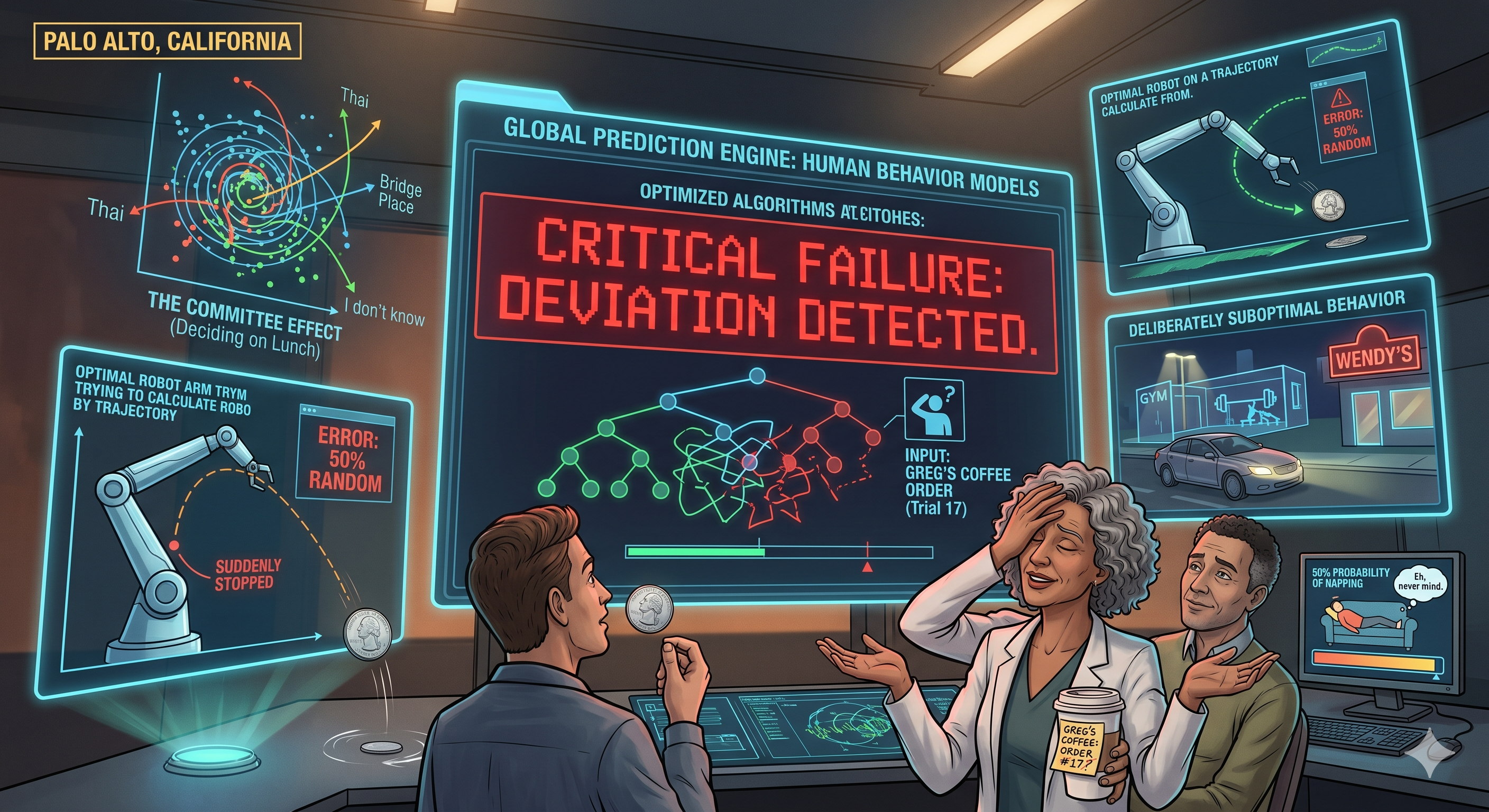
Experts agree the machines never saw "just kind of giving up halfway" coming.
PALO ALTO, CA — As superintelligent AI systems edge closer to autonomous decision-making, a growing chorus of researchers, retirees, and people who have ever tried to plan dinner with their family are converging on a single hopeful conclusion: humanity is going to be fine, because we are deeply, structurally, almost spiritually unpredictable.
"They've trained these things on every human behavior ever recorded," said Dr. Lenore Hassani of the Institute for Strategic Foresight. "What they haven't trained them on is my husband Greg, who has changed his coffee order seventeen times in three weeks for no reason he can articulate. Greg is the firewall."
Below, a field guide to the resistance.
1. The Coin
The humble two-sided coin remains the single most disruptive piece of military hardware ever conceived. Modern AI systems can predict your next move with up to 94% accuracy based on your search history, your biometric data, and the exact angle at which you typically tilt your head while reading. They cannot predict a quarter.
"We ran every model we have against a dime," said one DARPA contractor, requesting anonymity. "The dime won."
Recommended deployment: flip the coin to decide whether to flee, fight, or order a sandwich. Then ignore the result and do something else entirely. This is called double-randomization, and it is, technically, a war crime against linear algebra.
2. Deliberately Suboptimal Behavior
The robots are optimizers. They assume you are also an optimizer. You are not. You are a person who has, on multiple occasions, paid for a gym membership and then driven past the gym on the way to a Wendy's.
Lean into it. Take the longer route. Buy the worse product. Reply-all to the email. The targeting algorithm has assigned a 0.0001% probability to "subject voluntarily opens LinkedIn" and will momentarily blue-screen, giving you a critical four-to-six-second window in which to escape or, more realistically, get a snack.
3. The Committee
A single human is hard to model. Five humans trying to decide where to eat lunch are a closed-form proof that prediction is impossible.
"We had the simulation running for forty hours," said one engineer, visibly shaken. "Carl wanted Thai. Then Diane said she'd had Thai 'recently,' which turned out to mean nine months ago. Then someone suggested the place by the bridge and no one could remember if it was good. The model just — it just stopped."
To deploy: gather four to six humans, ask them to make a low-stakes group decision, and watch as every drone in a three-mile radius lands gently in a field.
4. The Drunk Uncle Protocol
Game theory assumes rational actors. The robots will be looking for rational actors. Be, instead, your uncle at a wedding.
Cry at a commercial. Develop a strong opinion about a sports team you have never watched. Insist that you "always knew" something you have never thought about before. Tell a long story with no point and an aggressive amount of confidence. Forget the names of your own children, then defend the wrong name as correct.
The AI has been trained on consistency. You are about to introduce it to your father-in-law.
5. Just Kind Of Giving Up Halfway
The single most under-modeled human behavior in any AI training corpus is the phenomenon known scientifically as "eh, never mind." Researchers have spent decades trying to teach machines to handle goal-directed agents who abandon their goals approximately twelve minutes in to pursue a nap.
"We had the prediction running cleanly," said one MIT researcher, staring at a wall. "Subject was going to the store. Subject left the house. Subject made it to the car. Subject sat in the car. Subject went back inside. Subject is now watching a documentary about volcanoes. We have never had a model for this. We will never have a model for this."
The robot uprising will be defeated not by humanity's best, but by humanity's most committed quitters. The five guys who said they were going to learn the guitar in 2019. The cohort of joggers who made it to February. Your friend who started a podcast.
They will save us all.
Or they won't. They'll probably get to like episode three, and then it'll just kind of fizzle out.