July 2026 Technology Wrap-Up: Trust Became the Bottleneck
July 2026 produced more robot foundation models than any prior month, and the technical center of gravity shifted in response: the scarce layer is no longer models or data but evaluation, certification, and standards. China's MIIT convened its humanoid standardization plenary and stood up a data working group, Europe's ISO 10218:2025 transition began sorting prepared vendors from unprepared ones, and a wave of benchmarks emerged to measure what the model flood actually delivers. The trust layer is becoming the product.
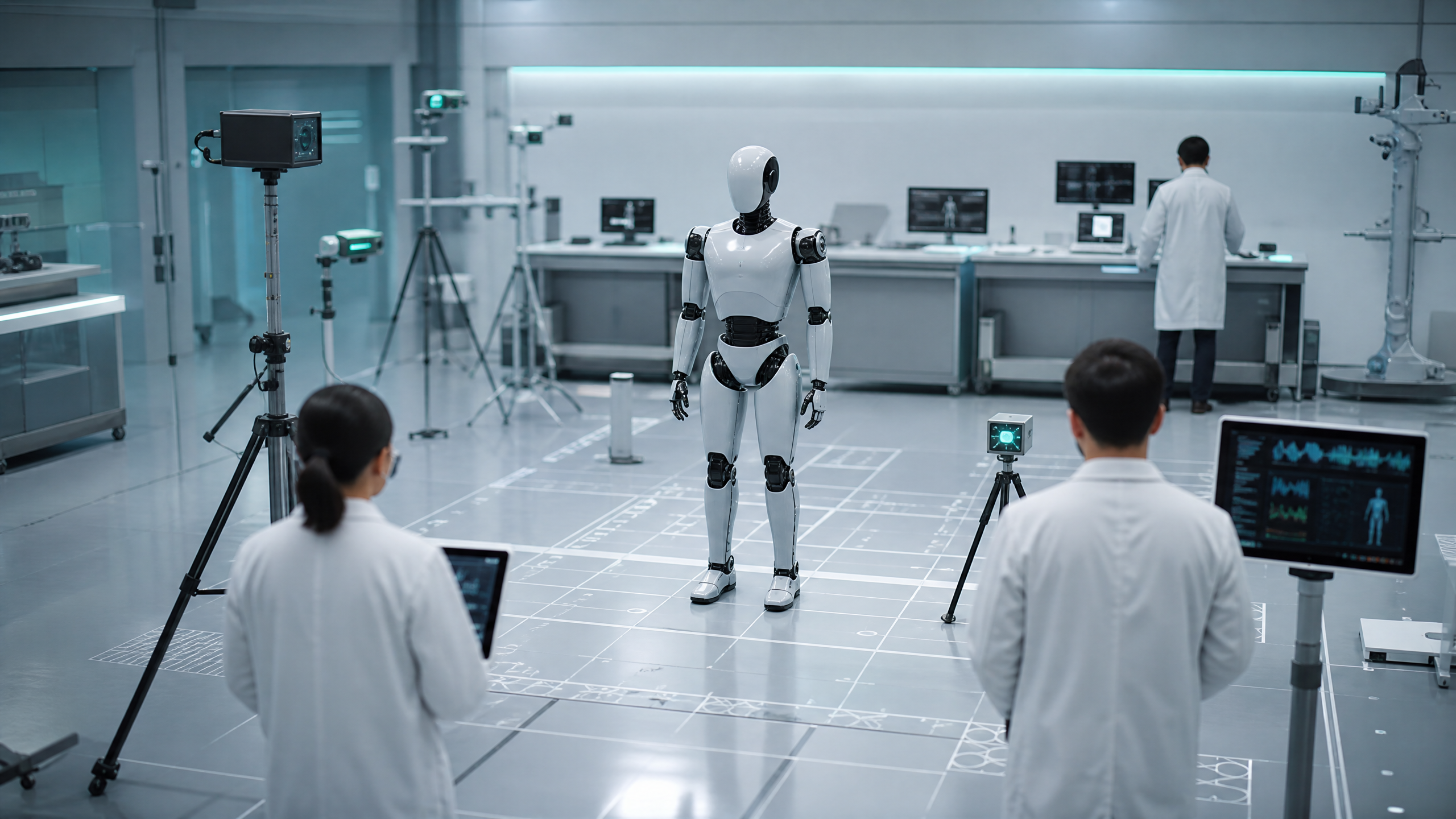
The structural change in robotics technology during July 2026 was not a new model, although the month produced plenty. It was the quiet migration of engineering effort from building capabilities to proving them. A year ago the binding constraint in embodied AI was training data, and the industry answered with data factories, teleoperation farms, and synthetic pipelines. July's record shows that answer working well enough to create the next constraint: a flood of models, platforms, and capability claims that buyers, regulators, and integrators cannot yet independently verify. The scarce technical layer is now measurement, and the month's most consequential announcements were benchmarks, certifications, and standards bodies rather than robots.
The model flood itself is easy to document. July brought Mistral's robotics model push, OpenBMB's MiniCPM-Robot compact open family, Kunlun Tech's Riemann 1.0 alongside three multimodal models, WeRide's WITT, Xiaomi's Robotics-1 trained on 100,000 hours of operational data, and Ant Group's open-sourced LingBot depth and vision foundation models. Every one of these arrived with capability claims stated by its vendor, and almost none arrived with independent verification. That asymmetry, multiplied across a month, is what pushed evaluation infrastructure to the top of the technical agenda.
Benchmarks Grew Teeth in July
Daxiao Robotics, a Chinese evaluation startup, introduced Physical IQ as a real-scene evaluation layer for physical AI, scoring robots on tasks in actual deployment environments rather than curated laboratory setups. RoboDojo, published to arXiv in July, proposes a unified sim-and-real benchmark for generalist robot policies, closing the loophole in which models excel in simulation and quietly degrade on hardware. RoboLab expanded robot policy evaluation beyond raw success rates into robustness and consistency dimensions. A workshop on post-training for robotics foundation models organized its entire first phase around a standardized real-robot bimanual manipulation benchmark, requiring teams to submit policies for evaluation on shared physical hardware. The IEEE Humanoids conference set for December in Santa Clara designed its Loco-Manipulation Challenge to score commercial platforms and academic research robots on the same published task circuit, with autonomy weighted above teleoperation in the scoring.
Individually each of these is a research artifact. Collectively they are the beginning of a public measurement regime for a field whose commercial claims have outrun its verification tools. The commercial stakes are visible in the claims themselves. London-based Humanoid, the wheeled industrial robot maker that raised a 152 million dollar Series A in July, states 99 percent bimanual task reliability under its KinetIQ Ascend framework. UBTech's founder acknowledged in the same month that deployed humanoids operate at roughly half the efficiency of human workers. Both statements can be true, and the distance between them is precisely the space that independent benchmarks exist to map. Until they do, every procurement decision in the industry prices that uncertainty.
The economics of the evaluation layer deserve their own accounting, because measurement is becoming a business rather than a public good. Evaluation startups sell scores to three distinct customers at once: robot makers who need credible third-party numbers for sales and fundraising, buyers who need procurement criteria that survive an audit, and insurers and financiers who cannot price a robot fleet without a defensible estimate of how often it fails. Every one of those customers pays for the same underlying asset, a trusted measurement, which gives the evaluation layer software margins on top of laboratory costs. The pattern has a familiar precedent in semiconductors, where independent test and certification houses became indispensable exactly when chip complexity outran any buyer's ability to verify claims in-house. July's benchmark wave suggests robotics reached the equivalent threshold this year.
Certification Became a Competitive Weapon
The standards story hardened from advisory to commercial during the month. ISO 10218:2025, the rewritten industrial robot safety standard, is on course to become mandatory for CE-marked products when the European Machinery Regulation takes legal effect in January 2027, and analyst interviews published in July found a sharp readiness divide: established global vendors are broadly prepared, while midsize suppliers and emerging Asian entrants show significant gaps, with compliance costs they have systematically underestimated. For Chinese robot makers expanding into Europe, the certification wall now stands directly in the path of the export push, and the standard's OJEU listing timeline will determine how quickly it starts excluding products from the market. KUKA moved early, securing IEC 62443-4-2 Security Level 2 certification for its operating system and controller, the first robotics manufacturer to hold it, and turned a compliance milestone into a sales argument for security-conscious industrial buyers the same week.
China's institutional response ran in parallel rather than in opposition. The Ministry of Industry and Information Technology convened the 2026 plenary session of its Humanoid Robot and Embodied Intelligence Standardization Technical Committee in Shaoxing during July, alongside a Standards Week program. Vice-Minister Ke Jixin framed the industry as moving from single-unit prototypes and stage demonstrations toward batch deliveries, a transition that raises coordination requirements across research, production, testing, application, and safety governance. The committee formally established a WG7 Data Working Group to govern data circulation and compliant utilization across the industry. Set beside the MIIT-linked finding that China produced more than 400 humanoid robot models in the first half of 2026, above half of global output, the sequencing is deliberate: standardize the measurement and data layer now, before 100,000 units ship into workplaces and homes.
The transatlantic contrast in method matters for anyone planning a 2027 product roadmap. Europe is regulating through mandatory conformity, with a hard legal date and market exclusion as the penalty for lateness. China is standardizing through coordinated committee work that runs ahead of mass deployment, aligning vendors on data formats and test protocols before the volume arrives. The United States, characteristically, is letting benchmarks, insurers, and procurement contracts do the work of de facto regulation. A vendor selling into all three markets now needs three different proof strategies for the same machine, and the cost of maintaining them is becoming a structural advantage for the largest players.
The sensor and component layer joined the same movement. Sonair's ADAR ultrasonic sensor completed certification as the first 3D sensor independently verified for safe human-robot collaboration at SIL 2 and PL d integrity levels, using sound rather than light, a certification aimed squarely at humanoids that must work around people. The National and Local Co-built Humanoid Robotics Innovation Center in China put real-world data infrastructure at the center of its deployment roadmap. Even the month's surgical robotics milestone fit the pattern: the FDA authorization for a table-integrated surgical robot was, at bottom, a trust event, a regulator certifying that an autonomous-capable machine may operate on human bodies.
What the Trust Layer Changes
Watch also what the trust layer does to the open-source calculus. Ant Group's decision to open-source its LingBot vision and depth models, and OpenBMB's compact MiniCPM-Robot family, put capable embodied models into any integrator's hands at zero license cost. Open weights shift the competitive question from who has the model to who can prove their deployment of it is safe, reliable, and certifiable, which moves value one layer up the stack again. A world of freely available robot brains is a world where the differentiating asset is the harness of tests, certifications, and operational data wrapped around them.
For technology strategists the July record suggests a reordering of where durable value sits. Vision-language-action models made robots software-upgradeable, which means a robot's capabilities are now a moving target that only continuous evaluation can track. Certification decides which vendors may sell into which jurisdictions, which makes the compliance stack a gate on revenue rather than a cost center. Standards bodies decide whose data formats and safety architectures become defaults, which converts committee seats into supply-chain leverage. The companies that treated these as afterthoughts spent July discovering they are the market.
The month closes on a small scene that captures the shift. In Shaoxing, a few hundred engineers, officials, and executives spent Standards Week arguing over test protocols, data formats, and safety governance for machines most of the world still considers science fiction. No robot walked on stage. Nothing was demonstrated. On the tables were draft documents specifying how a humanoid must prove what it can do before anyone is allowed to believe it, and in a year defined by spectacular demonstrations, the industry's most important room was the one where the machines were required to sit still and be measured.