Cleaning Robots Won by Never Picking Anything Up
Robotics spent twenty years trying to build a machine that could pick things up. The machines that actually sold were designed never to touch anything. A vacuum sucks. A mower spins a blade. A pool cleaner filters. None of them grasps — and Roborock shipped 5.8 million of them in 2025. Now the same companies are bolting arms onto them.


Robotics spent two decades trying to build a machine that could pick things up. The ones that sold were designed never to touch anything.
Cleaning robots are the only consumer robot category to reach genuine mass adoption, and the reason sits in the mechanism rather than the marketing. A vacuum applies suction. A mower spins a blade. A pool cleaner runs water through a filter. None of the three grips, lifts, or places anything — and Roborock alone shipped 5.8 million units across these categories in 2025, per IDC data reported in its March 2026 newsroom release. At CES 2026 in January, Dreame unveiled the Cyber 10 Ultra — a robot vacuum with a retractable claw — while Ecovacs used the same show to present a robot dog as part of what it described as a full-scenario robotics lineup.
Those two facts sit oddly together, and the gap between them is what this article is about.
What Is a Cleaning Robot?
Cleaning robots are autonomous machines that cover a bounded area to remove dirt, debris, or overgrowth — robot vacuums indoors, robotic pool cleaners underwater, and robotic lawn mowers outdoors. All three replace repetitive coverage work rather than tasks requiring hands. Roborock shipped 5.8 million units across these categories in 2025.
A cleaning robot is a mobile machine that moves across a defined space, applying a fixed tool as it goes. It matters now because IDC runs three separate quarterly trackers for the segment — Smart Vacuum Robotics, Pool Cleaning Robotics, and Lawn Mower Robotics — which is not how a research house treats a marginal category. For a buyer, the practical consequence is that these are three genuinely different engineering problems sold under one shopping heading.
The Three Categories and What Separates Them
Price is the visible difference and the least interesting one. Wire-free mowers now start under USD 1,000 and reach USD 3,599 at the premium end per The Consumers Guide (April 2026), and the three-category comparison in Figure 1 shows what separates them beyond price.
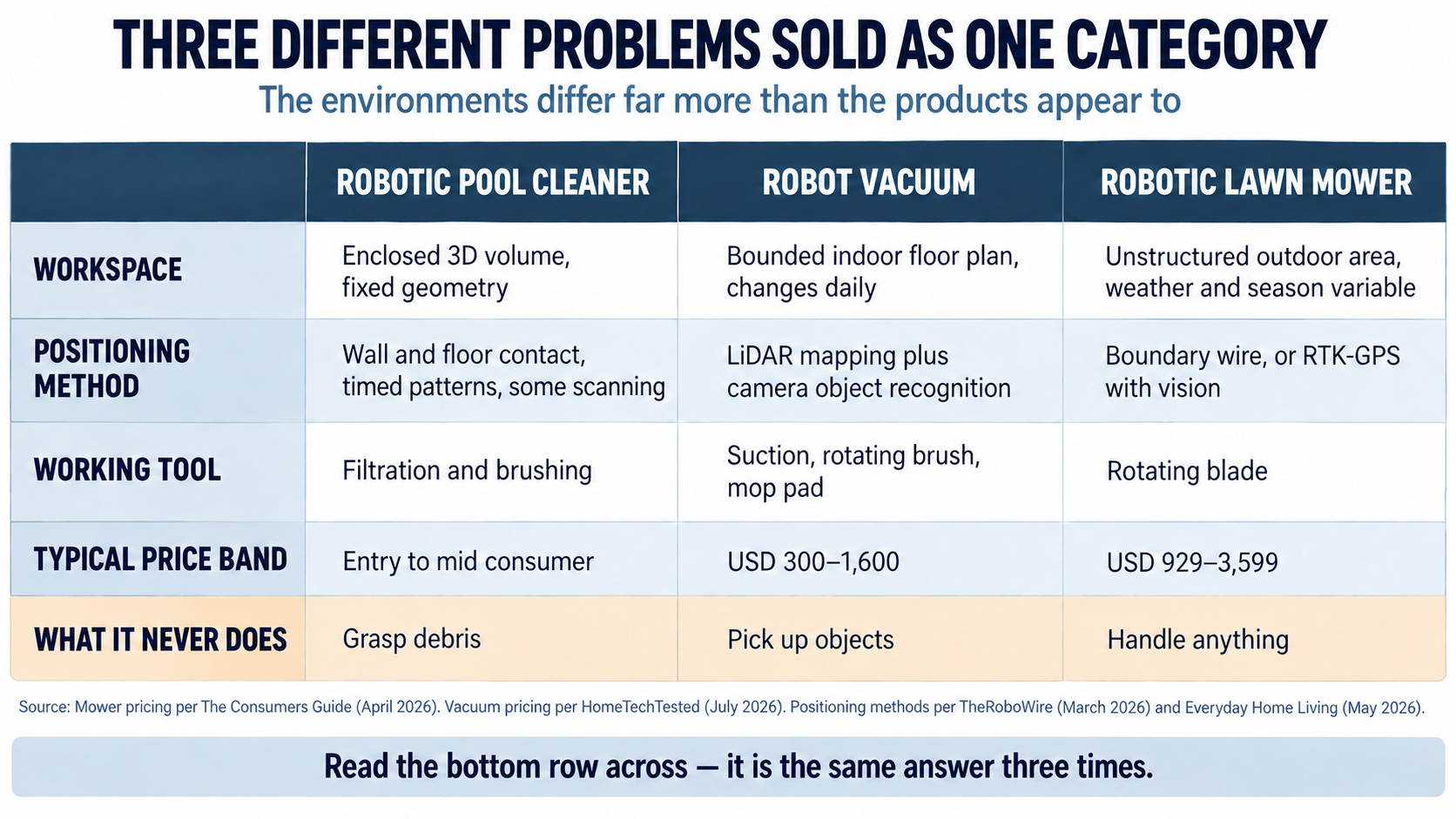
The bottom row of that table is the one that explains everything else.
Why These Tasks and Not Others
A robot vacuum does not pick up a sock. It routes around it. Roborock's StarSight 2.0, introduced on the Saros 20 in early 2026, recognises over 300 object types specifically so the machine can avoid them, per Everyday Home Living (May 2026). The entire product category is built on identifying objects in order not to touch them.
Why are robot vacuums and lawn mowers so much more successful than other home robots?
They succeeded because their tasks require covering an area rather than handling objects, and object handling is robotics' hardest unsolved problem. A vacuum uses suction, a mower uses a spinning blade, and a pool cleaner uses filtration — none needs to grip anything. Coverage of a bounded space with a passive tool is a tractable engineering problem, which is why Roborock alone shipped 5.8 million cleaning robots in 2025 according to IDC data reported in March 2026, while general-purpose home robots remain at demonstration stage.
The three tasks share a second property that matters as much as the first: the cost of failure is trivial. A vacuum that misses a corner is annoying. A mower that stalls is inconvenient. A pool cleaner that leaves a patch is invisible. No certification regime governs any of them, no liability attaches to imperfect performance, and the manufacturer can therefore ship, learn, and iterate at consumer speed rather than industrial speed.
These categories routed around the embodiment gap rather than closing it. They sell because they never grasp.
Why the Lawn Is the Hardest Problem Being Sold
Boundary wire installation takes two to four hours for an average yard, per TheRoboWire (March 2026), and the industry has spent five years engineering it away. The replacement is RTK-GPS positioning with centimetre-level accuracy, and the fastest-growing segment of the mower market is now wire-free.
The trouble is that satellite positioning fails in exactly the conditions gardens produce. RTK positioning fails under heavy tree canopy, beside metal roofs, and in narrow side yards, per season-long field testing published by Lawnmowers.com in June 2026 — and the difficulty ranking in Figure 2 explains why the lawn is the hardest of the three.
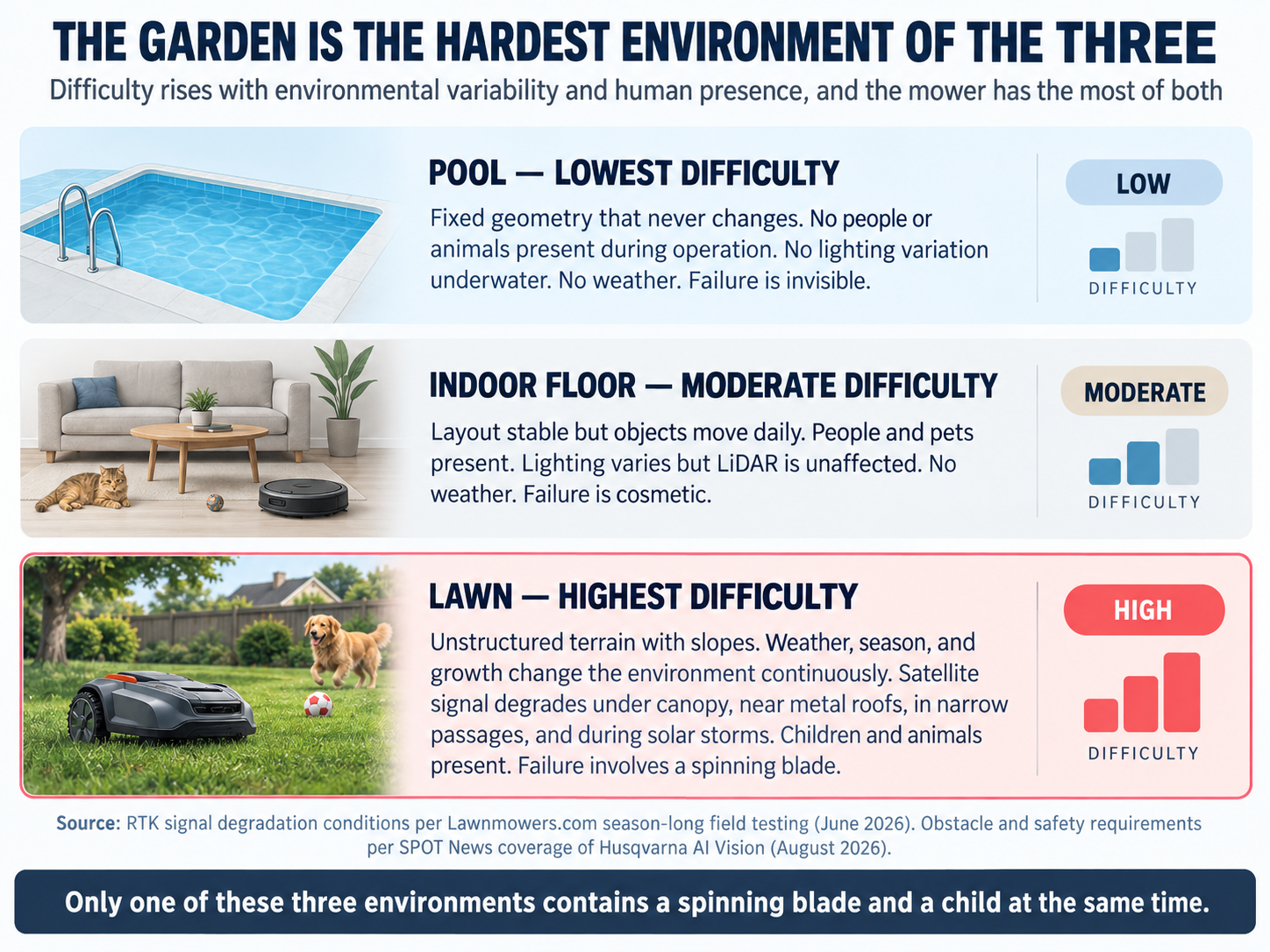
That is a sensor stack, on a consumer product, operating unsupervised outdoors among children and pets. It is worth pausing on how unusual that is.
What the Big Companies Are Actually Buying
Nobody bought an iPhone in 2007 for the camera. But shipping hundreds of millions of camera modules a year funded the image sensors, the signal processors, and the computational photography stack that now underpins automotive vision and medical imaging. The module was never the point. The volume was.
Dreame unveiled a robot vacuum with a retractable claw at CES 2026 and Ecovacs unveiled a robot dog at the same show, and the category-and-capability map in Figure 3 shows how few of these brands stay in one lane.
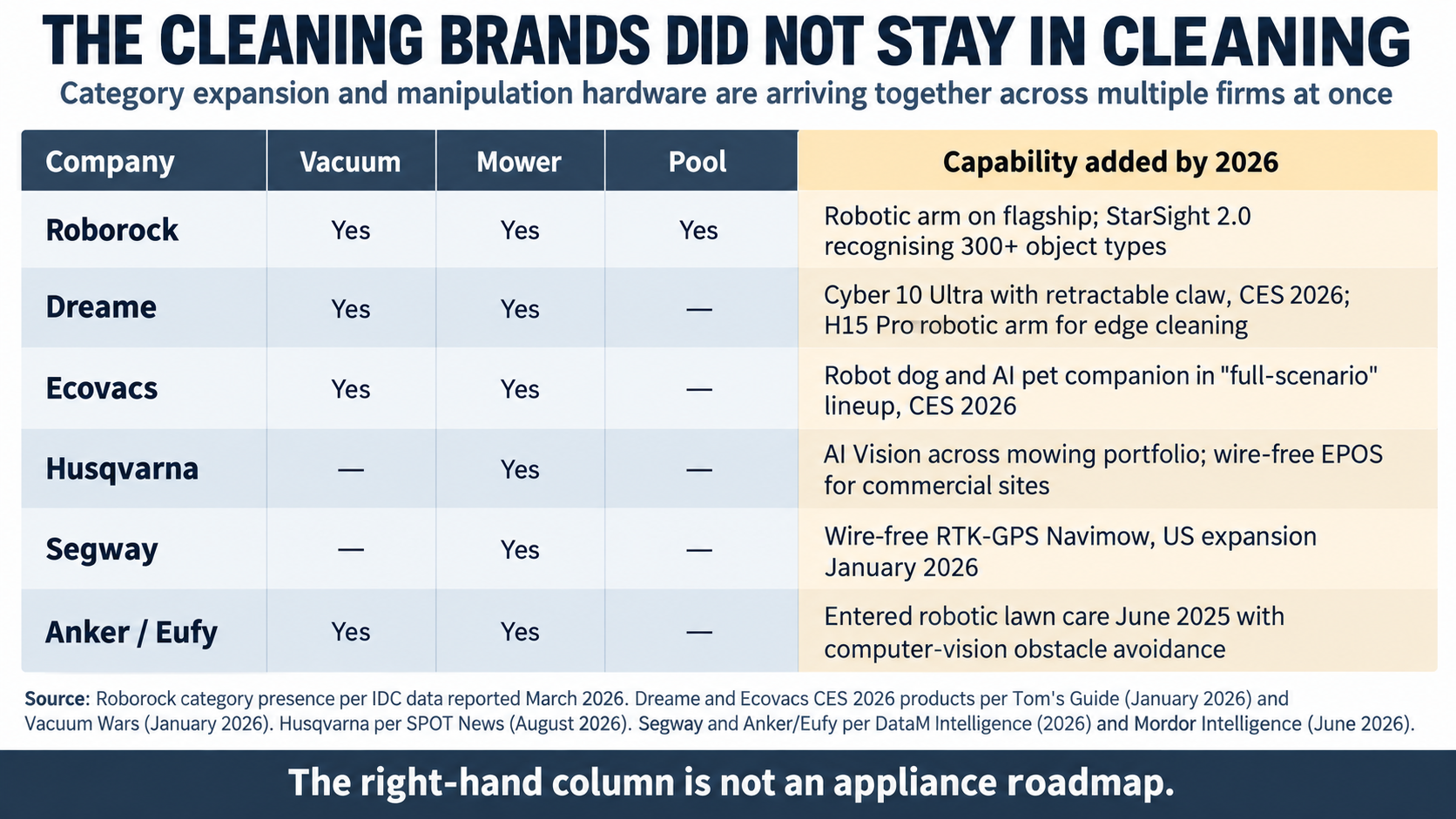
A claw does not clean a floor better than suction does — it does something a floor-cleaning product has no need to do, which is why its appearance on a flagship vacuum is a statement about the roadmap rather than the product. The same reading applies to a robot dog inside a cleaning company's CES booth.
What the installed base provides is the thing no robotics lab can buy: millions of hours of navigation, mapping, and obstacle handling in real, uncontrolled environments, paid for by the customer.
Appliance Business or Platform Play
The appliance reading: a category settling into a replacement cycle
GM Insights describes the robotic vacuum market decelerating from its historic growth rate, reflecting a shift from first-time adoption toward replacement, premiumisation, and feature-led upgrades in established markets. The competitive structure it reports is moderately fragmented — Roborock at 17.0% revenue share in 2025, Ecovacs at 11.5%, SharkNinja at 10.5%, Dreame at 7.5%.
That is a recognisable pattern. Four brands holding roughly 46% between them, competing on suction figures and dock features at declining growth, is how dishwashers and microwaves behaved. The reading is well-evidenced and the replacement dynamic is genuine.
The platform reading: manipulation hardware nobody needs for cleaning
The counter-evidence is what the same firms shipped. Three of the leading Chinese cleaning brands each added capability at CES 2026 that does nothing for cleaning — a claw, an arm, a quadruped. Three independent marketing decisions is a less parsimonious explanation than three firms reading the same strategic map.
Roborock's presence across vacuum, mower, and pool categories simultaneously points the same way. A company optimising an appliance line does not enter three environments at once; a company building a positioning and perception stack does, because each environment teaches the stack something the others cannot.
The two readings disagree about which asset is being built rather than about the facts. If the product is the asset, the appliance reading holds and the category matures on a replacement cycle. If the asset is the navigation stack and an installed base generating mapped-environment data at consumer scale, the appliance business is the funding mechanism and the margin pressure is a cost of capital rather than a problem. There is no published sell-through data on the claw-equipped models as of August 2026, which means both readings are currently arguments from intent — and the first quarter that reports volume on a manipulator-equipped vacuum will settle more of this than any amount of strategic inference.
This development reinforces:
- Where Robots Are Used: The pillar covering deployment contexts, including why the domestic environment has proven more tractable for autonomy than most industrial ones.
- Why Robots Struggle With Common Sense — and Why That Matters: The embodiment gap explains why manipulation stayed unsolved while coverage tasks scaled to millions of units.
- Who Owns Robot Data: Millions of mapped homes and gardens are an operational dataset, and the question of who holds it applies to consumer robots exactly as it does to industrial ones.
The scattered hose and the abandoned ball on the lawn are the whole problem in miniature. A mower has to see them, decide what they are, and route around them, outdoors, in changing light, with a blade spinning underneath — and it has to do it for under a thousand dollars because that is what the category will bear. Husqvarna and Mammotion are solving that with LiDAR, RTK positioning, and camera-based recognition on a garden appliance, which is a sensor stack that would have been a research platform a decade ago. The three categories reached scale by declining to pick anything up. The interesting question, now that Dreame has put a claw on one, is what happens the first time one of these machines is asked to.
Frequently asked questions
1. What is a cleaning robot?
A cleaning robot is an autonomous machine that covers a defined area applying a fixed tool — suction indoors, filtration in a pool, a rotating blade on a lawn. The three main consumer categories are robot vacuums, robotic pool cleaners, and robotic lawn mowers. IDC tracks each as a separate quarterly market, and Roborock reported 5.8 million shipments across them in 2025.
2. How do robot vacuums know where they are?
Most premium robot vacuums use LiDAR to build a floor map, paired with cameras for object recognition. Roborock's PreciSense LiDAR maps in total darkness, and its ReactiveAI 3.0 system combines dual RGB cameras, structured light, and Qualcomm AP-8053 neural processing to identify household objects, per BrandChoose (July 2026). StarSight 2.0, introduced on the Saros 20 in early 2026, recognises over 300 object types.
3. Do robotic lawn mowers still need a boundary wire?
No — wire-free models using RTK-GPS are now the fastest-growing segment. Traditional boundary wire takes two to four hours to install for an average yard, per TheRoboWire (March 2026), while RTK systems achieve centimetre-level positioning with the area defined in an app. Segway, Mammotion, Husqvarna NERA, and WORX all offer wire-free models, with entry options under USD 1,000.
4. Are robotic pool cleaners worth it compared to vacuums and mowers?
Robotic pool cleaners solve the simplest of the three problems, which is why they work reliably. The pool is a fixed geometry that does not change between cleanings, no people or animals are present during operation, weather is irrelevant underwater, and a missed patch is invisible. IDC runs a dedicated Pool Cleaning Robotics tracker, and the category was among the faster-growing segments in 2025.
5. Which companies lead the cleaning robot market?
Roborock led smart cleaning robots overall in 2025 with 17.7% share and 5.8 million shipments, per IDC. On robotic vacuum revenue share, GM Insights placed Roborock at 17.0% in 2025, Ecovacs at 11.5%, SharkNinja at 10.5%, and Dreame at 7.5%. In robotic mowers, Husqvarna Group and STIGA Group jointly hold an estimated 45–50% combined revenue share per Fairfield Market Research (July 2026).
6. Can robot vacuums pick things up?
Standard robot vacuums cannot — they identify objects specifically to route around them. That changed at CES 2026, where Dreame unveiled the Cyber 10 Ultra with a retractable claw after teasing it for over a year, per Tom's Guide (January 2026), and Roborock ships a robotic arm on its flagship. No published sales data on these manipulator-equipped models exists as of August 2026.
7. What happens to the map a robot vacuum makes of my home?
The map is stored by the device and typically synced to the manufacturer's app and cloud service, which is what enables room-level settings and scheduling. Mapping and camera technology in advanced models raises privacy considerations that vary by manufacturer and jurisdiction, as noted by Maximize Market Research (2026). Anyone concerned should check the specific manufacturer's data retention and processing terms before purchase.