Worldmodeldata Secures £7M Seed to Build Gaming Data Supply Chain
Cambridge-based Worldmodeldata emerges from stealth with a £7M seed round to aggregate licensed video game data for robotics training, targeting a critical bottleneck in physical AI development.

Cambridge-based Worldmodeldata emerged from stealth on July 6, 2026, with a £7 million (approximately $8.9 million) seed round to address a critical constraint in physical artificial intelligence. Led by Iona Star Capital, the funding will accelerate the startup's effort to aggregate and structure licensed gameplay data from modern video games into training datasets for physical AI and world models [1].
The physical AI industry is confronting a severe supply chain bottleneck, and it is not silicon or actuators. It is data. While large language models were trained by scraping the internet for text, robotics developers lack a comparable repository of physical interactions.
The Data Supply Chain for Physical AI
Worldmodeldata was founded in late 2025 by Rhea Loucas, a veteran with four to five years of experience in the video game industry who recognized the limitations of current AI training methods [1]. The company's core premise is that modern video games, with their complex physics engines and interactive environments, offer a massive, untapped reservoir of structured data demonstrating cause and effect.
The startup's immediate objective is to aggregate 1 million hours of gameplay data by the end of 2026. If achieved, this would represent a 25-fold increase over the current largest available dataset, which stands at approximately 40,000 hours according to company claims [1].
The £7 million seed round, which closed in December 2025 but was kept quiet during a seven-month stealth period, provides the capital necessary to build this infrastructure. The company has also appointed Lord Richard Allan, a former Meta vice president of public policy for EMEA, as its non-executive chairman, signaling a focus on data governance and licensing compliance [1]. The current team consists of approximately 10 people, including advisors and contractors [1].
Market Context and Competitive Dynamics
The market for synthetic and licensed training data is expanding rapidly. Mordor Intelligence projects the sector will grow from $710 million in 2026 to $3.67 billion by 2031, representing a compound annual growth rate of 39% [1].
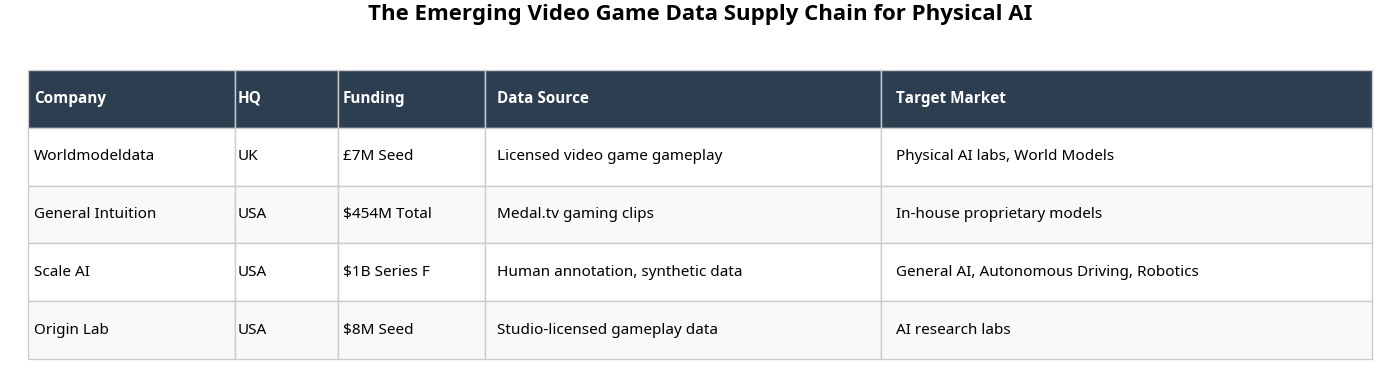
Worldmodeldata is positioning itself as a pure-play data provider, likening its model to Scale AI for the physical AI era. This strategy contrasts with competitors like General Intuition, a Medal spin-off that has raised $454 million across two rounds and recently reached a $2.3 billion valuation. While General Intuition keeps its gaming data in-house to build and sell proprietary models, Worldmodeldata intends to supply the broader ecosystem of robotics and AI developers [1].
Another notable competitor is San Francisco-based Origin Lab, which raised an $8 million seed round in May 2026 and claims partnerships with over 20 game publishers [1]. The emergence of multiple well-funded startups in this niche confirms that investors view gaming data as a critical enabler for the next generation of AI.
 The Real Constraint in Robotics Development
The robotics industry has historically focused on hardware engineering, improving motors, sensors, and battery life. However, as the focus shifts toward general-purpose humanoids and adaptable industrial systems, the primary constraint has become software, specifically the AI models that govern perception, decision-making, and control.
Training these models requires vast amounts of data demonstrating how objects behave, how environments respond to actions, and how complex tasks are sequenced. Real-world data collection via teleoperation or physical trials is slow, expensive, and difficult to scale. Simulation environments are useful but often lack the diversity and edge cases found in the real world.
Video games offer a middle ground: highly diverse, interactive environments governed by consistent physics rules, generating massive volumes of structured data as millions of players interact with them daily. By capturing and formatting this data, companies like Worldmodeldata aim to provide the foundational training material for physical AI systems.
The challenge for robotics developers is that the physical world is infinitely complex. A robot operating in a warehouse must understand that a cardboard box behaves differently when it is empty versus when it is full of heavy metal parts. It must recognize that a wet floor offers less traction than a dry one, and that a fragile item requires a different grip strength than a robust one. These nuances are difficult to capture through traditional programming or limited real-world data collection.
Video games, particularly those with advanced physics engines, simulate many of these interactions. When a player in a game throws an object, the game engine calculates the trajectory based on simulated mass, velocity, and gravity. When a character walks on different surfaces, the game engine adjusts the friction and movement speed accordingly. By extracting this data, Worldmodeldata aims to provide a foundational understanding of physics and object interaction that can be transferred to real-world robots.
The Challenge of Generalization
While video game data offers a promising solution to the data scarcity problem, it is not without limitations. The primary challenge lies in the "sim-to-real" gap, the discrepancy between simulated environments and the physical world. Even the most advanced physics engines in modern video games cannot perfectly replicate the complexities of real-world friction, material properties, and unpredictable environmental factors.
In addition, the actions performed by characters in video games are often stylized or simplified for gameplay purposes, which may not directly translate to the precise movements required by physical robots. For example, a character picking up an object in a game might not require the same level of fine motor control and tactile feedback as a robotic arm performing the same task in a factory setting.
To address these challenges, companies like Worldmodeldata must develop sophisticated methods for filtering, augmenting, and translating gameplay data into formats that are useful for training physical AI models. This process involves not only extracting the visual and physical information from the games but also mapping it to the specific kinematic and dynamic constraints of different robotic platforms.
The success of this approach will depend on the ability to bridge the sim-to-real gap effectively. If the data extracted from video games is too abstracted or inaccurate, it could lead to unpredictable or unsafe behavior in physical robots. Therefore, rigorous testing and validation in real-world environments will remain a critical component of the development process.
The reliance on licensed video game data also introduces potential legal and ethical considerations. Game publishers hold the intellectual property rights to their games, and the use of gameplay data for commercial AI training requires clear licensing agreements. Worldmodeldata's appointment of Lord Richard Allan, with his background in public policy, suggests a proactive approach to working through these complex issues [1].
Procurement Implications
For automation buyers and operations leaders, the emergence of a robust data supply chain for physical AI has significant implications. The speed at which robotics vendors can improve their systems' adaptability and common sense will depend heavily on their access to high-quality training data.
When evaluating robotics vendors, procurement teams should look beyond hardware specifications and inquire about the vendor's data strategy. Vendors that rely solely on slow, manual data collection may struggle to keep pace with competitors leveraging massive synthetic or licensed datasets. The ability to rapidly train and refine models using diverse data sources will become a key differentiator in the deployment readiness of autonomous systems.
The £7 million seed round for Worldmodeldata is an indicator of where the physical AI industry is directing its resources. The bottleneck has shifted from hardware design to data acquisition. The companies that successfully build the data supply chain for physical AI will wield significant influence over the development of the entire robotics ecosystem. Just as access to massive text datasets defined the winners in the large language model era, access to structured physical interaction data will define the leaders in the embodied AI era.
The shift towards data-centric robotics development also means that the lifecycle of robotic systems will change. Instead of static machines that perform a fixed set of tasks, future robots will be continuously updated and improved through over-the-air software updates, driven by ongoing training on new datasets. This continuous learning capability will require procurement teams to consider the long-term software support and data infrastructure of the vendors they choose.
In addition, the integration of physical AI into industrial and commercial settings will necessitate new approaches to safety and compliance. As robots become more autonomous and adaptable, ensuring that they operate safely in dynamic environments will be paramount. The quality and diversity of the training data will play a crucial role in determining the reliability and safety of these systems.
The investment in companies like Worldmodeldata highlights a fundamental shift in the robotics industry. The focus is moving from the physical components of the robots to the digital infrastructure that powers their intelligence. For procurement professionals, understanding this shift and evaluating vendors based on their data capabilities will be essential for making informed purchasing decisions in the era of physical AI. This evolution underscores the critical need for a robust, scalable, and legally compliant data supply chain to support the next generation of intelligent automation systems across various industries worldwide, ensuring that the future of robotics is built on a solid foundation of high-quality, structured data.
References
1. Tech Funding News, "Worldmodeldata lands £7M seed to turn gaming data into AI training," July 6, 2026. https://techfundingnews.com/worldmodeldata-7m-seed-ai-training-data-video-games/