Seoul Puts Government Weight Behind Its First Humanoids Summit
South Korea's government is backing the first Seoul edition of the Humanoids Summit, spotlighting ROBOTIS, Samsung, and Hyundai's coordinated push into physical AI.


Operating profit at ROBOTIS, the Seoul-based actuator and robotics maker, rose 723 percent in the second quarter of 2026 on explosive demand for the precision motors used inside humanoid robots, a single data point that captures why South Korea's government is now putting its own name behind a robotics trade event for the first time. The Humanoids Summit, an industry conference that has run editions in Silicon Valley and London, is holding its inaugural Seoul edition on September 22 and 23 at the COEX Convention Center with official backing from the Ministry of Science and ICT, whose vice minister, Ryu Je-myung, is scheduled to deliver opening remarks alongside a policy presentation from the ministry's Changjong Song on what South Korea now calls its national physical AI strategy.
A government ministry lending a vice minister's opening remarks to a private industry conference is not a routine gesture, and it signals that Seoul is treating humanoid robotics and the broader physical AI category, robots and machines that use AI models to act in the physical world rather than only process text or images, as a coordinated national industrial priority rather than a sector left to individual companies to develop on their own timelines.
The Companies the Government Is Choosing to Stand Behind
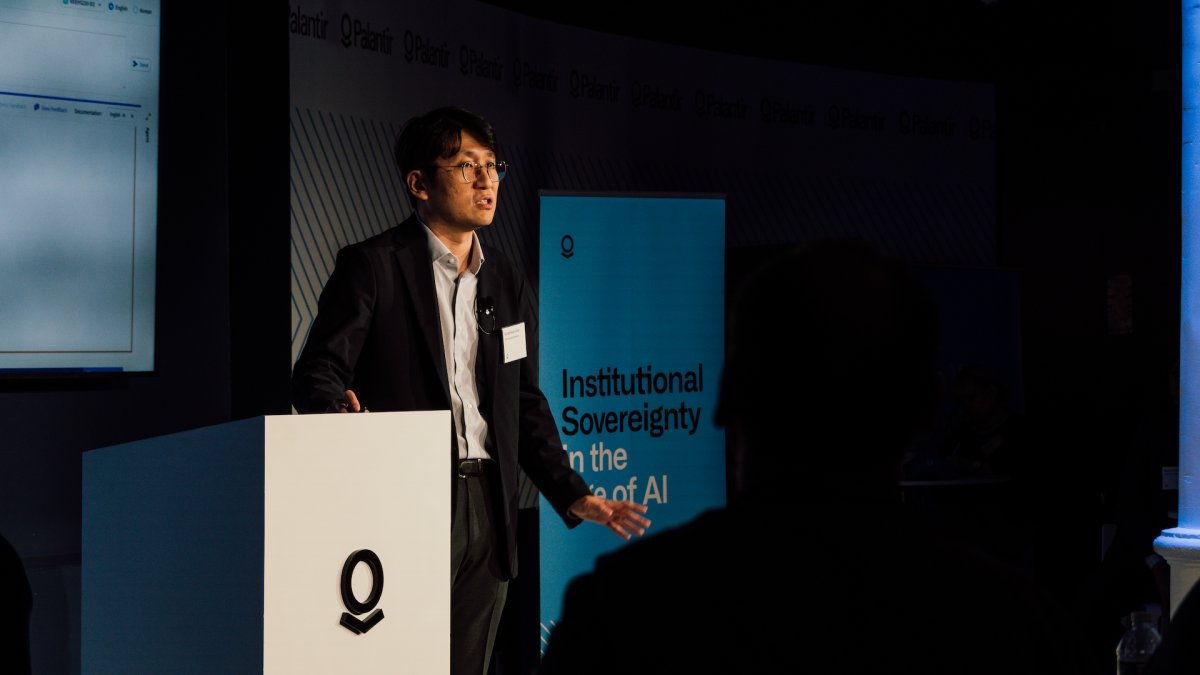
The summit's speaker list doubles as a map of who South Korea's government and its largest conglomerates are betting on to build that industry. ROBOTIS chief executive Byoungsoo Kim, whose company builds the Dynamixel actuator line used across the humanoid robotics industry and recently unveiled its own general-purpose humanoid platform, AI Sapiens, is scheduled to speak alongside Nic Radford, chief executive of Persona AI, a Houston-based humanoid robotics company focused on shipyard and heavy-industry welding tasks, and Junghee Ryu, founder of RLWRLD, a Korean AI robotics startup. Ali Agha of FieldAI, which builds foundation models for industrial robots operating in unstructured environments, rounds out the international presence, while Samsung, LG, NVIDIA, Qualcomm, and AWS are all sending representatives, with NVIDIA and ROBOTIS jointly running a sponsored technical workshop on the summit's sidelines.
That lineup reflects a deliberate strategy rather than a coincidence of scheduling. South Korea's largest industrial conglomerates have already made their humanoid robotics bets concrete well before this summit: Samsung Electronics holds a 20.29 percent stake in Rainbow Robotics, a Korean humanoid and industrial robot maker, since completing that acquisition in March 2025, while Hyundai Motor Group is the majority shareholder of Boston Dynamics and has committed US$26 billion to expanding its United States operations, including a new robotics factory intended to produce 30,000 robots a year. Layering a government-backed conference on top of those existing corporate positions gives South Korea something China and the United States have each pursued in their own ways but that Korea's smaller domestic market makes harder to achieve organically: a forum where policy, capital, and engineering talent converge in one place rather than dispersing across separate corporate roadmaps.
Why ROBOTIS Is the Company to Watch Inside the Room
Of the companies represented on stage, ROBOTIS carries the clearest through-line from the summit's policy framing to actual commercial results. Its 723 percent operating-profit jump was driven specifically by demand for the actuators, the motorized joints that give a robot arm or leg its precise, controllable movement, that sit inside humanoid platforms built by companies far beyond ROBOTIS itself, positioning the company as a component supplier whose fortunes rise with the entire category's growth rather than with any single robot maker's individual success. ROBOTIS has followed that actuator business with its own humanoid ambitions, having committed roughly 88.7 billion South Korean won, approximately US$62 million, to expand into humanoid software and control systems, and having unveiled AI Sapiens, a fully open-source humanoid hardware platform built around a newly developed Dynamixel-Q actuator, in a direct challenge to closed-platform competitors abroad.
Kim has described that open-platform approach explicitly as a strategy to differentiate South Korea's robotics industry from both Tesla's closed hardware and software model and the finished-product-centric approach favored by China's largest humanoid makers, opening ROBOTIS's core components and control source code to build a global developer ecosystem the company calls the K-Robot Ecosystem. That strategy mirrors the developer-first playbook chip and hardware companies elsewhere in the robotics supply chain have used to build switching costs before a market consolidates, betting that a wide base of engineers already building on ROBOTIS's open actuator and software stack becomes harder for closed competitors to dislodge once the category matures.
The Gap Korea Is Trying to Close
South Korea enters this coordinated push from a position that is strong in specific components but thin in overall platform scale compared with its two largest rivals in the physical AI race. China has state-backed manufacturers producing tens of thousands of humanoid units a year across a large and increasingly consolidated field of domestic competitors, while the United States hosts the best-funded humanoid software and foundation-model companies, including Figure AI and a cluster of well-capitalized startups building vision-language-action models comparable to the ones ROBOTIS and RLWRLD are now developing domestically. Korea's advantage sits narrower and deeper: world-class precision-actuator manufacturing at ROBOTIS, chaebol-scale capital and manufacturing integration at Samsung and Hyundai, and a semiconductor and electronics supply base built over decades for consumer devices and memory chips that transfers reasonably well to robotics hardware. What Korea has lacked, relative to Beijing's coordinated industrial planning and Washington's concentration of venture capital, is a single forum or policy vehicle that visibly aligns those pieces toward a shared national outcome rather than leaving each company to pursue its own robotics strategy independently, which is the specific gap this summit's government backing is designed to signal has been closed.
The risk in that framing is that a summit is easier to stage than an integrated supply chain is to build. Samsung's stake in Rainbow Robotics, Hyundai's ownership of Boston Dynamics, and ROBOTIS's actuator and open-platform strategy are three separate corporate bets that do not automatically combine into a coherent national platform simply because their executives share a conference agenda for two days in September. Actual integration, a Samsung-manufactured component reaching a Hyundai-owned robotics platform, or a ROBOTIS actuator standard adopted broadly enough across Korean humanoid makers to create the kind of ecosystem lock-in Kim has described, requires commercial agreements and engineering integration work that a government-endorsed conference can encourage but cannot substitute for.
What a Coordinated National Push Actually Buys
The practical argument for government coordination in a capital-intensive, hardware-heavy sector like humanoid robotics is that no single Korean company, even one as large as Samsung or Hyundai, controls enough of the supply chain, from actuators and sensors to the AI models that control them, to compete alone against the vertically integrated approaches emerging in the United States and China. A government-endorsed venue that puts ROBOTIS's actuator expertise, Samsung and Hyundai's manufacturing and capital resources, NVIDIA's compute platform, and a policy framework from the Ministry of Science and ICT in the same room over two days is, in effect, an attempt to compress years of arm's-length corporate coordination into a faster, state-facilitated alignment process. The Ministry has described the summit as a meaningful venue for international exchange in support of the country's national strategy for physical AI and robotics, language that positions Seoul explicitly as trying to establish itself as a hub for global physical AI commercialization rather than simply cheering on its domestic champions from the sidelines.
Whether that coordination produces results measurably different from what Samsung, Hyundai, and ROBOTIS would have achieved independently is the question that will not be answered by the summit itself, since a two-day conference generates visibility and relationship-building rather than shipped product. The more useful marker for procurement teams and investors watching South Korea's robotics sector will be whether the specific partnerships publicly floated around this event, particularly any deepening of the ROBOTIS-NVIDIA technical collaboration showcased in the sidelined workshop, produce concrete joint product announcements over the following two to three quarters, the timeframe in which a genuinely accelerated national push should start showing results that a purely market-driven, uncoordinated approach would have taken longer to reach.
South Korea's government has made its industrial bet on humanoid robotics explicit by putting a vice minister on stage next to the chief executives actually building the hardware. The 723 percent jump in ROBOTIS's actuator profits is the evidence that the underlying commercial demand driving that bet is real, not merely aspirational; whether Seoul's coordinated approach turns that demand into a durable domestic industry, rather than a supply chain that still depends on components, compute, and capital sourced from outside Korea, is the question the next several quarters of partnership announcements will settle.
For component buyers and integrators outside Korea, the more immediate signal from this week's announcement is where to look for a credible alternative actuator and open-hardware supplier as the humanoid category matures beyond a handful of vertically integrated Chinese and American platforms. A buyer wary of depending entirely on a single country's supply chain for a critical, hard-to-substitute component like a precision actuator now has a government-endorsed domestic champion in ROBOTIS actively courting exactly that diversification demand, and the summit's NVIDIA-ROBOTIS workshop is as much a pitch to that international buyer base as it is a domestic policy showcase.
This analysis draws on public statements from South Korea's Ministry of Science and ICT, ROBOTIS, Samsung Electronics, and Hyundai Motor Group regarding the Humanoids Summit Seoul and related corporate robotics investments. It is for general information purposes only and does not constitute investment, financial, or legal advice.
Hero image credit: Rainbow Robotics.