Pudu launches 2,000 kg AI-native pallet robot for industrial logistic
Pudu Robotics has launched the PUDU MP2000, an AI-native pallet-handling robot designed to move loads between floors in warehouses, logistics facilities, and factories. The company says the robot can carry loads of up to 2,000 kg, deploy quickly, recognize varied load carriers, and coordinate fleets even when external network connectivity is unavailable.
What the MP2000 changes
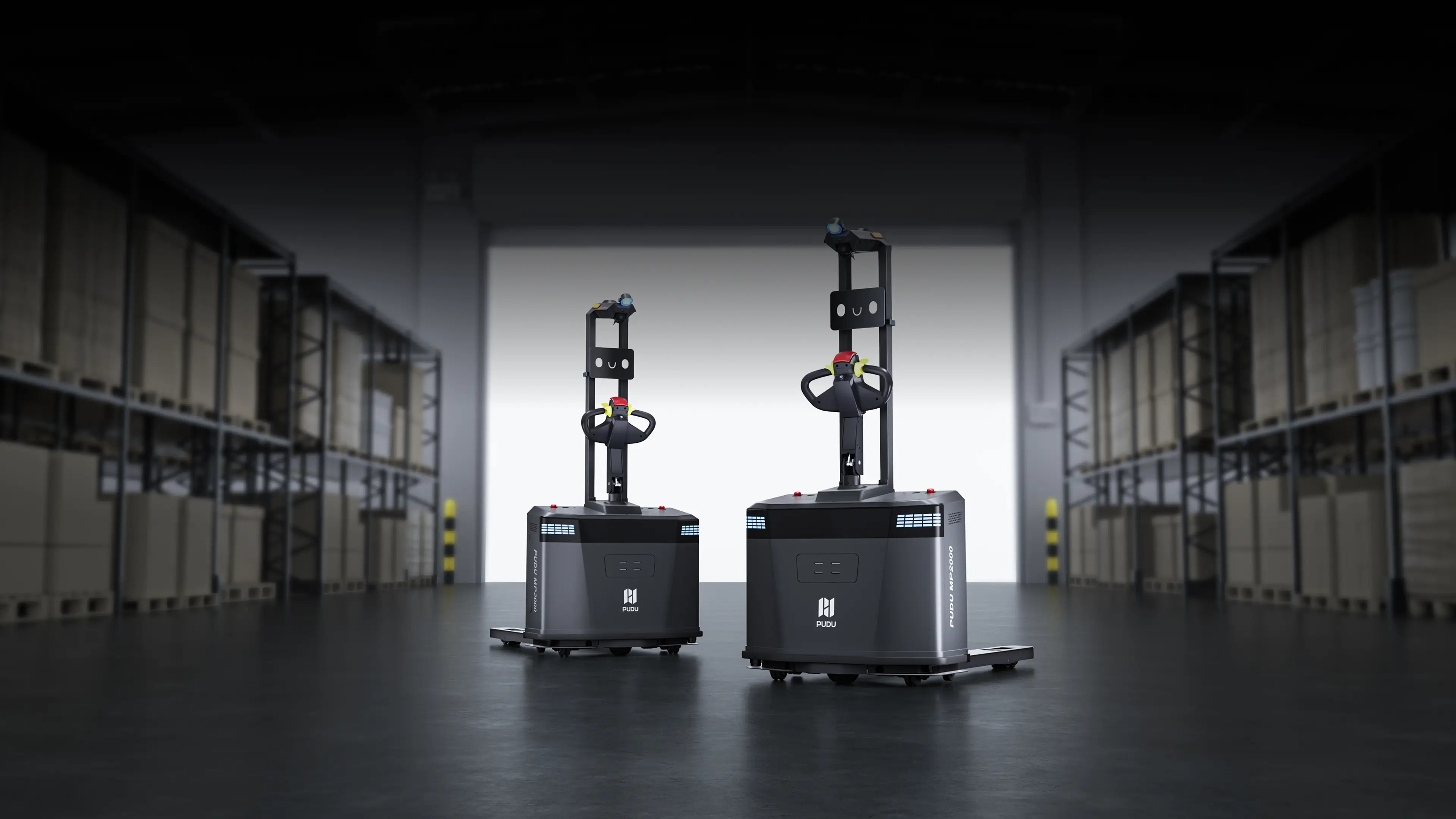
Pudu Robotics has introduced the PUDU MP2000, an AI-native pallet-handling robot built for autonomous floor-to-floor material transport. The company says the system can carry up to 2,000 kilograms, recognize standard and customized load carriers, navigate changing warehouse conditions, and coordinate with other robots without requiring extensive site modifications. The launch illustrates one application of physical AI: using perception and decision-making for repetitive industrial logistics tasks.
A robot aimed at the warehouse’s heavy, repetitive middle
Pudu Robotics is a Shenzhen-based commercial robotics company whose portfolio spans service, cleaning, delivery, industrial, and embodied-AI systems. The MP2000 extends that portfolio into heavier palletized transport. The MP2000 is aimed at operations that need to move loads between loading docks, warehouse aisles, production lines, and staging areas with less infrastructure work than a large fixed automation project.
That distinction matters. Pallet movement is a high-frequency task, but it is rarely a single, perfectly repeatable motion. Load carriers vary. Storage locations become occupied. Pallets may be placed slightly off-center or at an angle. People, forklifts, carts, and other machines change the route. Pudu’s product positioning is that an AI-native system can interpret these variations onboard and adapt without relying entirely on markers, reflectors, or a rigid facility layout.
Plug-and-play deployment is the commercial argument
Pudu says the MP2000 uses multi-sensor navigation, edge intelligence, and AI-native perception to reduce the preparation normally associated with autonomous forklift projects. The company describes rapid mapping and minutes-level deployment without extensive site modifications, dedicated reflectors, QR codes, or complex platform integration.
In practical terms, that means the customer’s first question is not only whether the robot can pick up a pallet. It is whether the robot can be introduced into an operating facility without a long construction and commissioning cycle. A faster deployment path could reduce disruption for manufacturers and make it easier for logistics operators to add capacity incrementally.
The official product page also says the MP2000 can detect storage occupancy, identify pallet positions, select a destination, and plan a route for each pickup or drop-off. It can adapt to pallets that are offset by up to 15 centimeters or angled by up to 15 degrees, according to Pudu’s product specifications. Those are company-reported capabilities, not independent performance results, but they identify the operating conditions the product is designed to address.
Perception, handling speed, and fleet coordination
The MP2000’s sensing system combines three-dimensional light detection and ranging, or 3D LiDAR, depth cameras, and other sensors. Pudu says this multi-layer system can identify people, equipment, and obstacles in real time, detect low and overhead hazards, reroute around static obstacles, and stop or avoid moving obstacles.
For pallet engagement, the company says fork insertion can be completed in as little as 20 seconds. The product page lists a maximum unloaded speed of 1.6 meters per second and a loaded speed of 1.2 meters per second. Pudu also says the robot can operate in right-angle stacking aisles as narrow as 2 meters, with pallet spacing down to 15 centimeters.
Those figures are relevant because a pallet robot competes against the total cycle time of a logistics process, not against a laboratory benchmark. A fast fork insertion is useful only if the robot can also find the correct pallet, approach it safely, complete the lift, and deliver the load without repeated operator intervention.
Pudu further describes a distributed fleet architecture. Each robot can make decisions and plan routes locally, while inter-robot communication coordinates the wider fleet. The company says fleet coordination can continue even when external network connectivity is unavailable. Tasks can be dispatched through PUDU Link, application programming interfaces, voice commands, or task buttons, with optional connections to elevators, automatic doors, and other Internet of Things devices.
The simple version
Imagine a warehouse where pallets need to move from receiving to storage, from storage to a production line, or from a production line to shipping. Instead of installing a fixed conveyor network or rebuilding the site around a large autonomous-forklift project, an operator could map the facility, define tasks, and let MP2000 units handle routine moves. The robot uses cameras, LiDAR, onboard computing, and fleet software to decide where to go, how to engage the load, and when to ask for human help.
What remains to be demonstrated
A product launch, however, is not the same as a verified deployment record. Pudu’s announcement provides a detailed description of the MP2000, but it does not disclose customer names, installed fleet size, delivered units, independent safety testing, achieved uptime, or a total cost of ownership. It also does not state a purchase price or a confirmed commercial availability schedule in the public release reviewed for this draft.
The company’s claims about minutes-level deployment, adaptive alignment, offline fleet coordination, and 20-second fork insertion should therefore be treated as product specifications and positioning statements until independent users or testing organizations report results in live facilities. The decisive questions for buyers will be different from the questions in a launch announcement: How often does the system require intervention? How does it behave around damaged pallets? What happens when a load is unstable? How are software updates validated? What support response is available when a fleet stops during a production shift?
A comparison between the stated design and the unresolved proof points makes the gap clear:

Why this launch matters for physical AI
The MP2000 is a useful signal because it applies the physical-AI conversation to a defined commercial workflow. Physical AI is often discussed through humanoids, foundation models, and demonstrations of general-purpose manipulation. Industrial adoption may advance through narrower systems that combine perception, planning, fleet management, and measurable task economics.
That does not make the MP2000 a humanoid or a universal robot. It makes the product a test of whether AI-native autonomy can improve a familiar machine category. The robot still needs a payload, a fork, a safe route, a charging plan, and a service model. The intelligence is valuable only when it reduces the work required to deploy and operate those physical components.
The launch also shows why deployment flexibility is becoming a competitive feature. Warehouses and factories are not static software environments. Their aisles change, pallets are imperfect, human workers move through them, and customer demand changes the workflow. A system that can adapt to those conditions without a large facility redesign has a chance to fit into existing operations. A system that requires every site to become a custom engineering project will face a slower path to scale.
A measured next step for warehouse automation
Pudu’s MP2000 launch does not prove that autonomous pallet handling has become solved. It does show where the company believes the next commercial opportunity lies: heavier loads, faster deployment, flexible perception, and coordinated fleets that can be added to industrial operations without a complete rebuild.
For logistics operators, the most important test will be the transition from specifications to evidence. If MP2000 deployments demonstrate reliable pallet engagement, low intervention rates, safe mixed-traffic behavior, and predictable service costs, the product could become a meaningful bridge between conventional forklifts and more ambitious physical-AI systems. If those conditions are not met, the launch will remain a well-described product concept rather than a proven operational platform.
The immediate news is straightforward. Pudu has launched a 2,000 kg AI-native pallet-handling robot and is targeting one of the most repetitive and expensive movement problems in warehouses and factories. The next story should be written by the facilities that use it.
This analysis synthesizes company statements and public product information; figures reflect disclosures available as of the information cut-off of August 18, 2026.
Disclaimer: This article is for general information purposes only and does not constitute investment, legal, or procurement advice. Readers should verify details with primary sources before making business decisions.