Palladyne AI and FANUC America Team Up on Robot AI
Palladyne AI and FANUC America will jointly optimize Palladyne's IQ embodied-AI software on FANUC's industrial robot arms, targeting adaptive motion planning and teleoperation to cut the custom integration work manufacturing and logistics deployments currently require.


Palladyne AI and FANUC America announced a strategic collaboration Tuesday to pair FANUC's industrial robot arms with Palladyne's embodied AI software, aiming to let manufacturing and logistics customers deploy adaptive robotic automation without the custom integration work that currently gates most projects. The companies will jointly optimize Palladyne's IQ software platform on FANUC's robot lineup, develop AI-driven motion planning and teleoperation tools, and validate the combined system against real customer use cases in manufacturing, warehousing, and logistics settings. Neither company disclosed financial terms, a development timeline, or named launch customers in the announcement, which was issued from Palladyne's Salt Lake City, Utah headquarters.
Palladyne AI, spun out of the robotics and human-simulation work formerly housed inside Sarcos Technology and Robotics Corporation, builds Palladyne IQ, a software layer intended to give industrial and collaborative robots the perception, adaptive motion planning, and autonomous decision-making that most robot arms lack out of the box. The company has spent the past two years selling that software primarily into defense and aerospace autonomy contracts, including US Air Force-funded work, alongside a smaller push into unmanned aerial systems. FANUC America, the US arm of Japan's FANUC Corporation, is by contrast one of the industrial robotics industry's most established hardware suppliers, with an installed base that spans automotive welding cells to warehouse palletizing lines. The pairing puts a young, defense-tested autonomy company's software on top of one of the most conservative and widely deployed robot arm catalogs in the world.
The Integration Cost the Deal Is Actually Targeting
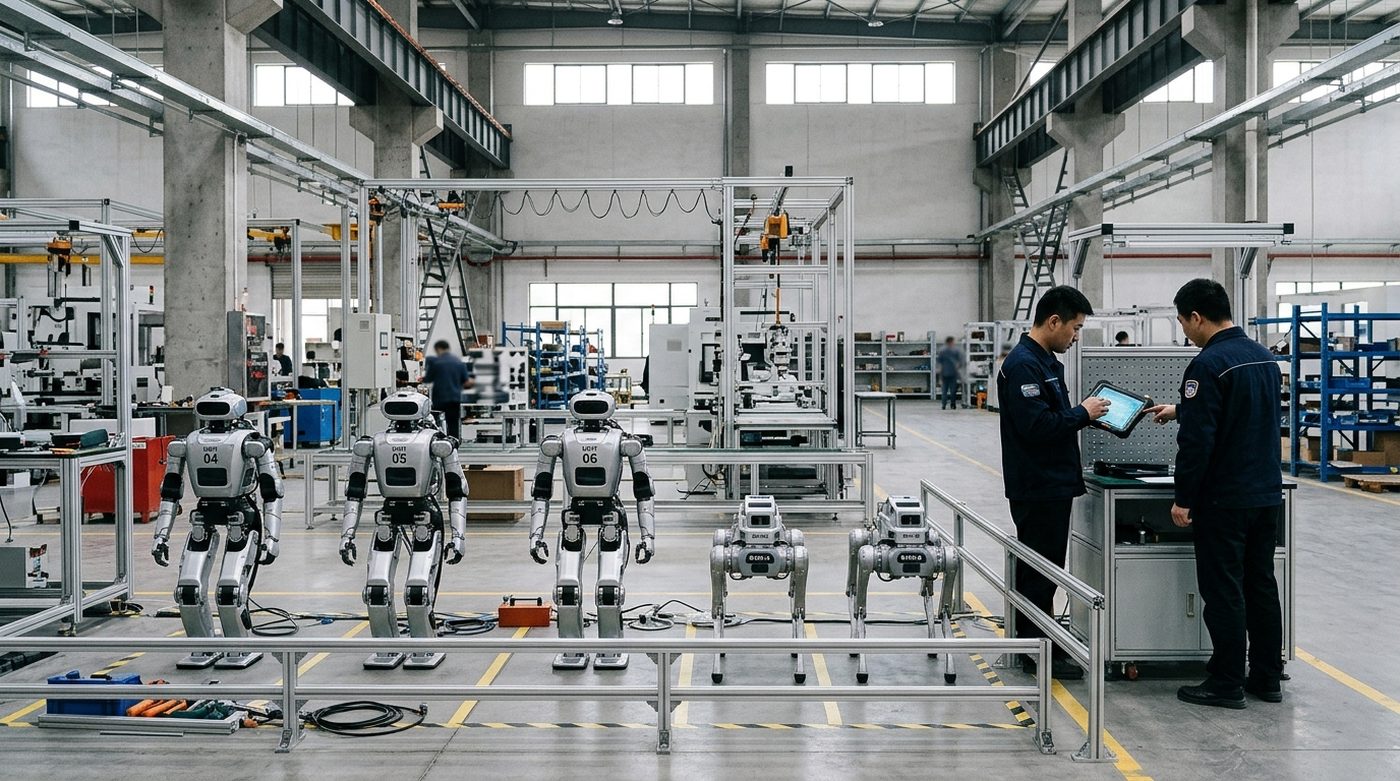
Industrial robot arms have shipped with capable motion-control hardware for decades; the persistent bottleneck has been the software layer that lets a robot adapt to a task it was not explicitly programmed for, whether that means picking a part that has shifted position, recovering from an unexpected obstruction, or handling a product variant the original programming never anticipated. Manufacturers have historically closed that gap with custom integration work, hiring systems integrators to write bespoke vision and motion-planning code for each specific cell, a process that can take months and rarely transfers cleanly to the next product line. Palladyne's pitch is that Palladyne IQ replaces a meaningful share of that bespoke work with a reusable software layer that adds perception and adaptive behavior on top of the robot's native motion controller, in principle shortening the path from a FANUC arm arriving on a factory floor to that arm running a production task that involves real-world variability.
Whether that promise holds up under FANUC's own customer base is the open question this announcement does not yet answer. FANUC's installed base skews toward high-volume, highly repeatable tasks, welding, machine tending, and palletizing, where the economic case for a robot has traditionally rested on doing the same motion thousands of times with minimal variation, not on handling novelty. Palladyne IQ's value proposition is strongest precisely where that repeatability breaks down: mixed-SKU warehouse picking, small-batch manufacturing, or any task where product variation defeats a hard-coded motion program. The collaboration's success will depend on whether FANUC's existing customers, many of whom bought FANUC arms specifically because their process does not require adaptive intelligence, actually have latent demand for the flexibility Palladyne is selling, or whether the partnership mainly opens new accounts that neither company currently serves well alone.
Teleoperation as the Bridge to Full Autonomy
The inclusion of teleoperation and human-assisted learning in the collaboration's stated scope is a more concrete signal than the motion-planning language surrounding it. Teleoperation, where a human operator remotely guides a robot through a task while the underlying software records the motion as training data, has become the dominant near-term strategy across the physical AI sector for building the datasets that eventually let a robot perform a task autonomously. Rather than promising that FANUC arms running Palladyne IQ will handle novel tasks autonomously on day one, the more credible near-term deliverable is a system where a human operator can remotely step in when a robot encounters a case its training has not covered, with each intervention becoming additional training data that narrows the autonomy gap over time. That is a materially different, and more honest, deployment path than a pure autonomy pitch, and it matches how most successful physical AI deployments to date have actually scaled: incrementally, with a human safety net that shrinks as the software improves, rather than as a single leap to unsupervised operation.
For a buyer evaluating this collaboration, that distinction should shape near-term expectations. A manufacturing or logistics operator considering a Palladyne-on-FANUC deployment in 2026 or 2027 should plan for a hybrid workflow that still requires human oversight for edge cases, not a fully autonomous cell from day one, and should structure pilot contracts around measuring how quickly the intervention rate declines rather than expecting zero interventions at launch.
What FANUC Gains That Palladyne Cannot Provide Alone
For Palladyne, access to FANUC's dealer and systems-integrator network solves a distribution problem that has constrained most physical AI software vendors: building capable autonomy software is one challenge, but getting it in front of the thousands of manufacturing customers already running FANUC hardware, through channels those customers already trust, is a separate and arguably harder one. FANUC's motivation is less obvious but follows a pattern now visible across the industrial robotics sector, where established arm manufacturers are increasingly partnering with, rather than building in-house, the AI software layer that differentiates a commodity robot arm from an adaptive one. Kawasaki, Yaskawa, and other legacy manufacturers have made similar external-software bets over the past two years rather than attempting to build embodied AI capability internally on the same timeline a dedicated software company can move at. FANUC's own recent moves, including a physical-AI showcase at IMTS 2026, suggest the company sees adaptive intelligence as a category it needs a credible answer to, and partnering with an already-proven autonomy vendor is faster than building one internally.
A Public Company Betting on a Slower, Broader Market
Palladyne AI trades publicly, which puts a degree of financial discipline on how the company frames a deal like this that a venture-backed rival would not face in the same way: investors will judge the collaboration on whether it produces a disclosed revenue contract within a reasonable window, not merely on the credibility a FANUC logo lends the pitch deck. The company's revenue base to date has leaned heavily on defense and government contracts, which pay well but move on government procurement timelines and rarely scale the way a broad manufacturing customer base can. A credible foothold in FANUC's commercial industrial base, if it converts into paid deployments rather than remaining a pilot-stage collaboration, would diversify Palladyne's revenue away from a small number of large government contracts and toward the kind of recurring software-licensing revenue that public-market investors typically reward with a higher valuation multiple than services-heavy defense work commands. That financial logic gives Palladyne a stronger incentive than FANUC to convert this announcement into disclosed commercial results quickly, and buyers negotiating early pilot terms may find more room to ask for favorable pricing or expanded technical support while Palladyne is still building its first reference accounts in this channel.
The Validation Gap Buyers Should Watch
The announcement's heaviest caveat is also its most important one: this is a collaboration agreement, not a shipping product with disclosed customers or performance data. The companies describe joint validation of customer use cases as a forward-looking initiative, not a completed step, which means no buyer can yet point to a reference deployment where Palladyne IQ on a FANUC arm has demonstrably reduced integration time or task-completion cost against a documented baseline. Procurement teams intrigued by the pairing should treat the current announcement as a signal to start a conversation, not as evidence sufficient to size a purchase order, and should specifically ask both companies for a named pilot site and quantified before-and-after integration timelines once those become available, likely sometime in 2027 given the joint-development work the release describes as still ahead.
The deal is nonetheless a useful data point on where industrial robotics is heading: hardware and adaptive-AI software increasingly sold as a bundle rather than as separate purchasing decisions left to a customer's own integration team. If that model works commercially, it shifts competitive advantage in industrial robotics away from arm manufacturers with the best mechanical hardware alone and toward whichever hardware-software pairing can most reliably compress the gap between a robot arriving on a dock and a robot running a variable production task without a six-month integration project behind it.
The verdict on that bet will not come from this announcement. It will come from whichever of the two companies first names a customer willing to say, on the record, how many weeks a Palladyne-on-FANUC cell took to go live compared with a conventional integration project, and how much of the intervention rate teleoperation was able to close in the following months. Until one of them produces that number, the collaboration remains a credible thesis about where industrial automation is heading rather than proof that this particular pairing gets there first.
Hero image credit: FANUC America.
This analysis draws on Palladyne AI's and FANUC America's own public announcement alongside independent trade-press coverage of the collaboration. It is for general information purposes only and does not constitute investment, financial, or legal advice.