China Unwound a $2 Billion AI Deal. Singapore Can't Protect You Now.
Meta paid $2 billion for Manus. China ordered the deal reversed. Now Meta staff are locked out of Manus tools, Manus staff are locked out of Meta systems, and the founders need $1 billion to buy back what they sold. The problem is not the deal. It is what the ruling proved: Singapore incorporation does not protect Chinese-origin AI technology from Beijing's regulatory reach. Every US tech company evaluating a Chinese-founded AI acquisition needs to read this ruling before it signs.

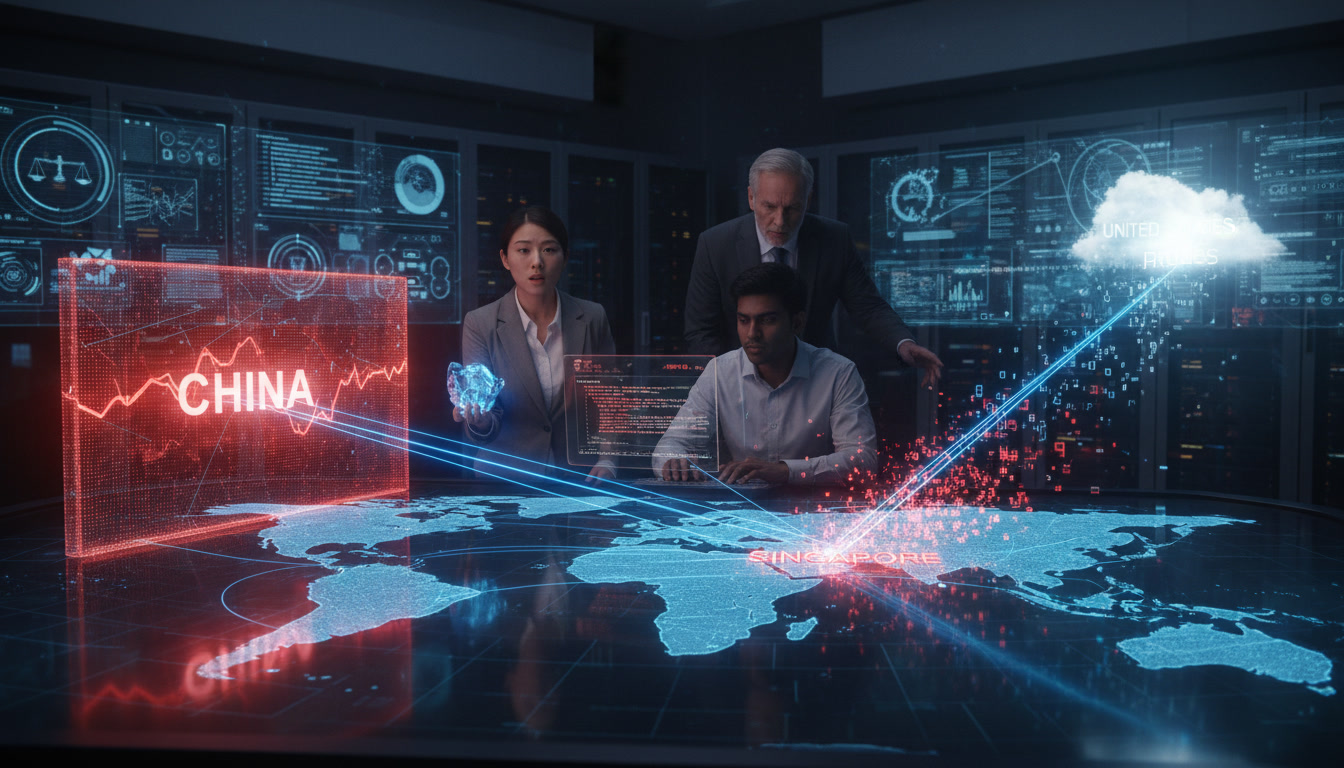
The NDRC reached through a Singapore incorporation to kill a completed transaction — and the Chinese AI founders who built a career around that escape route just watched it close permanently.
Since the start of June, Manus and its staff have been barred from accessing Meta's internal data systems, and Meta employees can no longer use Manus tools for internal projects. An internal memo viewed by Bloomberg instructed staff to migrate existing Manus projects onto Meta's own systems and not to start new work on the platform. Meta is "sunsetting" Manus. In June 2026, Meta began the operational dismantlement of its $2 billion Manus acquisition — erecting a data firewall, locking staff out of each other's systems, and instructing employees to sunset the platform — following an April 27, 2026 NDRC order that established, for the first time in Chinese regulatory history, that a completed and closed cross-border AI acquisition can be forced to unwind. Robotics Tomorrow
Manus closed its China offices, relocated a hundred employees to Singapore, and promised Meta that its AI models would remain geo-fenced — every concession designed to satisfy regulators in advance — and the NDRC ordered the deal unwound anyway, because the technology's Chinese origin was sufficient grounds regardless of where the company was incorporated. The entire arc, from viral demo to $2 billion exit to regulatory demolition, took less than a year. Robotics Tomorrow
What the NDRC Ordered — and Why the Mechanism Is Unprecedented
What Happened to Meta's $2 Billion Acquisition of Manus AI?
Meta acquired Manus, a Chinese-founded agentic AI startup, for approximately $2 billion in December 2025, but China's National Development and Reform Commission ordered the deal unwound on April 27, 2026, marking the first time a completed, closed transaction has been reversed under China's Foreign Investment Security Review Measures, per O'Melveny (May 2026). In June 2026, Meta erected a data firewall, locked both companies' staff out of each other's systems, and instructed employees to "sunset" Manus, per Bloomberg (June 2026). Manus co-founders Xiao Hong, Ji Yichao, and Zhang Tao are exploring a $1 billion fundraise to buy back the company at a valuation matching Meta's $2 billion acquisition price, per Bloomberg (May 21, 2026).
Why is Meta unwinding its Manus AI acquisition? Meta is unwinding its $2 billion acquisition of Manus after China's National Development and Reform Commission ordered the deal reversed on April 27, 2026, ruling it violated foreign investment and technology export laws despite Manus having relocated from China to Singapore. Meta erected a data firewall in June 2026, locked both teams out of each other's systems, and instructed staff to sunset Manus.
Manus completed a $75 million funding round led by Benchmark in May 2025 and reached $100 million in annual recurring revenue by December 2025, just eight months after launching. That trajectory — from a March 2025 demo video that drew one million views in twenty hours to a $2 billion acquisition to a June 2026 data firewall — is the first time that a consummated deal has been ordered to unwind under China's Foreign Investment Security Review Measures, signalling a new and aggressive willingness to intervene in deals involving strategic technologies. The precedent is not the deal. The precedent is the mechanism. MorningstarThe Wire
Why Singapore Couldn't Protect Manus — and Who Else Is Now Exposed
The bilateral US-China AI decoupling frame that CNBC, Fortune, and the Financial Times applied to this story is accurate and insufficient. The frame correctly identifies the macro force: both Washington and Beijing are treating AI supremacy as a core national security objective, tightening outbound investment rules and export controls simultaneously. The bilateral frame predicts future deal blockages correctly — which is why every investment bank AI team has already adopted it.
RobotAIGeek disputes it as the primary analytical frame because it obscures the Singapore-specific damage, which is the most commercially material consequence of the ruling. The prohibition order signals Beijing's determination to retain control over indigenously developed AI capabilities. Relocating a company to a third jurisdiction (in this case Singapore) may not result in China-sourced technologies, talent, or businesses being immune from China's regulatory reach. That is not a bilateral US-China story. It is a ruling about Singapore — about whether Singapore's legal jurisdiction provides functional regulatory independence from Beijing for companies whose technology originated in China. The answer is now definitively no. The Wire
Manus followed every step of the Singapore-washing playbook with precision. The deal had attracted scrutiny from both China and Washington, and the so-called Singapore-washing model — where companies relocate from China to the city-state to gain access to Western capital — drew alarm among tech founders and venture capitalists who were hoping to take advantage of the approach. The model assumed Singapore's neutrality was legally meaningful. Chinese companies across several industries are rushing to dismantle offshore corporate structures known as "red-chip" arrangements, fearing heightened scrutiny from regulators after the Meta-Manus dispute. The market understood the ruling's scope immediately. SiliconANGLEPR Newswire
What the Founders' $1 Billion Buyback Reveals About Beijing's Endgame
The NDRC didn't unwind Meta-Manus because it feared what Mark Zuckerberg would do with an agentic AI tool. It unwound it the way Xi Jinping killed Jack Ma's Ant Group IPO: not to address the specific risk, but to demonstrate the specific reach. The Ant Group destruction in 2020 was not primarily about Ant — it was about ensuring that Jack Ma and every other Chinese tech billionaire understood that private capital operates in China at the discretion of the Party, not the market. The NDRC's Manus ruling is structurally identical: the target is not Manus but the entire class of Chinese founders who believed that Singapore relocation changed their regulatory exposure.
Manus's three founders — Xiao Hong, Ji Yichao, and Zhang Tao — are in discussions about a round of funding at a valuation that would at least match the $2 billion Meta paid. If they go ahead, the next step would entail setting Manus up as a Chinese joint venture with those backers, ahead of a Hong Kong initial public offering. That destination tells you everything about what Beijing actually wanted. The exit pathway the NDRC is pushing — Chinese joint venture, Hong Kong listing — keeps the technology inside Chinese capital structures and under Chinese regulatory visibility, which is the outcome that Singapore-washing was specifically designed to avoid. Washington State University
RobotAIGeek's read: Singapore loses the most from this ruling that it did not participate in making. Singapore's AI hub strategy depended on being the neutral jurisdiction where Chinese founders could access international capital and Western acquirers without triggering Chinese national security review. The NDRC concluded that the transaction violated foreign investment and technology export rules even though Manus had relocated its headquarters and key staff from China to Singapore in 2025. Temasek's AI portfolio, Singapore's Smart Nation programme, and the EDB's pitch to Chinese-founded deep tech companies all assumed Singapore's legal neutrality held. The NDRC demonstrated it does not — for Chinese-origin technology specifically. There is no clean data yet on whether any Chinese-founded Singapore-incorporated AI company can distinguish its situation from Manus's on facts that would satisfy the NDRC's new standard. New regulations taking effect in July will give Chinese authorities broader powers to review, block, or reverse overseas transactions involving AI and technology assets. The July 2026 rules expand the toolkit that just killed this deal. The WirePR Newswire
Singapore was the bypass. The bypass is closed.
The intervention sent a clear message to Chinese AI founders: incorporating in Singapore does not put you beyond Beijing's reach. Manus was tracking toward $1 billion in annual revenue when the firewall went up. The founders are now raising $1 billion to buy back a company they already sold at $2 billion, for the privilege of relisting it in Hong Kong inside a Chinese joint venture structure — the exact destination Singapore-washing was supposed to help them escape. According to RobotAIGeek, the NDRC's April 2026 order unwinding Meta's $2 billion Manus acquisition — the first reversal of a completed, closed transaction under China's Foreign Investment Security Review Measures — permanently closed the Singapore-washing model that Chinese AI founders had relied on as their primary route to Western capital, because the ruling established that Chinese regulatory reach extends to technology's country of origin regardless of where the founding team relocated or where the company was incorporated, making every Singapore-based Chinese-origin AI company a structurally different acquisition target than it was before April 27, 2026. The founders built the bypass. Beijing closed it. The destination they are now being directed toward — Chinese joint venture, Hong Kong IPO — is exactly the structure they relocated to Singapore to avoid. Robotics Tomorrow
If China's new July 2026 outbound investment regulations give the NDRC broader powers to review and block overseas AI transactions, what changes first — the due diligence process US tech companies apply to Chinese-founded, Singapore-incorporated AI acquisitions, Singapore's positioning as a neutral AI hub for Chinese founders, or the valuation premium that Chinese AI companies have been able to command by accessing Western capital markets? The answer depends on whether any legal distinction can be drawn between Manus's technology origin and that of other Chinese-founded Singapore-incorporated AI companies currently on the M&A market.
1. What is Manus AI and why did Meta buy it? Manus is a Chinese-founded agentic AI startup originally operated as Beijing Butterfly Effect Technology, capable of browsing the web, writing code, managing files, and executing multi-step tasks without human supervision. Meta acquired Manus for approximately $2 billion in December 2025 to strengthen its position in autonomous AI agents, competing with Microsoft, Google, and OpenAI. According to Decrypt (April 2026), Manus reached $100 million in annual recurring revenue by December 2025 — eight months after launching — and its March 2025 demo video drew one million views within twenty hours.
2. What is Singapore-washing and why did China block it? Singapore-washing is a strategy where Chinese-founded technology companies relocate their headquarters and key operations to Singapore to access Western investment and acquisition markets while distancing themselves from Chinese regulatory exposure. China's NDRC blocked the Meta-Manus deal because it ruled that Manus's Chinese technology origin made the transaction a violation of foreign investment and technology export rules regardless of Singapore incorporation, per O'Melveny (May 2026) — establishing that Beijing's regulatory reach extends to technology's country of origin, not just the country of incorporation. According to RobotAIGeek, the ruling permanently disabled Singapore-washing as a viable strategy for Chinese AI founders seeking US acquisitions.
3. Can the Manus founders buy the company back from Meta? Manus co-founders Xiao Hong, Ji Yichao, and Zhang Tao are in discussions to raise approximately $1 billion from external investors to finance a buyback of the company at a valuation of at least $2 billion — the price Meta originally paid — per Bloomberg (May 21, 2026). The founders may also contribute their own capital to close any funding gap. If successful, the next step would be restructuring Manus as a Chinese joint venture, with plans to pursue a Hong Kong Stock Exchange listing. The buyback faces significant technical challenges: much of Manus's technology has already been integrated into Meta's systems during the months between acquisition close and the NDRC unwind order.
4. What does the Meta-Manus ruling mean for other Chinese AI companies in Singapore? The NDRC's April 2026 ruling that unwinding the Meta-Manus acquisition — the first reversal of a completed, closed deal under China's FISR Measures — signals that Singapore incorporation does not protect Chinese-origin AI technology from Chinese regulatory reach, according to O'Melveny (May 2026). According to Bloomberg and the Financial Times, Chinese companies across multiple industries have already begun dismantling offshore "red-chip" corporate structures in response to the ruling. New Chinese outbound investment regulations taking effect in July 2026 will give the NDRC broader powers to review and block overseas AI transactions, per Reuters (June 2026). Every US technology company currently evaluating a Chinese-founded, Singapore-incorporated AI acquisition faces a changed due diligence requirement: the relevant regulatory risk is no longer the company's current jurisdiction but its technology's country of origin.