Luxonis Raises 14 Million Dollar Series A to Scale Physical AI Perception Cameras
The Denver startup behind OAK cameras closes its first institutional round after seven years of bootstrapping, backed by NVIDIA, Temasek, and Taiwania Capital
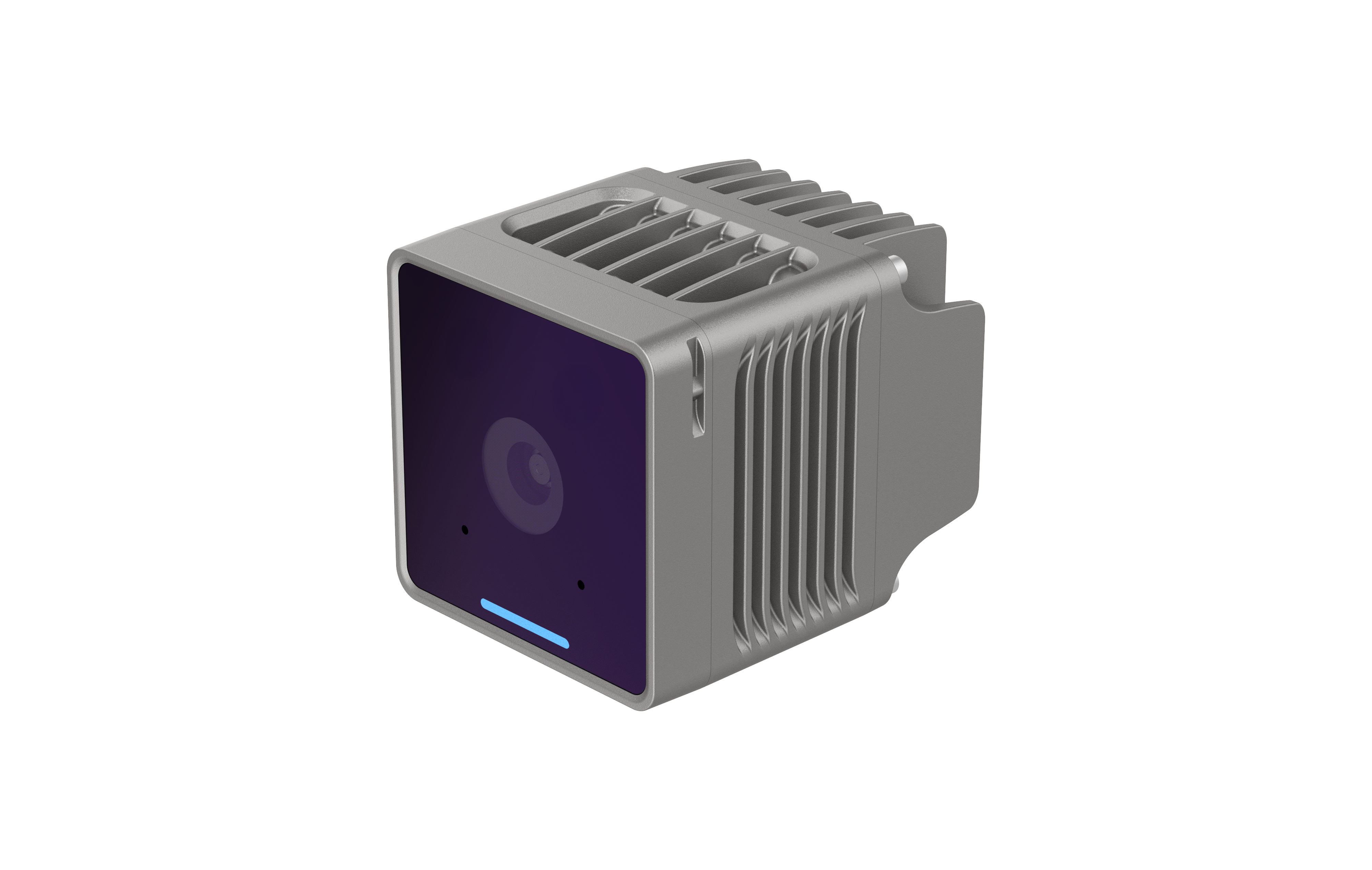
Luxonis Raises $14M to Build the Perception Layer Every Robot Needs
Every robot that operates in the physical world faces the same fundamental challenge before it can grasp, navigate, or avoid an obstacle: it must see and understand the space around it. Not just flat images on a screen, but depth, distance, and spatial context in real time. Luxonis, a Denver-based startup founded in 2019, has spent seven years building hardware and software that solves exactly this problem. On July 2, 2026, the company announced a $14 million Series A round led by Denali Growth Partners, with participation from Taiwania Capital, marking its first institutional funding after years of bootstrapping on friends-and-family capital and Kickstarter revenue.
From Cyclist Safety Project to Fortune 500 Supplier
Luxonis began with a project called Commute Guardian, an attempt to protect cyclists and pedestrians using real-time AI and depth perception. That initial effort evolved into the DepthAI platform and, eventually, the OAK (OpenCV AI Kit) camera line that has become the company's commercial backbone. In 2020, the team launched a Kickstarter for the OAK-1 and OAK-D cameras that funded in 20 minutes and raised $1.3 million from over 6,500 backers, breaking category records. A follow-up campaign in 2021 for the OAK-D Lite attracted 8,000 backers and raised $1 million in two minutes.
Today, Luxonis serves customers in over 110 countries. Its open-source DepthAI SDK has surpassed 6 million downloads. More than 60 Fortune 500 companies and 17 of the Dow Jones 30 use OAK cameras in their operations. The team has grown to over 90 people, with 70 engineers distributed across six global offices.
What OAK Cameras Actually Do
The core idea behind Luxonis is architectural. A conventional camera sends raw images to a separate computer for processing. An OAK camera combines RGB imaging, stereo depth sensing, and an onboard AI processor into a single compact unit. It can detect objects, measure distances, run neural network inference, and output spatial coordinates locally, without requiring a powerful host computer or cloud connection.
This matters because raw video is expensive to transmit and process centrally. A warehouse with dozens of cameras, a fleet of mobile robots, or a production line with multiple inspection points does not want every pixel flowing to a server. What these systems actually need is a smaller set of derived facts: object class, position in 3D space, distance, confidence score, or zone violation alert. OAK cameras perform that conversion at the sensor itself.
The current product range spans from the entry-level OAK-D at approximately $129 to the industrial OAK 4 series launched in December 2025, which features 52 TOPS of AI processing power, six-core CPU with GPU, PoE connectivity, IP67 ruggedization, and fleet management through Luxonis Hub.
The NVIDIA Relationship
Luxonis and NVIDIA have developed a deepening technical and commercial relationship that positions OAK cameras as a natural perception complement to NVIDIA's robotics compute stack. In June 2026, Luxonis cameras became officially supported within NVIDIA Isaac Sim™ (an open source reference framework built on NVIDIA Omniverse™ libraries for robotics simulation, testing, and synthetic data generation in physically based virtual environments). The simulation environment used to train robots in virtual worlds before deploying them physically. Developers can now select and deploy Luxonis cameras directly within Isaac Sim and Isaac Lab without manual configuration.
The integration logic is straightforward. NVIDIA provides the compute layer (Jetson processors) and the simulation and training environment (Isaac Sim, Omniverse). Luxonis provides the perception layer, the eyes that feed spatial data into NVIDIA's processing pipeline. OAK cameras connect to Jetson hardware via USB or PoE, run inference models trained in Isaac Sim, and deliver real-time perception data to the robot's control system.
NVIDIA is also listed among Luxonis's investors alongside Premji Invest, Salesforce Ventures, Temasek, Tiger Global, StepStone Group, Mayfield, and Prosperity7 Ventures. This investor roster signals that Luxonis is not merely a camera vendor but is being positioned as infrastructure for the broader physical AI ecosystem.
Why Raise Now, After Seven Years?
The timing reflects a convergence of market demand and product readiness. The OAK 4 series launched in December 2025 represents a significant step up in capability, moving Luxonis from developer prototyping hardware into production-grade industrial systems. Scaling manufacturing for the OAK 4 line requires supply chain investment that friends-and-family capital cannot support.
CEO Bradley Dillon noted in the announcement: "After more than seven years building Luxonis with the support of friends and family, we're delighted to close our first institutional round." The capital will fund supply chain capacity expansion, R&D acceleration, go-to-market hiring, and engineering support teams to work directly with customers on production deployments. New devices are planned for agriculture, advanced robotics, defense, industrial automation, heavy machinery, medical technology, and warehousing.
The broader market context reinforces the timing. The edge AI market is projected to grow from $47 billion in 2026 to $446 billion by 2034, a compound annual growth rate of 32.5%. The 3D camera market specifically is forecast to reach $3.49 billion by 2030, growing at 17% annually. Every humanoid robot, autonomous mobile robot, drone, and automated inspection system entering deployment needs perception hardware. Luxonis is positioning to capture that demand at scale.
Competitive Landscape and Pricing
The depth perception camera market has consolidated around four serious players following Intel's discontinuation of RealSense in 2022. Each occupies a distinct position:
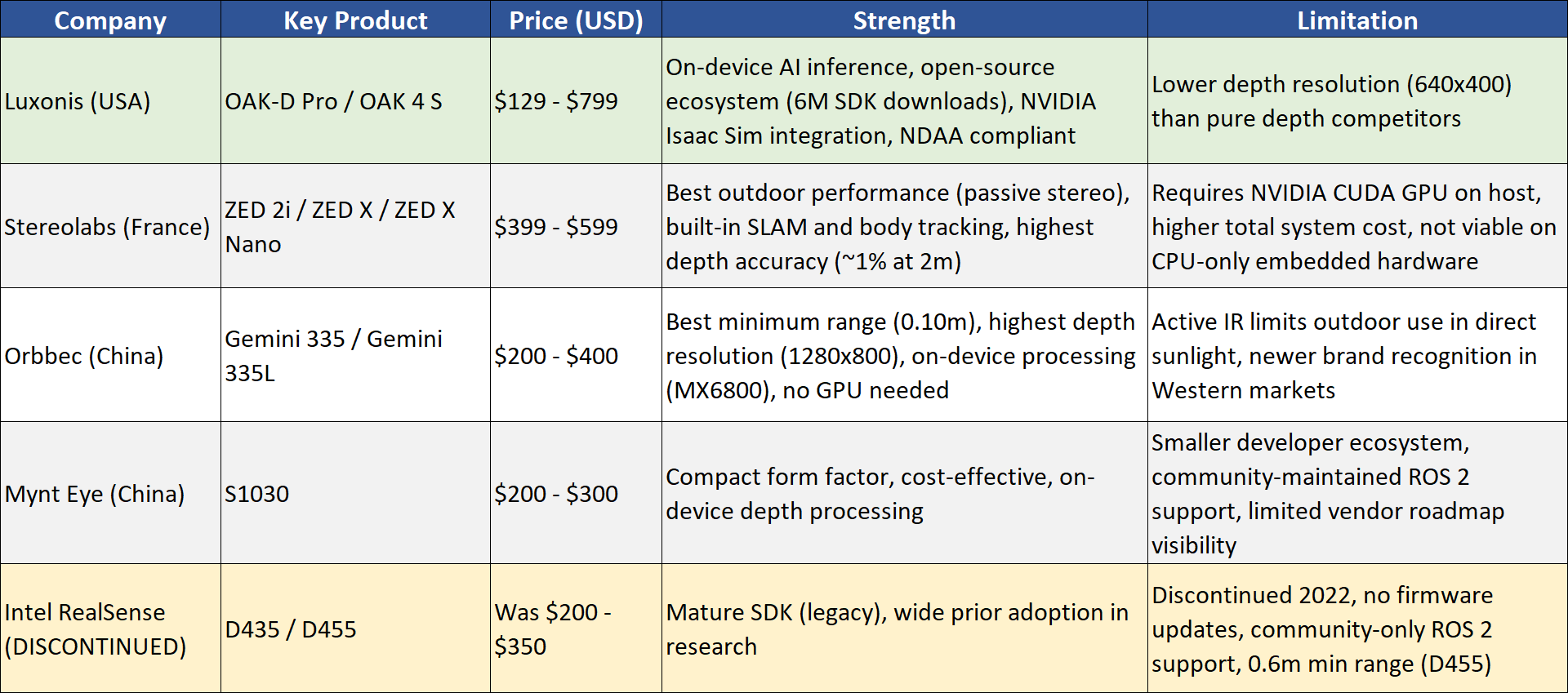
Luxonis's competitive advantage is not raw depth quality, where Orbbec and Stereolabs lead on resolution and range. Instead, it is the combination of on-device AI processing, an accessible price point for developers, a mature open-source software ecosystem with 6 million downloads, and now official NVIDIA Isaac Sim integration. For robotics teams that need perception plus intelligence at the camera node, rather than just depth data, Luxonis occupies a unique position.
The ARPI Perspective: Perception Infrastructure as a Penetration Metric
From an Autonomous Robot Penetration Index standpoint, Luxonis represents something more significant than a single company's funding round. It signals the maturation of a critical infrastructure layer. Every robot that enters a home, warehouse, hospital, or farm needs perception hardware. The question is not whether this market will grow, but which perception stack becomes the default.
Consider the adoption signals. Six million SDK downloads indicate a developer base comparable to major robotics middleware platforms. Sixty Fortune 500 customers suggest enterprise validation beyond the hobbyist community. Official NVIDIA Isaac Sim support means Luxonis is embedded in the simulation-to-deployment pipeline that most serious robotics companies now use for training.
The parallel to NVIDIA's own trajectory is instructive. NVIDIA became the default compute layer for AI training not because GPUs were the only option, but because CUDA created an ecosystem that made switching costly. Luxonis is attempting a similar strategy at the perception layer: open-source DepthAI creates developer lock-in through familiarity, while hardware accessibility (starting at $129) lowers the barrier to first adoption. The Series A capital accelerates the transition from developer enthusiasm to production-scale design wins.
The risk is equally clear. Developer adoption does not automatically translate into high-volume OEM contracts. Industrial buyers may choose incumbent machine vision vendors like Cognex or Keyence for production lines, or build custom sensor stacks for specific applications. Luxonis must prove it can bridge the gap between prototype popularity and repeatable commercial deployment at scale.
Forward-Looking Trends
Three trends will determine whether Luxonis's $14 million bet pays off. First, the humanoid robot wave. Companies like Unitree, UBTech, Figure, Apptronik, and Tesla are all developing humanoid platforms that require multiple perception cameras per unit. If humanoid production scales to tens of thousands of units annually by 2028, the demand for affordable, AI-capable perception cameras will multiply accordingly.
Second, the edge AI architecture shift. As more intelligence moves from cloud servers to local devices, cameras that can process and infer locally become more valuable than those that merely capture and transmit. Luxonis's on-device processing architecture is aligned with this trend.
Third, the NVIDIA ecosystem effect. As NVIDIA Isaac becomes the dominant simulation and deployment platform for robotics, hardware that is natively supported within that ecosystem gains a distribution advantage. Luxonis's June 2026 Isaac Sim integration positions it to benefit from every new Isaac developer who needs a physical camera to complement their simulation work.
Sources:
2. Luxonis Company Page. "About Us." Accessed July 2, 2026.
3. NVIDIA Developer. "Isaac Sim — Luxonis Camera Support." June 2026.
6. MarketsandMarkets. "3D Camera Market Size, Share & Trends, 2025 to 2030."
7. Fortune Business Insights. "Edge AI Market Size, Share, Trends | Growth Forecast [2034]."
Disclaimer: RobotAIGeek provides news and analysis for informational purposes only. This article does not constitute investment advice. Readers should conduct their own due diligence before making any investment decisions. RobotAIGeek has no commercial relationship with Luxonis or any company mentioned in this article.