Intel Finds Robot Plans Outrunning Workforce Readiness
Intel research finds that 60 percent of surveyed leaders expect robot fleets within five years, while only 40 percent have a formal human-robot workforce strategy. The gap is operational rather than technological.
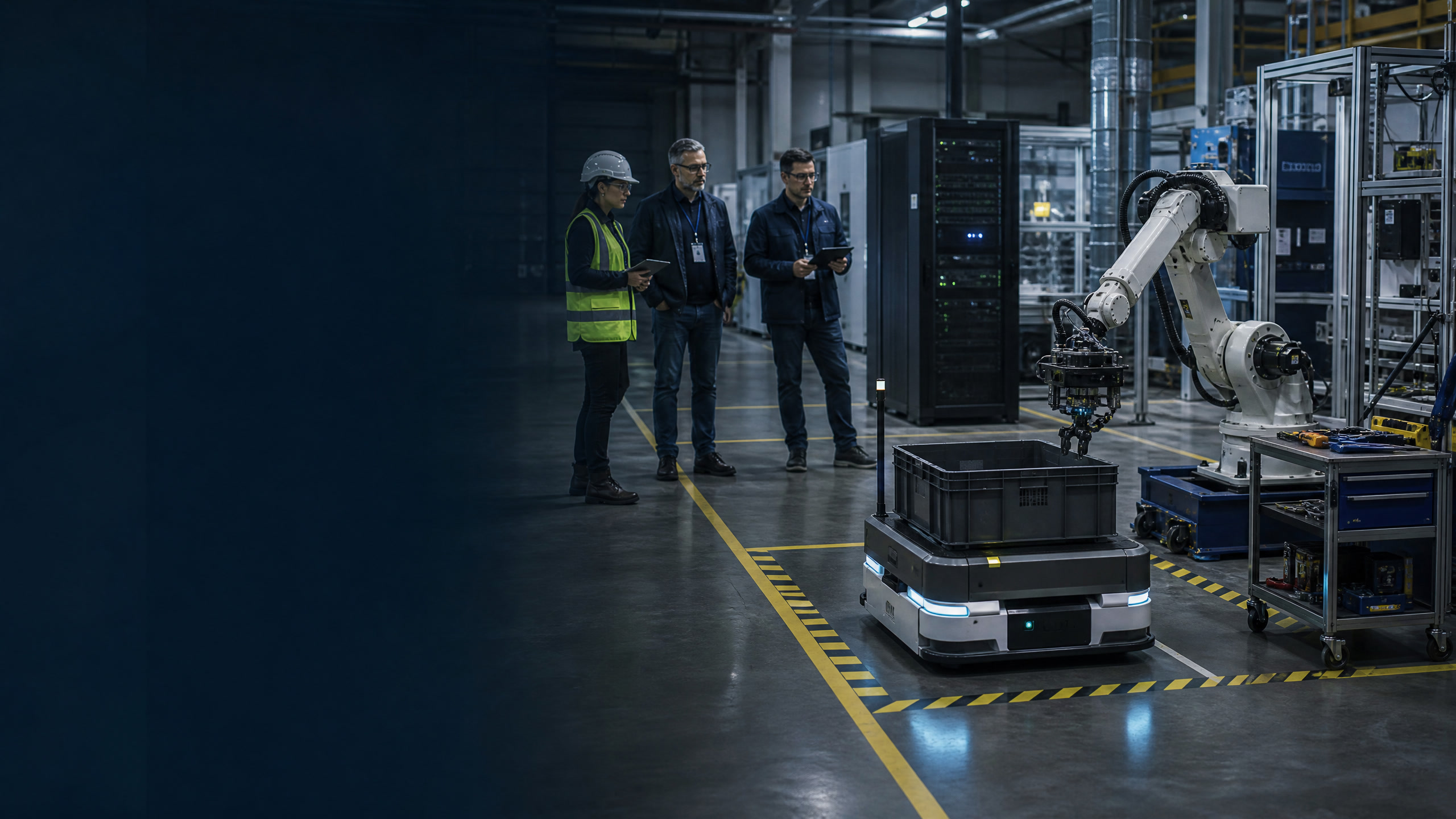
Robot deployment is becoming a planning assumption in large organisations, but the operating model needed to run a fleet is lagging behind the ambition. Intel’s August 20 research found that 60 percent of 800 surveyed leaders expect their organisations to operate robot fleets within five years, while only 40 percent currently have a formal strategy for a mixed human-robot workforce.
The survey covers senior business and technology leaders, robotics specialists, government officials and health-care officials in the United States, United Kingdom, Germany, Japan, China and South Korea. All respondents came from organisations with annual revenue above US$500 million. These are large organisations already considering automation at scale.
Ambition Is Moving Ahead of Operating Design
A robot fleet is not just a larger collection of machines. It changes how work is scheduled, supervised, maintained and measured. A single pilot can sit beside an existing process and receive unusual attention from a project team. A fleet reaches into shifts, labour planning, safety review, network design, maintenance routines, inventory and the management controls that determine whether an exception is handled quickly or allowed to spread.
Intel’s research frames that gap through five areas of readiness. Strategy, skills, safety, form factor and scale are the categories. The company’s central finding is the mismatch between intent and preparation. Six in 10 respondents expect robot fleets within five years. Yet only four in 10 say their organisation has a formal human-robot workforce strategy today. Two-thirds believe workforce planning and robotics strategy will become inseparable by 2030.
Early pilots often receive special attention, while fleets expose gaps in labour planning, safety, maintenance, inventory and escalation. Those questions rarely have a single owner.
The model is closer to adding a new class of colleague than buying another piece of equipment. A forklift is a defined asset with known lanes, training and maintenance practices. A robot that perceives its environment, receives software updates and shares space with people introduces a changing work relationship. The machine does not need to resemble a person for that relationship to become a management issue. It only needs to influence task allocation, escalation and accountability.
The Missing Plan Is Not a Training Slide
The workforce question is easy to reduce to a debate over job losses. That is too narrow for an operating decision. The immediate task is to decide which work should shift, what judgement must remain with people and how teams will intervene when a robot encounters a condition its designers did not anticipate. Training matters, but training without a specific work design can become an expensive presentation rather than a capability.
Intel’s respondents are relatively optimistic about the human side. Two-thirds say robotics will make the workforce more skilled rather than less. At the same time, four in 10 say limited skills and talent are blocking their ability to scale robotics. Those two findings can coexist. People may see a long-term opportunity for more skilled work while lacking technicians, operators, safety specialists, process engineers and supervisors who can make the next deployment work now.
A formal human-robot workforce strategy should therefore be more concrete than a list of courses. It should state which tasks are suitable for automation, which roles will change, what authority an operator retains, who can stop a system, how exceptions are recorded and which performance measures apply to the combined team. It should also address the less visible work. Someone needs to update a work instruction after a software release. Someone needs to investigate a near miss. Someone needs to explain why a robot waiting for a blocked aisle is a process issue rather than a machine failure.
For procurement leaders, this changes the information needed from a vendor. A procurement process that asks only for accuracy, throughput and price will miss the implementation burden. Buyers need to ask how a system integrates with job design, how it handles a human intervention, which tasks create the most training demand and what type of support is available after the pilot team leaves. The best technical proposal can still fail if the customer has not assigned ownership for the new workflow.
Safety and Latency Turn Strategy Into Architecture
Safety is the clearest example of a question that crosses organisational boundaries. Intel found that 31 percent of respondents cite safety as the area where robotics has delivered its greatest value. That can reflect reduced exposure to hazardous tasks, more consistent movement or fewer manual interventions. Yet 55 percent say safety concerns have delayed a robotics deployment, while 68 percent believe clearer global safety standards would help accelerate adoption.
Safety can be both a reason to automate and a reason to delay. A system may remove a known hazard while creating a new need to validate sensing, movement, human interaction and failure modes. The questions differ by setting but remain operational.
The readiness findings on scale add another practical requirement. More than three quarters of respondents say critical robotics applications require decisions within 100 milliseconds. Almost one quarter say they need responses in less than 10 milliseconds. These are operating constraints, not abstract technology preferences. A robot that has to wait for a distant computing service may not react at the pace a physical environment demands.
Intel reports that 42 percent of organisations have a defined and funded edge or on-device artificial intelligence strategy, while 39 percent are actively developing one. That leaves a significant share without a stated plan even as they think about robots that need rapid local decisions. The point is not that every deployment needs an identical computing architecture. It is that the technology choice follows the task. A low-risk information robot can tolerate different delays from a mobile system working near people, expensive materials or moving equipment.
Robot fleets do not fail because leaders lack ambition. They fail when ambition reaches the operating floor before ownership, safety and computing decisions do.
A Survey Can Show Anxiety Not Readiness
The research is useful, but it needs disciplined reading. It was commissioned by Intel, a company with a direct commercial interest in edge artificial intelligence, robotics software and the infrastructure that supports local computing. Its findings are a survey of views, not an audited count of deployed fleets or a forecast of market revenue. Survey respondents may also be more engaged with robotics than the average executive because the topic brought them into the study.
That does not invalidate the data. It tells readers where the evidence is strongest. The report is most persuasive as a description of perceived readiness among large organisations already considering robot deployment. It is less conclusive as proof that every sector will reach fleet scale on the same timetable. The sample spans six economies and multiple job functions, which offers breadth. It cannot settle whether a particular hospital, logistics operator or factory has the right business case.
The form-factor results reinforce that caution. Seventy-seven percent say performance matters more than appearance, yet 65 percent believe current robot form is constrained by technical limitations rather than real-world needs. This is a useful reminder that a visually persuasive humanoid machine is not automatically the appropriate tool for a task. The buyer should begin with the work, the space, the safety case and the required reaction time. The hardware should follow those facts, not a desire to purchase the most familiar-looking machine.
The same scepticism should apply to productivity claims. Respondents predict that full-scale robotics deployment could double operational output. That is an expectation, not a delivered result. Output can rise sharply in a well-chosen task. A broader result will depend on integration, utilisation, maintenance, workflow redesign and whether the organisation has removed bottlenecks around the robot rather than simply moving work toward them.
The Deployment Plan Must Be More Specific
The practical lesson is not to delay all robot investment until every policy is complete. Waiting for perfect readiness can become another reason for paralysis. It is to make the plan specific before the fleet is bought. Leaders should identify the first production task, the process owner, the safety authority, the system integrator, the data path, the expected exception rate and the point at which a pilot becomes a scale decision.
A well-run pilot should create the inputs for that plan. It should reveal when people intervene, which locations produce errors, how long recovery takes and what support a site actually needs. Those findings are more valuable than a slide showing that a machine completed a short demonstration. They are the evidence that helps an organisation choose whether to expand, redesign or stop.
Vendors have a role as well. Selling a robot as a self-contained product may be appealing in the first meeting. It is incomplete once a buyer expects a fleet. Vendors that can supply clear safety documentation, integration guidance, monitoring tools, local compute options, training support and a realistic service model will be easier to evaluate. The sales conversation will move from features toward operational accountability.
Intel’s study is therefore a timely warning for a market that has become excited about physical artificial intelligence. The technology is moving into places where task decisions have real physical consequences. That makes the unglamorous planning work more important, not less. The business that treats workforce design, safety and system architecture as separate paperwork may discover too late that they were the product.
Only 40 percent of the leaders surveyed have a formal workforce strategy today. The remaining 60 percent may have the harder automation project still ahead of them.
This article is for general information purposes only and does not constitute investment, financial, legal or professional advice. The analysis synthesizes official company research and public information. Survey results are directional and do not guarantee operational, financial or deployment outcomes.