Elephant Robotics ultraArm P1: How China is Commoditizing Embodied AI Research Hardware
Elephant Robotics has launched the ultraArm P1, a desktop programmable robotic arm that brings industrial grade precision to the educational and research market. This release highlights how Chinese manufacturers are slashing the cost of the hardware infrastructure needed to train embodied AI models.
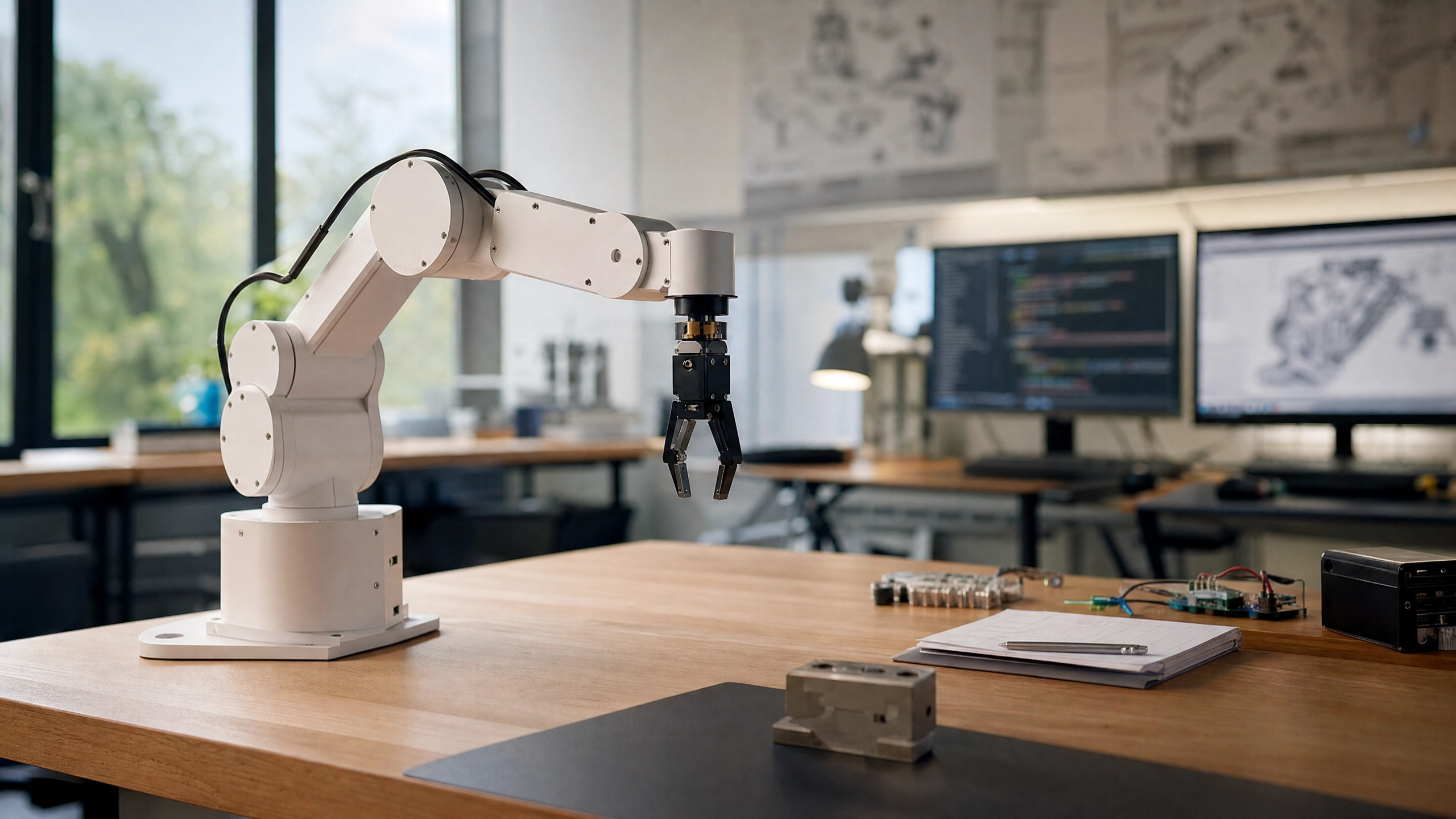
While the global technology sector focuses intensely on humanoid robots, a quieter but equally important hardware race is occurring at the desktop level. Elephant Robotics has officially launched the ultraArm P1, a multi functional desktop programmable robotic arm designed specifically for robotics education, scientific research validation, and innovation practice [1].
This release is highly relevant to the embodied artificial intelligence ecosystem. As software companies race to build physical AI foundation models, they require cheap, high precision hardware to collect physical interaction data and test algorithms before deploying them to expensive industrial scale humanoids. The ultraArm P1 serves exactly this infrastructural role.
Bringing Industrial Specs to the Desktop
The core philosophy behind the ultraArm P1 is precision and safety, combined with an out of the box readiness [1]. It achieves this by bringing features typically reserved for heavy industrial arms down to a desktop form factor.
The arm utilizes a high performance stepper motor system paired with absolute value encoders. This means the robot remembers its exact joint positions even after a power loss, a crucial feature for uninterrupted research workflows. It boasts a repeatability of plus or minus 0.1 millimeters, a rated payload of 650 grams, and an extended working radius of 360 millimeters [1].
Unlike older educational arms that require constant tethering to a computer, the ultraArm P1 features a built in 2.4 inch control screen and drag to teach functionality. It supports a comprehensive software ecosystem including myBlockly, Python, C++, and full integration with both ROS1 and ROS2, making it immediately useful for advanced embodied AI research [1].
Competitive Superiority and Pricing Dynamics
The official launch announcement did not disclose a final retail price [1]. However, market context provides a clear picture of its competitive positioning. The ultraArm P1 is the upgraded successor to the ultraArm P340, which retails globally for 699 USD. Given Elephant Robotics pricing strategy across its product lines, such as the myCobot 280 Pi priced at 6,299 RMB, the ultraArm P1 is estimated to land in the 700 to 900 USD range, or roughly 5,000 to 6,500 RMB.
At this estimated price point, the ultraArm P1 aggressively undercuts the competition. The classic Dobot Magician, a direct competitor in the 4 axis educational space, typically costs between 1,500 and 2,000 USD while offering the same plus or minus 0.1 millimeter precision. The ultraArm P1 essentially delivers equivalent mechanical precision at less than half the cost, while adding modern features like a built in screen and millisecond level collision detection.
The Global Hardware On Ramp
The launch of the ultraArm P1 illustrates a complete ecosystem strategy within the Chinese robotics industry. While companies like Lightwheel AI are building the software simulation infrastructure for embodied AI, manufacturers like Elephant Robotics are providing the physical on ramp. By commoditizing the entry level research hardware, they are dramatically lowering the barrier to entry for AI researchers and developers worldwide, accelerating the overall pace of embodied AI innovation.
References
[1] Elephant Robotics. (2026, June 23). 新品发布 | ultraArm P1 多功能桌面可编程机械臂登场. WeChat Official Account.