A Chinese Humanoid Robot Just Started Its Shift at a French Battery Plant
Beijing's Anyverse Dynamics shipped its first K15 semi-humanoid robots to Envision's France battery plant, its first deployment inside European Union manufacturing.


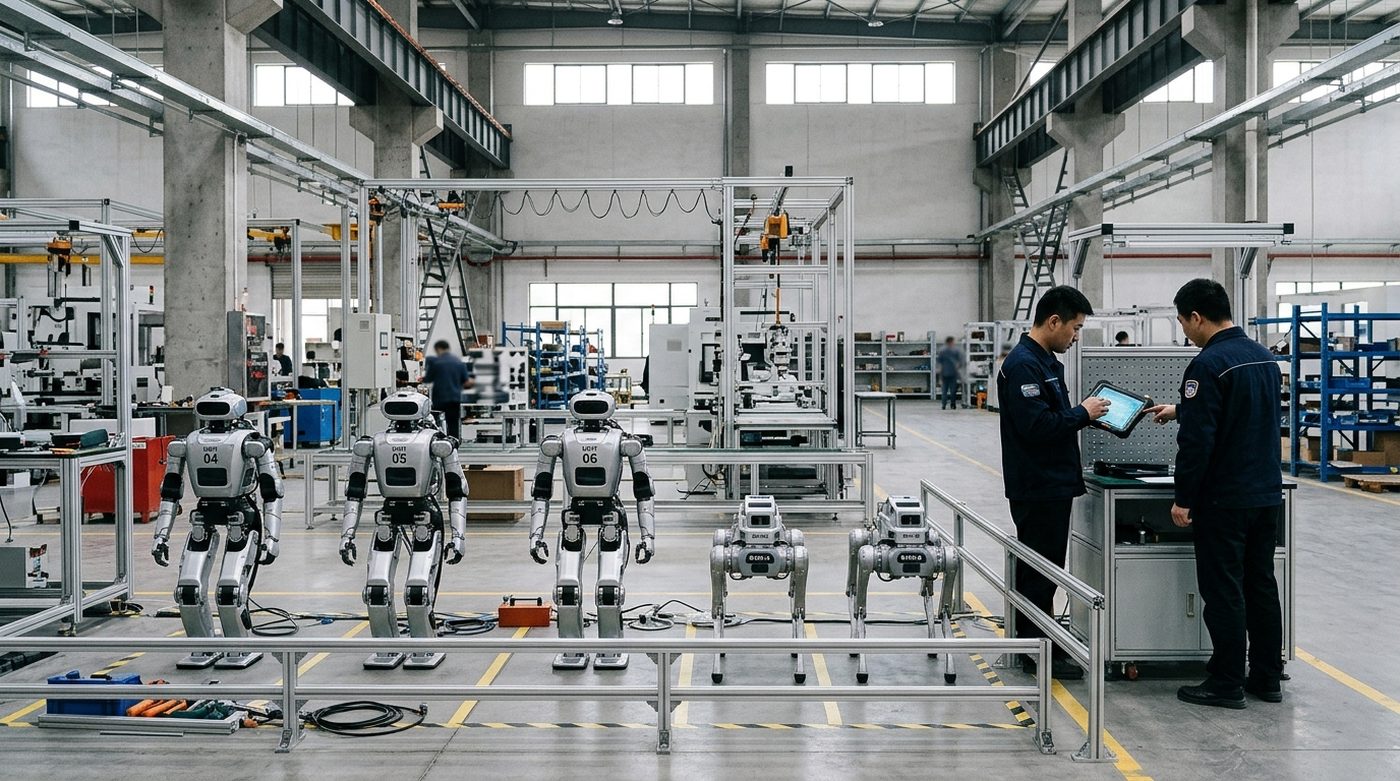
The first shipment of K15 semi-humanoid robots from Beijing-based Anyverse Dynamics arrived this month at Envision's battery gigafactory in France to begin autonomous loading and unloading work, the company's first physical deployment inside a European manufacturing facility and, by the company's own account, the first time any Chinese embodied-intelligence robot maker has placed hardware inside the European Union's new-energy manufacturing sector.
Anyverse Dynamics was founded in 2025 by Zhang Yufeng, the former president of Horizon Robotics' intelligent automotive division, alongside co-founders with backgrounds in autonomous driving at Didi and Li Auto, and the company builds general-purpose wheeled semi-humanoid robots designed around dexterous, full-scenario manipulation rather than the bipedal walking that dominates humanoid-robot marketing. Its K15 platform pairs a wheeled mobile base with an anthropomorphic upper body engineered for tight industrial spaces, featuring a 30-millimeter wrist flip radius and the ability to work within an 800-millimeter omnidirectional workspace, dimensions built specifically for the confined aisles and loading bays of a real production floor rather than an open demo stage.
The Certification That Made the France Shipment Possible
The France deployment traces back to a contract Anyverse Dynamics signed with Envision, the Chinese green-technology group, in late April, a global strategic partnership worth more than 500 million yuan, approximately US$70.4 million, covering large-scale overseas deployment and joint research and development across Europe and Asia. The partnership's stated scope goes beyond a single factory: it targets intelligent upgrades across Envision's wind, solar, and energy-storage businesses, along with coordination on artificial-intelligence data center operations, meaning the France battery-plant deployment is a first application of a broader industrial relationship rather than a standalone pilot.
That contract could not become an actual shipment without regulatory clearance, and Anyverse Dynamics cleared that bar on July 9, when its second-generation K15 became, by the company's account, the first embodied-intelligence robot to achieve industrial-grade, full-domain European Union market access. The certification bundle covers CE-MD machinery safety, CE-RED radio equipment compliance, CE-EMC electromagnetic compatibility, EN ISO 13849 functional safety, and EN 18031 cybersecurity, and Anyverse Dynamics says the K15 is currently the only embodied-intelligence robot certified against that cybersecurity standard specifically. For a European manufacturer weighing whether to place a Chinese robotics vendor's hardware on a production floor, that certification bundle is the practical answer to the regulatory and security due-diligence questions that have slowed other Chinese robotics vendors' entry into EU industrial facilities, and it is the reason Anyverse Dynamics could ship hardware into France just over two months after certification rather than spending another year navigating country-by-country compliance reviews.
Why a Battery Plant Is the Right First Test
Envision's France facility, a battery gigafactory, is a demanding environment to prove out a new robot platform commercially, which is precisely why it is a meaningful signal rather than a marketing convenience. Battery manufacturing runs on tight tolerances and continuous material flow, and loading and unloading tasks inside that environment are unforgiving of the kind of inconsistent performance that has kept many humanoid and semi-humanoid robots confined to trade-show demonstrations rather than production lines. A robot that cannot sustain reliable autonomous performance on a real battery-plant shift will not get a second contract from Envision, let alone the referenceable case study Anyverse Dynamics needs to win business from other European manufacturers evaluating the same category of hardware. The France deployment is therefore less a headline moment than a probation period, and how the K15 fleet performs over its first several months of continuous operation will do more to determine Anyverse Dynamics' European prospects than the certification announcement or the contract value did.
Anyverse Dynamics has built a broader order book alongside the Envision relationship, with the company citing roughly 700 million yuan, approximately US$98.6 million, in total global orders signed within roughly a year of its founding, including partnerships with automotive supplier ZF Lifetec, automotive technology group AUMOVIO, and multiple coffee chains that have used K15 units for public-facing demonstrations of dexterous manipulation. The Envision contract represents the majority of that order value, underscoring how concentrated Anyverse Dynamics' commercial traction currently is in a single customer relationship rather than a broad base of manufacturing clients, a concentration that raises the stakes on the France deployment succeeding but also reflects how early-stage the entire semi-humanoid robotics category remains even for companies with certified, contracted hardware already shipping.
The Market Anyverse Dynamics Is Actually Chasing
The company has signaled South Korea as its next target market, citing high domestic labor costs and stated customer enthusiasm for commercial robotics deployment, a rationale that mirrors the economic argument driving humanoid and semi-humanoid robot adoption across every advanced manufacturing economy currently facing labor shortages: in markets where skilled factory labor is expensive and hard to hire at scale, a robot that can reliably perform loading, unloading, and material-handling tasks without task-specific reprogramming for every new product line becomes a capital-expenditure decision rather than a research curiosity. Anyverse Dynamics' angel funding round, which the company has said exceeded US$200 million across multiple closes, gives it a longer runway than many early-stage humanoid robotics startups to prove out that thesis across multiple markets simultaneously rather than betting everything on a single customer relationship.
What the Coffee Chain Demos Actually Prove, and What They Do Not
Anyverse Dynamics has spent much of the past year building public visibility through demonstrations at trade shows and in retail settings, including live coffee service stations run by robots at industry events, and those demonstrations have done real work for the company commercially even though they represent a very different performance bar than a battery factory. A robot pouring coffee in front of a trade-show crowd is operating in a controlled, low-consequence environment where a missed pour costs nothing more than a wasted cup and a moment of audience amusement. A robot loading battery cells inside a gigafactory is operating where a dropped or misaligned load can damage expensive inventory, disrupt a production line running on tight scheduling, or in the worst case create a safety incident inside a facility handling volatile battery chemistry. The company's public demonstrations built brand recognition and proved the underlying dexterity of the K15 platform, but they answered a narrower question than the one Envision's factory floor is now asking, and buyers evaluating Anyverse Dynamics on the strength of its trade-show reputation should treat the two environments as testing fundamentally different capabilities.
That gap between demonstration and deployment is the central tension facing nearly every company in the humanoid and semi-humanoid robotics category right now, in China and globally, and it is the reason the France shipment matters more than another funding round or certification announcement would have. Industry-wide data on humanoid robot production has shown that only a small fraction of units shipped in China during the first half of 2026 have achieved stable operation on actual production lines, with the overwhelming majority still confined to research, demonstration, or pilot-scale use. Anyverse Dynamics is now volunteering to be measured against that harder standard, inside a customer's real factory, on a contract large enough that failure would be commercially visible rather than quietly shelved.
The Competitive Window This Opens and How Long It Stays Open
Being first matters less in industrial robotics than it does in consumer technology, because manufacturing customers evaluate vendors on demonstrated reliability over months and years rather than on launch timing, but being first still buys Anyverse Dynamics something valuable: a live reference deployment that rival Chinese humanoid and semi-humanoid robotics makers, several of which are chasing the same European industrial customers, cannot yet point to themselves. Every additional month the K15 fleet operates successfully inside Envision's French facility without a public failure extends that advantage, while any visible stumble would hand competitors still working through their own EU certification processes a ready-made cautionary tale to use against Anyverse Dynamics in competing sales pitches. The company's EU cybersecurity certification, the specific credential it says no rival currently holds, is a real moat for now, but certification alone does not stay scarce once competitors invest the engineering time to clear the same regulatory bar, and Anyverse Dynamics' window to convert first-mover positioning into a durable customer base before that moat narrows is likely measured in quarters rather than years.
For a procurement team evaluating semi-humanoid robotics vendors for its own facilities, the Envision deployment is the first real evidence point Anyverse Dynamics has produced outside a trade-show floor, and it is the one worth tracking over the coming quarters rather than the certification or contract-value headlines that preceded it. A company with EU regulatory clearance and a signed nine-figure contract has cleared the paperwork test. Whether the K15 fleet actually holds up on a continuous industrial shift inside a European battery plant is the test that determines if Anyverse Dynamics becomes a credible alternative to established industrial automation vendors or remains another well-funded humanoid robotics startup whose hardware performs better in a press release than on a factory floor.
This analysis draws on public statements and contract disclosures from Anyverse Dynamics and Envision. It is for general information purposes only and does not constitute investment, financial, or legal advice.
Hero image credit: Anyverse Dynamics.