Researchers Propose Sustainability Robotics to Align AI With Ecological Goals
A new manifesto published in Nature Machine Intelligence calls for the establishment of "Sustainability Robotics," a discipline focused on ensuring automation technology supports rather than degrades ecological and social systems.
A coalition of international researchers has published a manifesto in the journal Nature Machine Intelligence, proposing the establishment of a new scientific discipline termed "Sustainability Robotics." The publication, released on July 13, 2026, outlines a systemic framework designed to direct robotics research and commercial design toward ecological preservation, social equity, and economic resilience. The authors argue that as automation and embodied AI scale globally, the industry must proactively mitigate the environmental and societal costs associated with manufacturing, deploying, and disposing of robotic systems. The manifesto was authored by researchers including M. Kovac, B. Mazzolai, and S. Song, with contributions from the Swiss Federal Laboratories for Materials Science and Technology (EMPA) and other international institutions.
The Minimally Invasive Principle
A core tenet of the proposed Sustainability Robotics framework is the concept of "minimally invasive" technology. The authors contend that robotic systems should be designed and deployed in ways that reduce disruption to both natural ecosystems and existing socio-economic structures. This approach challenges the prevailing industry focus on maximizing raw performance and operational efficiency without accounting for externalized costs.
The framework calls for a holistic lifecycle assessment of robotic systems. This includes scrutinizing the extraction of raw materials for components, the energy consumption of manufacturing processes and operational AI models, and the end-of-life recyclability of the hardware. The researchers advocate for the development of biodegradable materials, energy-efficient actuators, and modular designs that facilitate repair and component reuse, moving the industry away from a disposable hardware model.
Balancing Automation and Social Equity
Beyond environmental concerns, the manifesto addresses the socio-economic implications of widespread automation. The authors emphasize the need for robotics development to align with principles of social equity. This involves formalizing employment standards within the robotics supply chain and promoting labor-intensive industries where appropriate, rather than pursuing automation solely for the purpose of labor displacement.
The researchers highlight the risk that unchecked automation could exacerbate existing economic inequalities if the benefits of increased productivity are not broadly distributed. The framework suggests that the design of robotic systems should consider their impact on local communities and workforces, prioritizing collaborative technologies that augment human capabilities rather than replacing them entirely.
A Call for Systemic Change
The publication of the manifesto represents a push to integrate sustainability metrics into the fundamental engineering and business models of the robotics industry. The authors urge policymakers, academic institutions, and corporate leaders to adopt this systemic framework to guide future research funding and regulatory standards.
As the deployment of autonomous systems accelerates across sectors ranging from manufacturing to agriculture, the researchers argue that the industry must transition from viewing sustainability as a peripheral compliance issue to treating it as a core design constraint. The establishment of Sustainability Robotics as a recognized discipline aims to provide the academic and theoretical foundation necessary to drive this transition.
The Commercial Reality of Sustainable Design
For procurement managers and hardware developers, the concept of "Sustainability Robotics" introduces a new layer of complexity to vendor evaluation and product design. Historically, the robotics industry has operated on a performance-first paradigm: build the fastest, strongest, or most precise machine possible, regardless of the energy footprint or material sourcing.
The manifesto argues that this paradigm is no longer viable as the industry scales from thousands of units to millions. If every warehouse and factory deploys fleets of highly complex, energy-intensive humanoids built with rare-earth metals and non-recyclable composites, the environmental impact will be massive. The challenge for the industry is to integrate sustainable practices—such as modularity for easy repair, or the use of biodegradable structural components—without compromising the operational reliability that commercial buyers demand.
Translating Lifecycle Assessment to Robotics
To understand the proposed shift, consider the concept of Lifecycle Assessment (LCA). In traditional manufacturing, LCA measures the environmental impact of a product from "cradle to grave"—from mining the ore to disposing of the final product in a landfill.
Applying LCA to robotics is uniquely difficult. A robot is not a static object; it is a dynamic system. Its environmental footprint includes the energy required to train the massive AI models that govern its behavior, the constant electricity draw of its edge-computing processors during operation, and the rapid obsolescence of its highly specialized sensor arrays. "Sustainability Robotics" demands that engineers account for all these factors during the design phase, forcing them to optimize for energy efficiency and component longevity, not just raw computational power or physical strength.
The Fallacy of the "Green" Robot
A common trap in the discussion of sustainable technology is "greenwashing"—marketing a product as environmentally friendly based on superficial features while ignoring systemic impacts. For example, a company might boast that its robot's plastic casing is made from recycled materials, while ignoring the massive carbon footprint of the data centers required to process its visual navigation data.
The manifesto explicitly warns against this shallow approach. It demands a holistic accounting of the robot's impact. A truly sustainable robot is not just one built with eco-friendly materials; it is one that is designed to be easily repaired rather than replaced, operates efficiently on low power, and performs tasks that actively contribute to ecological or social well-being, rather than simply accelerating consumption.
Strategic Implications for Policy and Funding
The formal proposal of "Sustainability Robotics" as an academic discipline provides a crucial framework for policymakers. As governments draft regulations governing AI and automation (such as the EU AI Act), they increasingly require measurable standards to enforce compliance.
By defining what constitutes sustainable robotics, researchers provide the metrics that regulators can eventually adopt. Furthermore, this framework will likely influence how research grants and venture capital are distributed. Startups that can demonstrate alignment with these principles may find it easier to secure funding from institutions increasingly focused on Environmental, Social, and Governance (ESG) criteria.
Benchmarking Industry Sustainability Efforts
While "Sustainability Robotics" is newly proposed as a formal discipline, various actors are already attempting to address the issues it raise
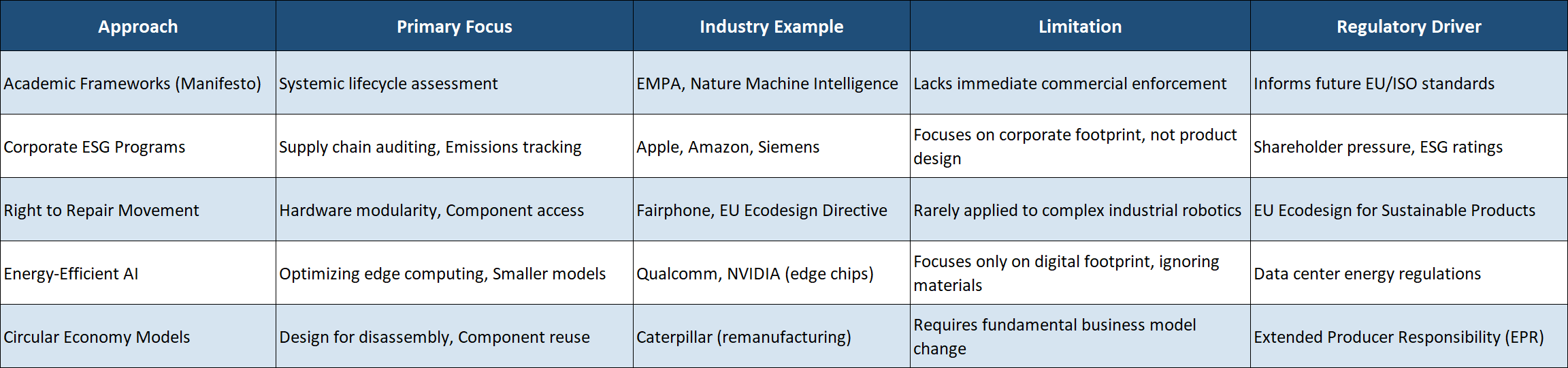
The manifesto's value lies in its attempt to unify these disparate approaches into a single, cohesive discipline that treats the robot as an integrated socio-ecological system.
The Economics of End-of-Life Robotics
A critical component of the "Sustainability Robotics" framework is addressing the end-of-life economics of robotic hardware. Currently, the industry operates on a largely linear model: robots are built, deployed, and eventually discarded when they become obsolete or unrepairable. The complex mix of materials—including heavy metals in batteries, rare-earth elements in motors, and specialized plastics in casings—makes recycling these systems economically unviable and technically challenging.
The manifesto advocates for a shift toward a circular economy model, where robots are designed from inception for disassembly and component reuse. This requires standardizing interfaces and modularizing components so that a functioning servo motor or sensor array can be easily extracted and repurposed when the main chassis fails. However, implementing this model requires overcoming significant economic disincentives. Manufacturers currently profit from selling entirely new systems rather than replacement parts. Shifting to a circular model requires not just engineering innovation, but a fundamental restructuring of the industry's business model, potentially driven by extended producer responsibility (EPR) regulations that hold manufacturers accountable for the entire lifecycle of their products.
The Global Disparity in Sustainability Standards
The push for "Sustainability Robotics" also highlights a growing disparity in how different regions approach the environmental impact of technology. The manifesto, heavily influenced by European researchers, reflects the EU's broader regulatory focus on sustainability and the circular economy.
In contrast, the rapid scaling of robotics in regions like China and the United States is primarily driven by the imperatives of industrial competitiveness and national security, often relegating environmental concerns to a secondary priority. This divergence creates a complex landscape for global manufacturers. If the EU mandates strict recyclability and energy-efficiency standards for imported robotics, manufacturers must either design bespoke "compliant" models for the European market or elevate their entire global product line to meet the highest standard. The "Sustainability Robotics" framework, therefore, is not just an academic exercise; it is a preview of the impending regulatory friction that will shape the global trade in automation technology.
The Role of Open Source in Sustainable Robotics
A critical enabler for the "Sustainability Robotics" vision is the adoption of open-source hardware and software architectures. The current proprietary model, where each manufacturer uses unique, closed-source components and operating systems, fundamentally opposes the goals of repairability and component reuse.
If a proprietary sensor fails, the user is forced to buy a replacement from the original manufacturer, often at a significant markup, or discard the entire robot if the part is discontinued. An open-source approach, utilizing standardized interfaces and interoperable components, would allow third-party manufacturers to produce replacement parts and independent technicians to perform repairs. This extends the lifecycle of the hardware and reduces electronic waste. The manifesto implicitly challenges the robotics industry to move away from the "walled garden" business model and embrace the collaborative, open standards that have driven innovation in the software sector, recognizing that sustainability requires systemic interoperability.
The Tension Between Innovation Speed and Sustainability
There is an inherent tension between the rapid pace of innovation in AI and the goals of sustainable hardware design. The software models driving embodied intelligence are evolving at an exponential rate, often requiring completely new sensor arrays or processing architectures every 12 to 18 months.
If a robot is designed to be physically durable and last for a decade, its internal processing hardware will be hopelessly obsolete long before its mechanical components fail. To resolve this tension, sustainable robotics must prioritize extreme modularity. The "brain" of the robot (the compute module and sensors) must be easily swappable, allowing the user to upgrade the AI capabilities without discarding the durable "body" (the chassis, motors, and battery). Designing for this level of upgradeability requires a fundamental shift in how robots are engineered, moving away from tightly integrated, monolithic designs toward flexible, component-based architectures.
This analysis synthesizes academic publications, institutional research frameworks, and scientific proposals regarding the environmental and social impact of automation technology.
Disclaimer: This article is produced for informational purposes only. The analysis represents the views of the editorial team and does not constitute investment advice, endorsement of any company, or recommendation to buy or sell any security. All facts have been verified against primary sources to the best of our ability.