Procuring a Humanoid Robot: Key Specs and Supplier Questions
A practical buyer guide to humanoid-robot specifications, supplier questions, lead-time planning, safety and market-access checks, and the cost items that belong in a comparable quotation.
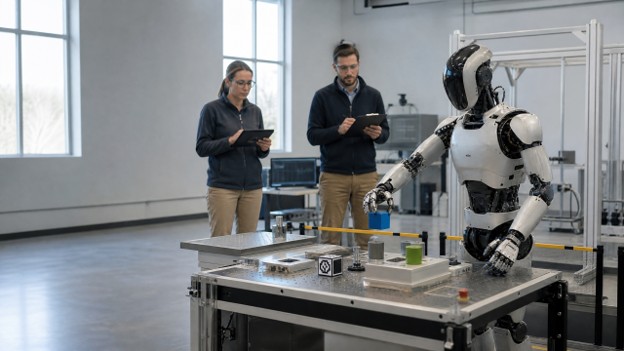
A humanoid robot can look affordable on a quotation and still become an expensive project if the buyer compares body specifications without defining the work the machine must accept. The practical procurement question is not whether a robot can walk, grasp, or follow a demonstration. It is whether a named configuration can complete a measurable task, in the buyer’s environment, at an acceptable intervention rate and with a documented route to safety and market compliance.
That distinction matters because official public evidence still describes a young and uneven market. China’s June 2026 real-world validation notice asks user units to measure task success, efficiency, safety, reliability, economic feasibility, intervention handling, data governance, and lifecycle responsibility. Those are the fields that should appear in a request for proposal. Procure a testable operating envelope, not a humanoid silhouette.
Key Specifications to Evaluate
Start with the task envelope. Record the object mass, centre of gravity, presentation height, cycle time, walking distance, floor condition, lighting, temperature, human proximity, and acceptable recovery behaviour. “Payload” is not one number. Ask for the load at a stated wrist posture, reach, speed, walking state, and battery condition. Require separate values for continuous and peak load, and ask what happens when the arm is fully extended.
Reach and range of motion should be tied to the workstation, not presented as a laboratory maximum. The buyer should know grasp height, turning clearance, step height, doorway width, and whether the robot can recover from a blocked route without a remote operator. Request repeatability at the actual hand position and with the actual end-effector. A hand that can close around an object is not necessarily a hand that can place it reliably into a fixture.
Degrees of freedom can indicate mechanical flexibility, but they are not a performance score. Unitree’s G1 developer documentation, for example, separates the basic G1 configuration from the G1-EDU configuration, listing 23 joint degrees of freedom for the former and 23 to 43 for the latter. The same documentation gives different arm-load values by configuration and states that battery life is about two hours, while warning that parameters vary by scenario and configuration. Every number in a supplier sheet needs a model code, option list, operating condition, and test method.
Sensing and computing deserve the same discipline. Ask which sensors are used for depth, ranging, force, joint position, and safety monitoring, and which signals are safety-rated. Request the compute module, network interfaces, software version, update process, data-retention policy, and offline behaviour. A robot that depends on a remote connection for ordinary motion has a different risk and service profile from one that executes an approved task locally.
Finally, measure recovery. The specification should state what the robot does after a dropped object, obstruction, network loss, depleted battery, human entry into the work envelope, or failed grasp. Require a recovery-time distribution and a clear description of when a human must intervene.
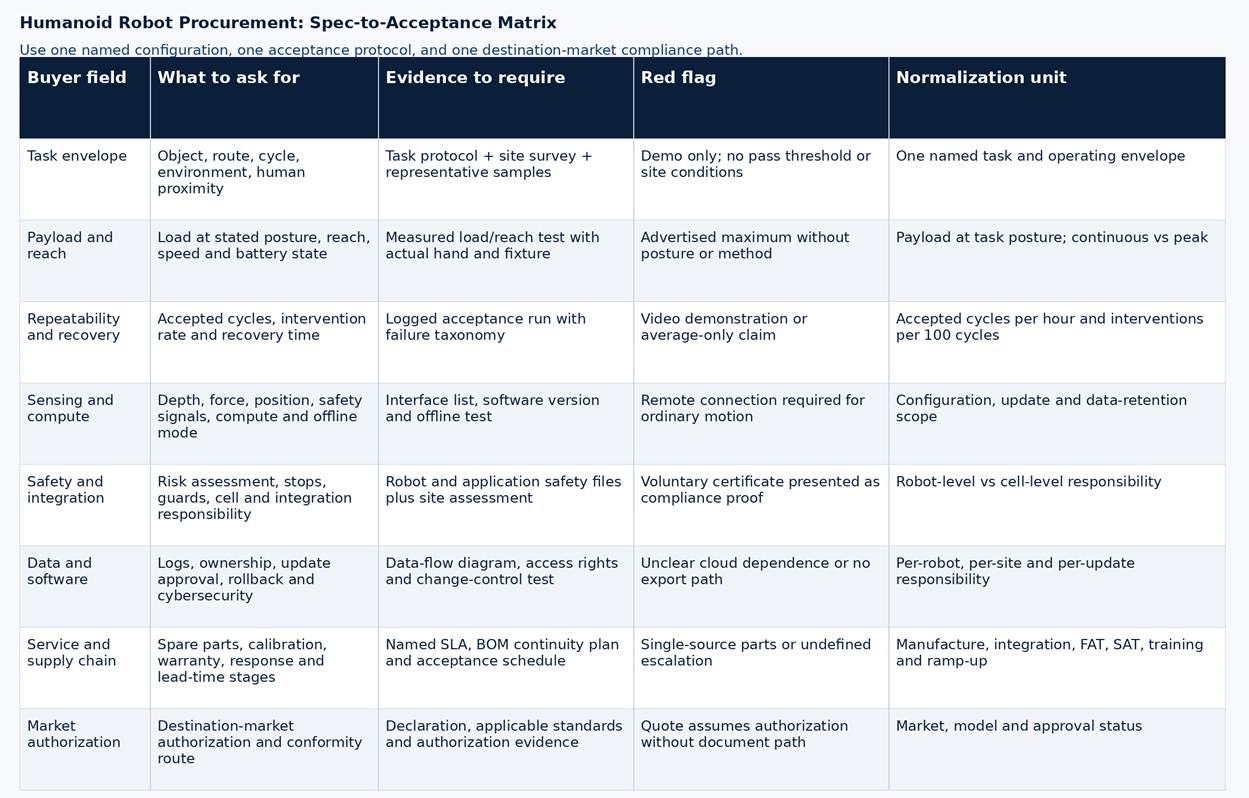
The matrix is an original buyer instrument. It translates a product sheet into five acceptance questions: can the robot perform the task, repeat it, operate safely on site, maintain the data and software loop, and document its limits?
Questions to Ask Suppliers
A procurement team should require answers to seven questions before it compares headline prices.
1. Which configuration is being quoted? Request the model code, hand type, battery, charger, computing unit, sensor package, software licence, safety equipment, and all options. A configuration that looks comparable may exclude the hands, cell integration, or training environment that makes the task possible.
2. What is the acceptance test? Ask the supplier to define the task, input variation, cycle-time target, permitted interventions, safety stop conditions, sample size, and pass threshold. Require a video or log to be accompanied by the test protocol rather than treated as proof on its own.
3. What does the robot do without a remote operator? Ask when teleoperation, supervisory approval, or manual recovery is required. Separate autonomous execution from assisted demonstration and state which mode is included in the quote.
4. How are failures recorded and improved? Ask whether the system logs failed grasps, collisions, route interruptions, human interventions, and software changes. The Ministry of Industry and Information Technology and the State-owned Assets Supervision and Administration Commission’s 2026 notice makes data governance and lifecycle responsibility buyer-relevant requirements, not optional extras.
5. Who owns the data and who can change the software? Clarify whether production data leaves the site, whether the buyer can export logs, how model updates are approved, and how a rollback is performed. Ask for cybersecurity responsibilities across the robot, controller, cloud service, application interface, and maintenance connection.
6. What evidence supports the safety case? Request the machine risk assessment, safety functions, stop categories, protective devices, integration assumptions, operating limits, and destination-market conformity documents. Ask which parts are covered by the robot manufacturer and which belong to the integrator or user.
7. What happens after delivery? Require named response times, spare-parts availability, training hours, software-support terms, warranty exclusions, battery-replacement policy, and an escalation path for failures that occur after the pilot team leaves.
The answers reveal whether the supplier is selling a research platform, a pilot service, or an integrated production system. Those are different purchases even when the hardware looks similar.
Lead Times and Supply Chain Considerations
No qualifying official source provides a dependable market-wide humanoid lead-time average. Treat lead time as a configuration and acceptance variable. Ask the supplier to separate manufacturing, option assembly, software configuration, safety integration, factory acceptance testing, site acceptance testing, training, and ramp-up.
The production evidence that is available points to why this separation matters. A Guangdong government report describes an automated humanoid-robot line with stated capacity above 10,000 units annually and digital management and quality traceability. That is evidence of a production-line design and its stated capacity, not proof that a buyer can receive a configured robot on a particular date. Ask whether the quoted unit comes from a standard build, a shared production slot, or a custom engineering queue.
Supply-chain questions should cover motors, reducers, batteries, cameras, force sensors, compute modules, hands, cables, and safety components. Ask which parts have qualified second sources, which require minimum order quantities, and which require supplier-specific calibration. A spare-parts plan should state which components are stocked locally, which are repairable, and what happens if a software update changes safety-relevant calibration.
For a United States deployment, the Federal Communications Commission’s 28 July 2026 Frequently Asked Questions (FAQ) page adds a market-access check. New foreign-produced advanced robotic devices generally cannot receive equipment authorization for import, marketing, or sale in the United States unless the applicable authorization or conditional-approval path is available. The rule is broader than humanoids, but the FCC definition expressly includes humanoid robots that meet its conditions. A supplier quote should therefore identify the destination-market authorization path before the buyer commits to a delivery date.
Certification and Compliance Standards
Compliance should be treated as a design input, not a certificate collected at the end. The International Organization for Standardization published ISO 10218-1:2025 for robot-level safety requirements and ISO 10218-2:2025 for industrial robot applications and robot cells. The first addresses the robot as partly completed machinery; the second addresses integration, commissioning, operation, maintenance, decommissioning, and disposal of the application.
Those standards are useful anchors, but their scope must be checked. ISO states that the 2025 documents exclude several service, consumer, healthcare, mobile-platform, and special-use cases. A mobile humanoid operating in a mixed human environment may require additional risk controls and standards beyond the parts that apply to a fixed industrial cell. The buyer should ask the supplier to identify the applicable standards, the hazards covered, the hazards excluded, and the party responsible for completing the system-level assessment.
The European Commission states that Machinery Regulation (EU) 2023/1230 becomes mandatory on 20 January 2027. It includes requirements relevant to artificial-intelligence-powered safety functions and cyber-safety for compliance-relevant software and safety-control systems. The Commission also warns that voluntary certificates are not a recognised means of proving compliance. The buyer should request the declaration of conformity, technical file access appropriate to the role, instructions for use, software and cybersecurity documentation, and the notified-body route where the applicable category requires it.
Total Cost of Ownership Preview
The invoice price is only the opening line of the Post 9 total-cost analysis. Official procurement records illustrate why. One Ningxia award lists a Unitree G1eduU2 at CNY 226,000 in a science-outreach purchase, a Beijing vocational-education award lists an iFlytek training humanoid at CNY 394,730, and a university award lists a CASBOT 02 with Handle-L1 at CNY 1,085,000. These are named public configurations, not comparable enterprise quotes; their scope, training, integration, support, and use cases differ.
A defensible comparison should normalize the robot, hands, batteries, chargers, compute, safety cell, integration, training, software, support, spare parts, downtime, and compliance work into one quote. Then divide the result by accepted task cycles rather than by the robot’s advertised operating hours. Record the intervention rate and the cost of failed work. A lower invoice can be more expensive if the buyer must supply the missing integration, remote supervision, or safety engineering.
Closing Position
The right humanoid procurement decision is the one that survives a task-level acceptance test, a destination-market compliance review, and a service-continuity question. Buyers should shortlist suppliers that can document limits as clearly as capabilities. In this market, the strongest quote is not the one with the most impressive specification sheet; it is the one that makes performance, evidence, delivery, safety, data, and ownership responsibilities measurable before the purchase order is signed.
This analysis synthesizes company statements, exchange filings, and public market activity; figures reflect disclosures available as of the information cut-off of August 18, 2026.
Disclaimer: This article is for general information purposes only and does not constitute investment, legal, or procurement advice. Readers should verify details with primary sources before making business decisions.