The Robotaxi Race Has Four Contenders. Grab Backed Three of Them.
While the trade press keeps score between Waymo, Baidu, Pony.ai and WeRide, Grab has quietly hedged across three rival robotaxi makers at once, treating self-driving hardware as a commodity its app decides who gets to sell in Southeast Asia.

Riders in Manila will not meet their first robotaxi through a livestream, a keynote, or an autonomous-vehicle company's own press release. They will meet it as a new icon inside an app they already have installed, the day Grab decides one of the self-driving fleets it has quietly bought into is ready to go live in a district it already maps and dispatches for.
That is the part of the robotaxi story the scoreboard journalism keeps missing.
Coverage of autonomous ride-hailing treats it as a horse race between vehicle makers: Waymo against Baidu's Apollo Go, against Pony.ai, against WeRide, ranked by fleet size and weekly trip counts as though the winner will simply roll into every city that wants one. Outside the United States and China, that is not how deployment actually happens. It happens through whichever ride-hailing app already owns the customer relationship, and that app is treating self-driving hardware as a commodity it can shop for, not a technology it needs to pick a side on.
The fleets everyone is counting
The numbers behind the horse race are real, and worth being precise about. Waymo's co-CEO said in February that the company aims to cross one million paid weekly rides across the US by the end of 2026, up from roughly half a million a week across ten cities by March; the company raised US$16 billion at a US$126 billion valuation in February to fund that expansion, and every vehicle in that fleet is Waymo's own, dispatched through Waymo's own app, in cities where Waymo itself decided to launch.
Baidu's Apollo Go took a different shape. By its own count, Apollo Go delivered close to one million fully driverless rides in the second quarter of 2026 alone, pushing cumulative rides past 23 million since launch. It picked up its first Hong Kong permits in June, opened fully driverless commercial service in Dubai in July, and began open-road testing in Switzerland the same quarter, with a memorandum in place to explore Kazakhstan next. Pony.ai's fleet passed 1,700 vehicles in the first quarter and the company raised its own year-end target to more than 3,500, spread across more than 20 cities, nearly half of them outside China, including Europe's first commercial robotaxi service in Zagreb. WeRide's fleet stood at just over a thousand vehicles in January and is set to more than double past 2,600 by year-end on the strength of a 2,000-vehicle order with Geely's Farizon unit, running on driving permits across eight countries.
One line under all four numbers
None of those four companies reaches a paying rider without someone else's app.
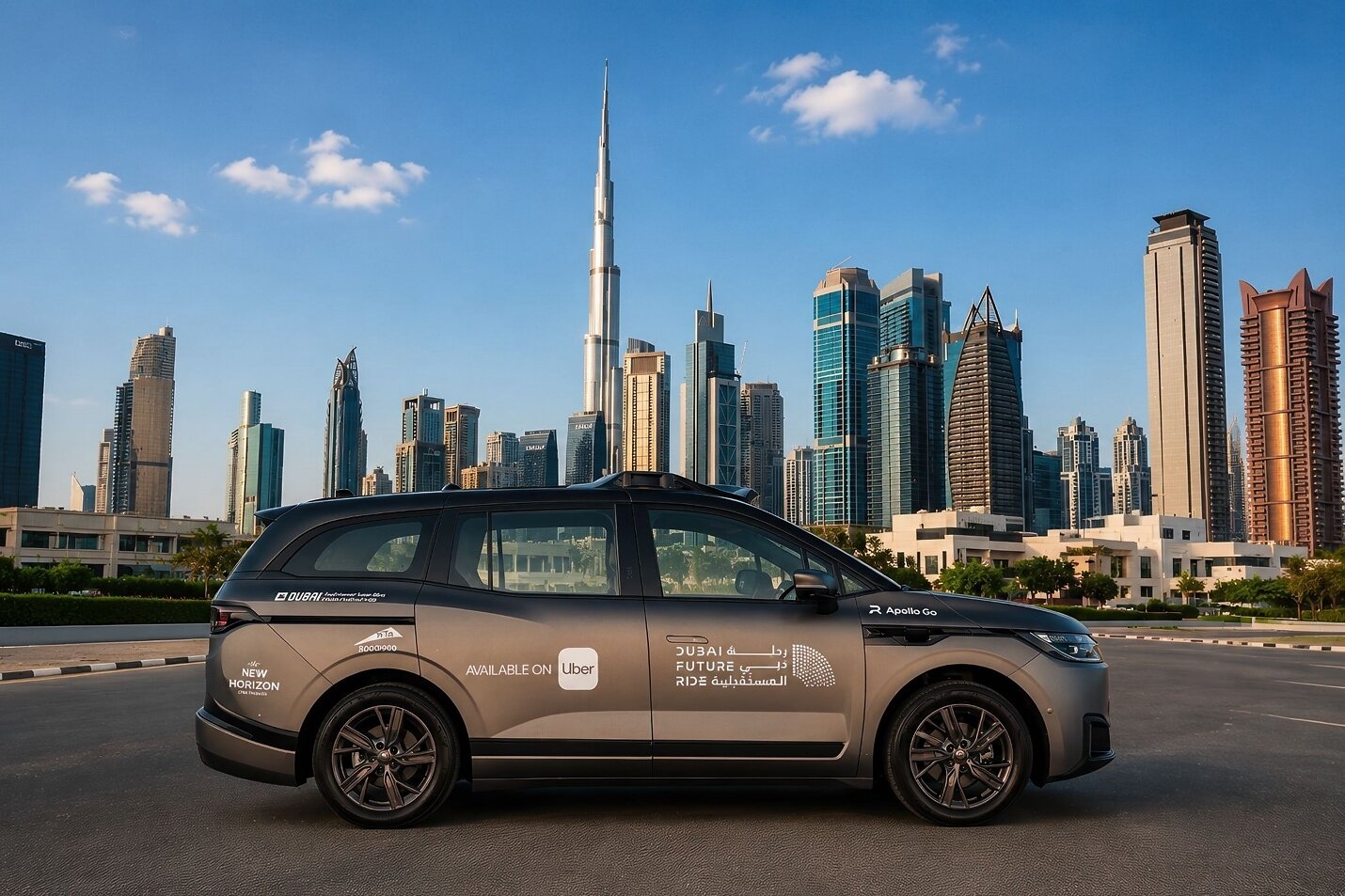
Waymo is the exception that proves the rule, and only because it still owns the whole US stack end to end. Everyone racing to scale outside their home market has reached for the same shortcut: rent the front door instead of building one. Apollo Go's Dubai service runs through both its own app and Uber's. WeRide's Middle East expansion is a joint commitment with Uber to put 1,200 robotaxis on the road across Dubai, Abu Dhabi and Riyadh. Pony.ai leaned on Toyota for a thousand purpose-built vehicles rather than building its own manufacturing scale. The vehicle-maker's job, increasingly, is to show up with a working sensor stack and a permit. The app decides who gets a rider.
Grab is not choosing a winner. It is collecting options.
That is the pattern Grab has taken furthest, and it is the one that matters most from where I sit. Grab has taken a strategic equity stake in WeRide and struck a partnership to deploy its robotaxis and shuttles across Southeast Asia. In the same stretch, it also backed May Mobility, handing the Michigan-based developer its own regional mapping data to adapt to Southeast Asian road conditions, and separately partnered with Momenta to bring a third autonomous-driving stack into the region. Three competing suppliers, one distribution layer, no public commitment to any single one of them.
Grab has already proven the model works: its Ai.R service with WeRide opened to the public in Singapore's Punggol district on 1 April 2026, after more than a thousand riders trialed it free starting in January. The vehicles are WeRide's. The app, the routing, the customer, the brand a rider actually trusts enough to get in, is Grab's.
A fourth supplier just joined the queue
The bench Grab is drawing from keeps getting deeper. On 31 August, Didi's autonomous-driving unit opened its newest robotaxi, the R2, to fully driverless passenger testing in demonstration zones of Beijing and Guangzhou. The vehicle, co-developed with GAC Aion and running Didi's own L4 stack across 33 sensors, had already been operating round the clock in restricted zones since late 2025; the passenger-facing test is the next gate before wider release. Didi has no announced Southeast Asian robotaxi partnership yet, and Grab has not named it among its self-driving bets. Whether a fourth option like Didi eventually joins Grab's shortlist, gets shut out of it, or tries to reach the region on its own is still an open question, but the shortlist is clearly not fixed at three.
What the hedge costs
Buying options is not free of tradeoffs. A supplier that knows it is one of three being evaluated has less incentive to prioritize the harder, lower-margin work of adapting to a monsoon downpour on EDSA or an unmarked jeepney lane, when Riyadh or Zagreb offer cleaner roads and friendlier regulators for the same engineering budget. Multi-supplier hedging protects the platform. It does not obligate any single vendor to solve Southeast Asia's actual driving conditions first, and nobody has committed a fleet to Manila, Jakarta, or Bangkok on any public timeline yet.
The other constraint is regulatory, and it is the one American commentators tend to undersell. California's own permitting regime, run by the DMV, counted only 27 companies holding a testing permit as of May 2026, spread across separate tiers for testing with a safety driver, driverless testing, and commercial deployment. Even Waymo's home market gates fleet growth one state approval at a time. Most Southeast Asian jurisdictions do not yet have an equivalent permitting framework at all, which means the binding constraint on when a robotaxi reaches Manila will not be Grab's supplier shortlist. It will be whichever transport regulator writes the first rulebook.
The question worth tracking
So the question worth watching from an ASEAN vantage point is not which self-driving company builds the best sensor stack. It is which regulator writes the permitting rules first, and which of Grab's three bets that regulator's rulebook happens to favor. The platform has already made its move. The rulebook has not been written yet, and whoever writes it first will do more to decide Manila's first robotaxi than any of the engineers currently racing to improve one.
Disclaimer: This article is for general information purposes only and does not constitute investment, legal, or procurement advice. Readers should verify details with primary sources before making business decisions. Hero image: Baidu Apollo Go, from its official press materials for its fully driverless service in Dubai, available through both the Apollo Go and Uber apps.