Physical AI's First Real Casualty Wasn't a Humanoid. It Was a Factory That Actually Worked.
Daedalus, a Karlsruhe startup founded by an early OpenAI robotics engineer, built real automated factories for paying customers and raised more than US$40 million from Y Combinator, Khosla Ventures, and NGP Capital, yet entered insolvency proceedings this month, while a Brooklyn warehouse robotics startup that licenses its AI instead of owning it raised a fresh US$50 million round in the same week.

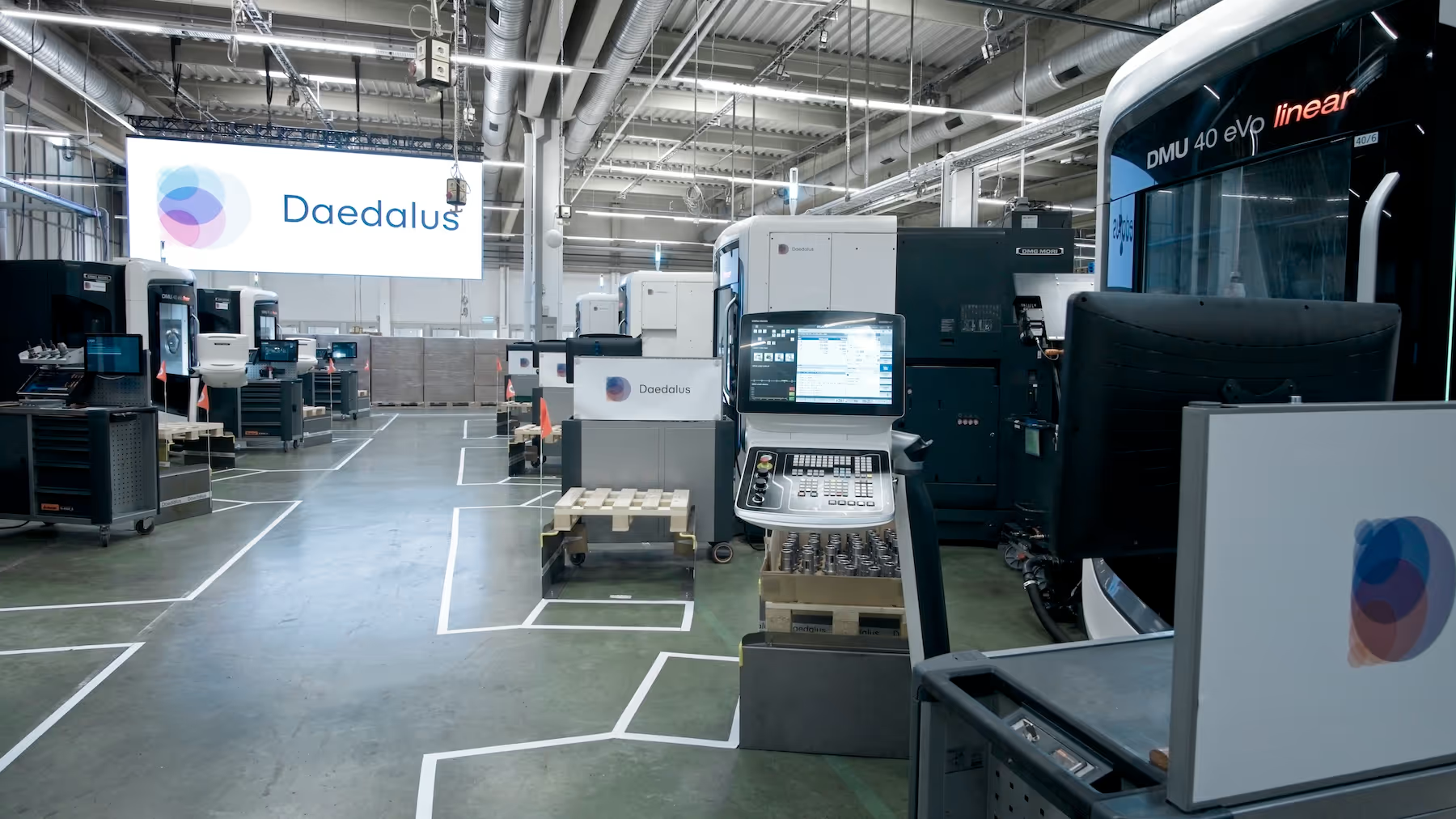
A Karlsruhe startup called Daedalus entered insolvency proceedings this month. If you have not heard of it, that is itself the point. Daedalus did not fail on a demo stage. It built real, automated precision-manufacturing lines, running for paying customers in semiconductors, defense, energy, e-mobility, and medical devices, the sectors every "physical AI" pitch deck claims to be chasing. It raised more than US$40 million from investors most founders would kill to have on a cap table: Y Combinator, Khosla Ventures, NGP Capital. Its founder spent three years as one of the first engineers inside OpenAI's own robotics team before leaving to build something that actually shipped hardware. None of that bought enough runway.
My thesis: the industry telling itself a single "physical AI boom" story is missing a split that happened underneath it. Capital this month is not rewarding deployment. It is rewarding which layer of the stack you refuse to own.
A Company That Did the Hard Part and Still Lost
Jonas Schneider left OpenAI in 2019 after three years on its earliest robotics efforts, then spent 2021 through 2024 raising the money to build Daedalus: a US$11.5 million seed round led by Addition, with Khosla Ventures alongside, and a US$21 million Series A in February 2024 led by NGP Capital, with Addition and Khosla both returning. That return-investor pattern matters more than the headline number. Existing backers do not re-up on a company unless the previous round's thesis is holding up in the metrics they can see.
The thesis was ambitious in a specific way: not a robot arm sold to a factory, but the factory itself, autonomous end to end, with Daedalus owning the capital expenditure, the hardware, the software, and the operating risk. Customers across five industrial verticals signed on. This was not vaporware. It was the single hardest version of the physical AI bet, fully built, fully deployed, and it still ran out of money.
That sentence should unsettle anyone using "they actually deployed it" as a stand-in for "they will survive."
The Same Week, Capital Went Somewhere Else Entirely
Here is the part that turns one company's bad month into a pattern. In the same week Daedalus's insolvency became public, a Brooklyn warehouse-robotics startup called Ultra closed a US$50 million Series A led by Framework Ventures, and used the round to deepen, not reduce, its reliance on an outside foundation-model supplier, Physical Intelligence. Ultra's dual-arm OP1 robot has packed more than 500,000 orders for paying customers. That is a real, revenue-generating deployment, by the same standard Daedalus cleared. The difference is what Ultra chose not to build: its own AI stack.
Put the two side by side and a pattern that the "physical AI is booming" headlines flatten becomes visible:
- Daedalus owned the factory, the hardware, and the software, and ran out of runway.
- Ultra owns the hardware and rents the intelligence, and just raised fresh capital to expand.
- Physical Intelligence, the foundation-model supplier sitting underneath Ultra's robots, is the one accumulating leverage across multiple hardware customers at once, without ever bearing a single customer's capital expenditure.
None of this proves licensing intelligence is a free pass. Cyngn, which retrofits industrial sites with autonomous tugger fleets rather than owning any of them, told investors this same week that its fleet logged more than 11,600 missions through September, a real operational number. It also disclosed a thin quarterly revenue base and an August reorganization aimed at cutting costs. The lean, asset-light model is not a guaranteed survival ticket either. It is just a cheaper way to be wrong, and a cheaper way to still be standing twelve months later if you are wrong only a little.
Why Pedigree and Marquee Investors Didn't Buy Time
It would be comfortable to tell this story as a talent or technology failure. It was not. Daedalus had the OpenAI lineage every recruiter in robotics name-drops, three well-regarded venture firms, and a working product with diversified customers across defense and medical-device buyers who do not sign contracts casually. What it also had was the single most capital-intensive version of the bet: the one where you build the plant, not just the brain or the hands that visit it.
Capex is not a technology risk. It is a balance-sheet risk, and balance-sheet risk does not care whose robotics team you used to work on.
I run a platform that tracks thousands of these companies by their funding rounds, their customer announcements, and the gap between the two, and the pattern that keeps showing up this year is the same one visible in Daedalus's two funding rounds, three years apart, with no third round disclosed since. A company that owns its own factories needs either a fast path to recurring revenue that outpaces its capex, or an investor base willing to fund a decade-long buildout the way utilities and telecoms get funded. Robotics venture capital, even from firms as patient as Khosla, is not structured like utility finance. It wants years, not decades, to see a return.
The Tradeoff Nobody's Pitch Deck Admits
The licensing model carries its own quiet cost, and it is worth stating plainly rather than treating "rent the brains" as a clean answer. A company like Ultra now has its product roadmap partially set by a supplier it does not control. If Physical Intelligence changes its pricing, its roadmap priorities, or its own fundraising needs, every hardware customer downstream inherits that decision with no seat at the table. The asset-light path trades capex risk for dependency risk. It is a better trade in a capital environment this tight, but it is a trade, not a solution, and the companies making it should say so to their own customers rather than letting "AI-powered" marketing language paper over who actually owns the model running inside the box.
From an ASEAN vantage point, where most of the robots I track arrive as imported hardware running someone else's software, this split is not abstract. A factory operator in this region deciding whether to buy from a vertically integrated builder or an integrator renting a foundation model is making the same bet Daedalus's and Ultra's investors just made, at a much smaller scale and with much less room to absorb a wrong call.
What I'm Watching Next
The question worth tracking into next year is not which founders have the best pedigree or the cleanest demo. It is who is quietly moving capital expenditure off their own balance sheet and onto someone else's, and whether the companies now accumulating that risk, the factory operators, the leasing arms, the foundation-model suppliers themselves, are being priced for it honestly. Daedalus built the hardest, most complete version of physical AI's promise and still could not outrun its own balance sheet. Every company still trying to own the factory, not just the software running inside it, should be asking this week exactly why it expects a different ending.
This analysis draws on Daedalus's own disclosed funding history (2021 seed round led by Addition with Khosla Ventures; February 2024 Series A led by NGP Capital with Addition and Khosla Ventures returning), reporting on its October 2026 insolvency proceedings based on court filings, Ultra's disclosed US$50 million Series A led by Framework Ventures and its Physical Intelligence partnership, and Cyngn's own investor disclosure of fleet mission data and its August 2026 cost reorganization. It is for general information purposes only and does not constitute investment, financial, or professional advice.
Hero image credit: Daedalus's own Karlsruhe factory floor, official company photography.