Xynova's Dexterous Hand Debuts at Hangzhou Trade Expo Preview
Hangzhou-based component maker Xynova previewed its dexterous-hand robot performing calligraphy and factory tasks ahead of the Fifth Global Digital Trade Expo, alongside a pharmacy-automation system.


Inside a preview pavilion in Hangzhou on Sunday, September 20, a robotic hand loaded a pencil between two fingers and wrote the character for "Hangzhou" in a fluid, continuous stroke, part of a public preview ahead of the Fifth Global Digital Trade Expo, which opens its full exhibition September 23 to 27 with 2,008 participating companies, including 402 from outside China, and more than 50,000 registered professional visitors from 163 countries. The demonstration belonged to Hangzhou Xynova Technology, a Hangzhou-based core-component supplier for humanoid robots that builds high-degree-of-freedom dexterous hands, high-torque-density integrated joint modules, and micro electric cylinders, whose dexterous-hand line has moved past the trade-show trick and into factory material handling and assembly work, according to engineer Geng Hongwang, who staffed the company's booth during the preview.
Xynova's dexterous hand is built for the specific mechanical problem that has kept most humanoid and industrial-manipulation programs from moving past controlled demos: grasping objects of varying shape, weight, and rigidity with the kind of fine motor control a human hand applies without conscious effort. The calligraphy demonstration, tracing brushstrokes that referenced Hangzhou landmarks including the Leifeng Pagoda, was a deliberately legible way to show a general audience what that control looks like, but Geng was explicit that the same hardware is already doing less photogenic work on factory floors, loading and unloading parts on production lines and assembly stations, and has been adapted for household tasks including folding laundry and preparing coffee.
A Dexterous Hand's Real Test Is Force, Not Flourish
The calligraphy demo photographs well precisely because it requires the opposite skill set from industrial part-handling: sustained, delicate, low-force control over a single point of contact, rather than a firm, repeatable grip across varying object geometries under production-line speed. A dexterous hand that can trace a pencil stroke has proven fine motor coordination and closed-loop feedback control, but it has not proven the grip-force consistency and durability that a factory buyer actually needs across an eight-hour shift of repetitive picking and placing. Xynova's claim that the same hand architecture handles both tasks, artistic fine motor work and industrial load-bearing grasp, is the more commercially relevant claim in the demonstration, and it is one procurement teams evaluating the platform should verify directly against duty-cycle and failure-rate data rather than the pencil stroke alone.
Coffee-making and clothes-folding, the household applications Geng cited, occupy a middle ground between those two extremes: enough variability in object shape and compliance, a coffee cup's rim versus a shirt's fabric, to test general-purpose grasping, but without the sustained industrial duty cycle of a factory line. For a company still building out its commercial deployment record, showing capability across that full range, delicate, industrial, and domestic, at a single public preview is a compact way to signal platform generality to potential customers and investors without disclosing unit economics or specific factory client names, neither of which the company shared during the preview.
The Specifications Behind the Trade-Show Flourish
Xynova's published hardware backs up the range Geng described at the booth. The company's Flex 1 hand carries 25 degrees of freedom, 20 of them actively driven, while its newer Flex 2 generation trims that to 23 degrees of freedom, 19 active and four passive, in exchange for a hybrid-drive architecture the company says lets the hand work more efficiently across varied tasks rather than simply maximizing joint count. Flex 2's sensing package goes further than most dexterous hands on the market: where earlier designs across the industry typically confined tactile sensing to the fingertips, Flex 2 adds a stereo camera pair at the wrist, giving the hand its own local vision when a robot's main body-mounted cameras lose sight of what the fingers are doing, alongside integrated tactile, force, and proximity sensing across four sensing modalities in total. That wrist-mounted vision system is a direct engineering response to a known failure mode in humanoid manipulation, where an arm or torso blocks the main camera's view of the hand exactly when the robot needs to see what it is gripping.
Xynova has already converted that hardware into order volume the company describes as entering a delivery phase rather than a pilot phase, with contracted orders reported in the thousands of units and a target of roughly 100 hands delivered within 2025 as production scaled from prototype runs. As a component supplier rather than a finished-robot maker, Xynova sells into the same humanoid and industrial-manipulation programs that Genisom AI and larger humanoid developers are trying to scale, positioning the company as a picks-and-shovels play inside China's broader embodied-AI buildout: whichever humanoid platforms win the commercial race, a meaningful share of them will need a dexterous hand supplier, and Xynova's calligraphy demonstration is, underneath the spectacle, a sales pitch aimed at exactly that buyer.
Pharmacy Automation Shares the Pavilion Floor
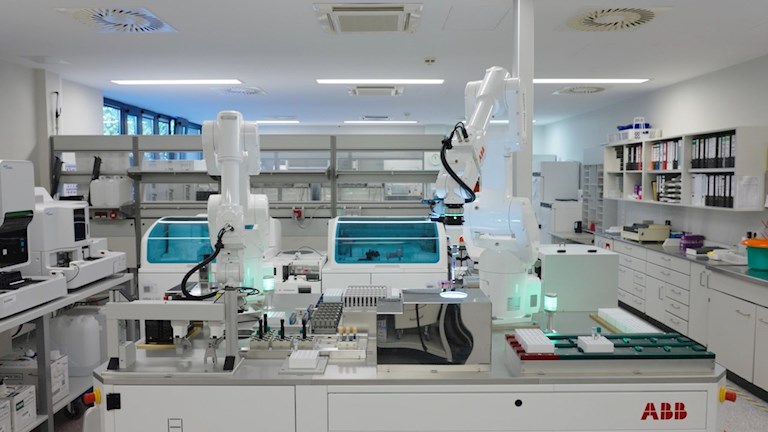
A few booths away, a separate exhibitor demonstrated an automated pharmaceutical sorting and dispensing system built around what its booth signage described as a self-developed embodied general-purpose model, branded Lingbo, positioned explicitly as what the display called China's first pharmacy-retail-storefront solution built on that foundation model, capable of navigating store shelving and dispensing medication without a human pharmacist handling every individual transaction. The booth's branding pointed to backing from Ant Group's robotics unit, a lineage that, if confirmed at the full expo, would place one of China's largest fintech companies directly inside the pharmacy-automation contest alongside dedicated robotics startups, a notable entrant for a sector that has so far been dominated by smaller, specialist automation vendors rather than consumer-internet giants diversifying into embodied AI hardware. The pairing of a dexterous-hand manipulation demo and a pharmacy-automation deployment inside the same preview pavilion reflects the Digital Trade Expo's broader framing this year: less an exhibition of standalone robot hardware and more a showcase of embodied AI systems built for specific, named commercial verticals, retail pharmacy, light manufacturing, home service, rather than general-purpose humanoid platforms seeking any application that fits.
An intelligent flight-simulation system offering pilot-training style demonstrations rounded out the robotics-adjacent portion of the preview, alongside brain-computer-interface headsets shown elsewhere in the pavilion, underscoring that Hangzhou's expo organizers are positioning embodied AI and human-machine interface technology as a unified theme this year rather than segregating robotics into its own category, a curatorial choice with real signal value: it tells exhibiting companies, and the buyers who will walk the floor starting September 23, that the market increasingly evaluates these technologies as parts of one interoperating stack rather than as separate purchasing decisions.
Sixteen International Pavilions Signal Buyer Interest Beyond China
The preview also confirmed that Malaysia and Hungary are establishing national pavilions at this year's expo, while Kazakhstan and Peru have already completed their exhibition builds ahead of the September 23 opening. Peru's pavilion, centered on a project called Inca Raw Territory, pairs smart eyewear with a digitally recreated Andean and Amazon rainforest environment, an application further from industrial robotics than the dexterous-hand and pharmacy demonstrations but one that project director Gabriel Messeš framed around "AI plus cultural tourism" integration, a reminder that the embodied-AI and extended-reality technologies converging at events like this one are being adapted for tourism and cultural-heritage applications well outside the manufacturing and logistics use cases that dominate most industry coverage.
For a manufacturing or logistics buyer, the more directly relevant signal from the preview is that Chinese dexterous-hand and embodied-AI developers below the scale of Unitree, AgiBot, or UBTech are now confident enough in their factory-deployment track records to lead a public demonstration with an artistic flourish rather than an industrial pitch. A company that opens with calligraphy because the factory-floor use case is already a settled, unremarkable part of its business is making a different claim than one still trying to prove basic manipulation works at all, and that distinction, more than the pencil stroke itself, is what a hardware buyer scouting China's dexterous-hand supplier field should take from Hangzhou's preview floor.
What the Full Expo Should Confirm Next Week
The preview pavilion is, by design, a curated highlight reel rather than a full picture of what 2,008 exhibiting companies will show when the Fifth Global Digital Trade Expo opens in full on September 23. Buyers with a genuine procurement interest in dexterous-hand manipulation technology should treat Sunday's demonstration as an invitation to verify Xynova's industrial deployment claims directly at the company's full booth next week, where duty-cycle data, named factory clients, and pricing, none of which surfaced during the preview, are the details that will actually determine whether the hand that wrote "Hangzhou" in pencil can also survive a full shift on an assembly line.
This account synthesizes on-site reporting and company statements from the Fifth Global Digital Trade Expo's September 20 pavilion preview in Hangzhou. It is for general information purposes only and does not constitute a product endorsement or investment advice.
Hero image credit: Xynova, via the Fifth Global Digital Trade Expo.