Schaeffler Cuts 3,460 Jobs, Bets on Robotics and Defense
Schaeffler disclosed a net 3,460 job cuts across Europe alongside nine-month results showing its humanoid robotics order book has grown to about €400 million, with the company naming robotics and defense as growth areas to offset the reductions.

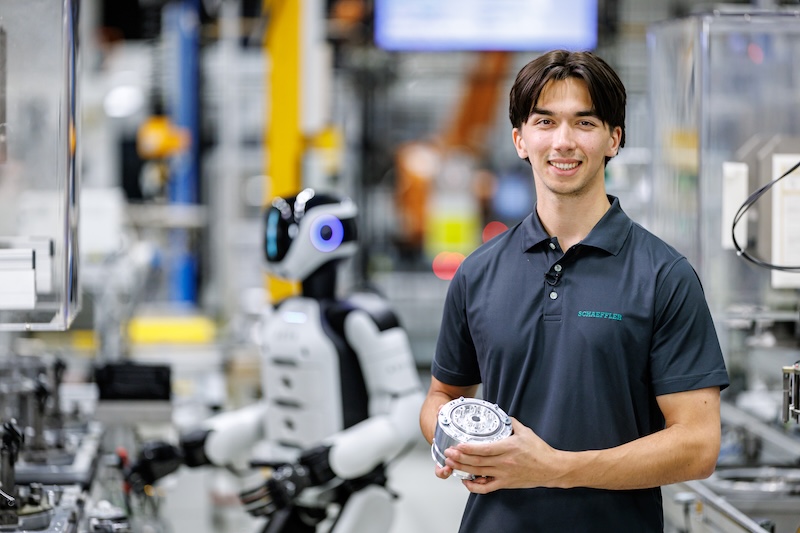
Schaeffler is cutting a net 3,460 jobs across Europe while naming humanoid robotics and defense as the two businesses it expects to absorb part of the resulting capacity, a structural trade the German bearings and components maker disclosed alongside nine-month 2026 results on Tuesday. The job reductions, concentrated in Germany and tied to roughly €480 million (approximately US$520 million) in one-time restructuring costs, land in the same earnings release that shows Schaeffler's humanoid robotics order book has grown to about €400 million (approximately US$430 million) after winning two new customers in Greater China during the third quarter.
Reading those two numbers side by side is the point. Schaeffler is not framing this as a company in crisis cutting costs to survive; it is framing it as a company reallocating capacity away from a shrinking core automotive business and toward two newer lines it believes will eventually replace the revenue the cuts remove. Whether that reallocation closes the gap on anything resembling the original timeline is the open question every supplier watching Schaeffler's transition is now pricing into its own planning.
Where the Cuts Actually Land
The 3,460 net positions being eliminated span 16 European locations, with about 2,660 of them in Germany, roughly 9 percent of Schaeffler's core German workforce of 31,957, or closer to 18 percent when combined with earlier restructuring programs and partial-retirement agreements already in motion. Half the affected roles sit in production, and 30 percent in research and development, a split that signals the cuts are not purely a shop-floor labor reduction but also touch the engineering capacity tied to Schaeffler's legacy combustion and early-generation electric drivetrain programs.
Five sites are closing outright: Dortmund, with 430 employees; Morbach, with 160; Berlin, where roughly 270 people will lose their roles as operations wind down; Schwalbach, where about 385 employees are affected and most are expected to relocate to Frankfurt, leaving around 190 net positions cut; and Herstal in Belgium, a smaller site with about 15 employees. Schaeffler is also reducing capacity at additional locations in France, Slovakia, and elsewhere in Germany without closing those sites entirely. Most of the €480 million (approximately US$520 million) in one-time costs will be booked within 2026, and the company expects roughly €300 million (approximately US$325 million) in annual savings by 2030, a payback window that stretches well past the current restructuring program's visible endpoint.
The Earnings Picture Underneath the Headline Cut
The job reductions arrive against nine-month results that are, by Schaeffler's own framing, stable rather than alarming. Group revenue through the first nine months came in at about €17.5 billion (approximately US$18.9 billion), nearly flat against €17.7 billion (approximately US$19.1 billion) a year earlier, while the operating margin before special items improved to 4.5 percent from 4.2 percent. Free cash flow before acquisitions turned negative, about minus €40 million (approximately US$43 million) against positive €47 million (approximately US$51 million) a year earlier, largely a function of roughly €240 million (approximately US$260 million) in E-Mobility one-off charges, about €220 million (approximately US$238 million) of which landed in the third quarter alone, tied to impairments and provisions as European automakers scale back electric vehicle project volumes in China.
Segment performance makes clear which part of Schaeffler's business is actually under pressure. E-Mobility revenue grew to about €3.9 billion (approximately US$4.2 billion) but still posted a margin of negative 14.8 percent, an improvement from negative 17.8 percent a year earlier but still deeply unprofitable. Powertrain and Chassis revenue declined to €6.3 billion (approximately US$6.8 billion) with margin compressing to 10.8 percent from 11.5 percent. Bearings and Industrial Solutions, the segment closest to Schaeffler's traditional strength and the one most directly tied to its robotics ambitions, grew margin to 8.9 percent from 7.8 percent on flat revenue of €4.8 billion (approximately US$5.2 billion). Chief executive Klaus Rosenfeld confirmed both the company's full-year 2026 guidance, revenue of €22.50 billion to €24.50 billion (approximately US$24.3 billion to US$26.5 billion) with an EBIT margin of 3.50 to 5.50 percent, and its 2028 mid-term targets, language meant to signal that the restructuring charges are a contained, planned cost rather than a sign of deteriorating core demand.
Why Humanoid Robotics Still Cannot Carry the Weight Alone
Schaeffler's robotics business generated less than 1 percent of group sales in 2025, which puts the €400 million (approximately US$430 million) order figure in useful perspective: it is a meaningful pipeline of future revenue and a credible signal that Schaeffler's actuator and precision-bearing components are being specified into real humanoid programs rather than remaining a demonstration partnership, but it is not yet a business capable of offsetting the scale of an automotive supplier doing tens of billions of euros in annual revenue. Chief operating officer Jochen Schröder, the board member responsible for the businesses, said the group sees its most promising growth opportunities in humanoid robotics and defense specifically, but Schaeffler has disclosed no timeline or headcount figure for how many of the roles eliminated in this restructuring round might eventually be replaced by work tied to either business.
That gap between stated strategic direction and disclosed numbers is where buyers and competitors evaluating Schaeffler as a components supplier should focus. A company naming humanoid robotics as a growth pillar while declining to say how many jobs, or how much revenue, that pillar will actually generate over a specific timeframe is making a directional statement rather than a committed plan. What matters more than the headline order figure is that Schaeffler is positioning its precision-manufacturing capacity, reducers, actuators, bearings, the same components that made it a dominant automotive supplier, to be sold into a different end market as the automotive one contracts around it.
Defense as the Quieter Second Bet
Defense has received less public attention than humanoid robotics in Schaeffler's strategic messaging, but Schröder naming it alongside robotics as a growth area is notable given how few traditional European automotive suppliers have publicly pivoted toward defense manufacturing. Automotive suppliers generally carry underused precision-manufacturing capacity once vehicle production volumes soften, exactly the kind of spare capacity that defense contractors need for component production on compressed timelines, and Schaeffler disclosing defense as a named priority alongside robotics suggests the company sees both markets drawing on the same underlying manufacturing competency rather than requiring entirely separate capital investment.
A components supplier moving into defense work also carries a different qualification bar than a consumer-facing pivot would. Defense primes typically require years of supplier audits, security clearances, and quality certifications before awarding production contracts at meaningful volume, which means any defense revenue Schaeffler eventually books is more likely to arrive on a multi-year timeline than the comparatively faster sales cycle visible in its humanoid robotics order wins. That asymmetry matters for how investors and competing suppliers should weight the two growth bets: humanoid robotics orders can show up in a single quarter's disclosure, as the €400 million (approximately US$430 million) figure just did, while defense revenue is structurally built to lag any stated strategic intent by several years before it registers as a comparable line item. Suppliers and buyers tracking Schaeffler's progress should therefore expect the robotics order book to keep moving quarter to quarter long before any comparable defense number becomes public.
What Competing Component Suppliers Should Take From This
Rival bearing, actuator, and precision-gearing suppliers watching Schaeffler's restructuring have a narrower window than the headline job-cut number suggests to establish their own position in humanoid robotics and defense component supply chains. Schaeffler is not alone in recognizing that automotive precision-manufacturing capability transfers directly into humanoid actuator production, and the two new Greater China customers behind this quarter's order growth signal that Chinese humanoid robot makers are actively qualifying multiple component suppliers rather than consolidating around a single incumbent. A supplier still treating humanoid robotics as a speculative side project, rather than a qualification race already underway, risks finding the early design-win slots already spoken for by the time it decides to compete seriously, and by then the cost of displacing an incumbent already running production volume is considerably higher than the cost of winning the original qualification.
The picture that emerges from Tuesday's disclosures is a major European industrial supplier mid-transition, closing plants built for a combustion and early-EV era while it tries to prove that the same precision-engineering capability can be re-pointed at humanoid actuators and defense components fast enough to matter before the restructuring savings run their own multi-year clock. The €480 million (approximately US$520 million) being spent to get there and the €400 million (approximately US$430 million) in robotics orders booked so far sit on opposite sides of the same ledger, and neither number alone tells a buyer, supplier, or competitor whether Schaeffler's bet closes before the next earnings cycle forces the comparison again.
This article synthesizes Schaeffler's public financial disclosures and statements from company executives. It is for general information purposes only and does not constitute investment advice.