Humanoid Robots Break Human Sprint and High Jump Records in Beijing
A humanoid robot ran 100m in 9.39 seconds at Beijing's World Humanoid Robot Games, beating Usain Bolt's human record, while a second platform cleared a 2.88m standing high jump. The comparison to human athletics doesn't hold under scrutiny, but the underlying actuator and control progress is real and more relevant to industrial buyers than the sprint headline suggests.

The Sprint Record Fell. The Comparison Did Not Survive It.
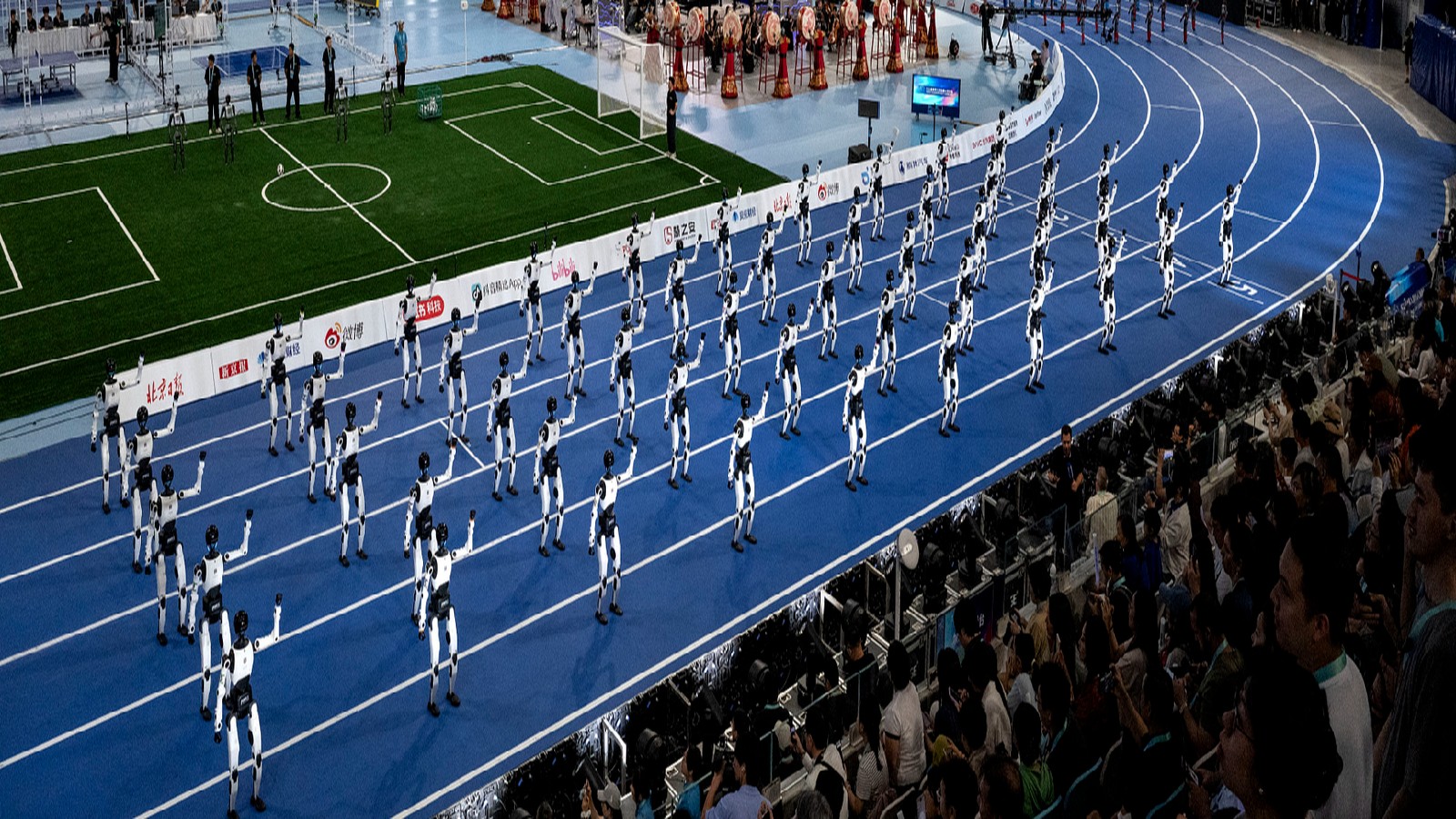
A humanoid robot ran 100 metres in 9.39 seconds at the National Speed Skating Oval in Beijing on Saturday, August 22, and by Sunday the number had travelled further than any robot in the building. Usain Bolt's human world record, set in Berlin in 2009, is 9.58 seconds. The machine was built by X-Humanoid, the Beijing Humanoid Robot Innovation Center, and the same programme also produced a standing high jump of 2.88 metres against Javier Sotomayor's human record of 2.45 metres from 1993.
Both numbers are real. Both were clocked in public, at a competition with 2,056 robots from 666 teams across 16 countries. And both are being read in a way that tells you almost nothing useful about whether humanoid robots are ready to do paid work.
What Was Actually Clocked
The competition is the second edition of the World Humanoid Robot Games, held at the venue built for the 2022 Winter Olympics and running a programme of roughly 51 events and more than a thousand individual contests. The sprint results came early, during the opening days.
X-Humanoid's Tiangong-series platform posted the 9.39-second run that drew the international coverage, though reports differ on the exact model designation within that series. A second machine, from the smartphone maker Honor and rendered in English coverage as both Lightning and Blitz, recorded 9.32 seconds in a trial run before the opening, hitting a reported peak of 14.5 metres per second, and then 9.47 seconds in the 100-metre final itself.
Note the structure of those figures. The fastest single number, 9.32 seconds, was set in a test rather than a race. The fastest competitive number, 9.39 seconds, came from a different manufacturer. Coverage has tended to collapse the two into one headline, which is how a trial-run figure ends up being compared directly against a record set under World Athletics conditions with a starting pistol, a false-start rule, and a wind gauge.
By Sunday, August 23, twelve gold medals had been awarded, and the finals of freestyle fighting and five-a-side football had been run.
Why This Is Not a Like-For-Like Record
A human sprint record is a tightly specified artefact. It requires a legal tailwind under two metres per second, a certified track surface, reaction time measured from starting blocks with a floor below which the start is ruled false, and drug testing. Every one of those constraints exists because, without them, the number stops being comparable across athletes and years.
None of them applies here in the same form. A robot's start is a software event rather than a neuromuscular one, and the concept of a false start does not translate. Nothing in the machine gets tired across rounds. The surface, the ambient conditions, and the number of attempts available before the recorded run are not published in a way that would let an outside party reproduce the result.
That does not make the achievement fake. Getting a bipedal machine to cover 100 metres upright at an average of better than ten metres per second is a genuinely hard control problem, and it was not solvable at this quality two years ago. It makes the comparison a category error. The right reading is that humanoid locomotion has reached a speed regime previously out of reach, not that a machine has beaten Usain Bolt at his own event under his own rules.
There is a commercial version of this distinction that matters more. No customer buys a robot to sprint. Buyers care whether a machine can move at a working pace, for a full shift, around people, without falling. Peak velocity in a straight line on a clear track is close to the least transferable capability a humanoid can demonstrate.
What Actually Changed in the Hardware and the Model
The engineering behind a sub-9.5-second humanoid sprint is worth separating from the record framing, because it is the part that transfers.
Running, unlike walking, has a flight phase in which no foot is in contact with the ground and no correction is possible. Every stride is a controlled fall that must be caught by a limb swinging into a position computed before the machine left the surface. Doing that repeatedly at ten metres per second requires joint actuators that can deliver high torque at high speed rather than trading one for the other, a control loop fast enough to update mid-stride, and a structure that survives the repeated impact loading without drifting out of calibration.
Two years ago the limiting factor across most Chinese platforms was actuator power density. The visible progress in Beijing suggests that constraint has eased, which matters well beyond athletics: the same torque envelope that lets a machine sprint is what lets it carry a load up a ramp or catch itself when a floor surface changes underfoot. That is the transferable result, and it is a quieter claim than beating a sprinter.
The Crash Rate Is the More Useful Number
The more informative footage from Beijing is the footage nobody put in a headline. Across the events, machines crashed out in a variety of ways. At least one caught fire. At least one crossed the line and then hit a safety barrier. Those failures were visible precisely because the organisers chose to run the competitions live, in front of cameras, rather than release curated highlight reels.
That choice deserves credit, and it also supplies the metric a procurement team should actually want. In a deployment, the question is never what the machine achieves on its best attempt. It is how often it fails, how badly it fails when it does, and how quickly it returns to service. A robot that posts a world-class time once in twenty attempts and destroys itself on the other nineteen is a research result. A robot that posts a mediocre time in nineteen out of twenty attempts and walks away each time is a product.
The Games do not currently publish attempt counts, failure rates, or repair intervals alongside the winning times, and that omission is the single change that would turn a spectacle into a benchmark. Until then, the honest summary is that Beijing demonstrated a ceiling, not a floor, and industrial buyers are paid to care about floors.
Why Beijing Runs the Games at All
It would be a mistake to read the event purely as showmanship. China's approach to embodied AI over the past two years has consistently favoured public, verifiable demonstration over closed-door benchmarking, on the theory that competition in front of an audience of government procurement officers, industrial buyers, and rival engineering teams applies a kind of pressure that internal testing cannot.
The structure of the programme reflects that. Alongside the athletic events sit a large slate of work-scenario contests covering factory, hotel, home, hospital, retail, and emergency-response settings, with tasks such as industrial assembly, library sorting, housekeeping, and rescue. New additions this year include tug-of-war and weightlifting, along with the traditional Chinese sports Taijiquan and Touhu.
Those scenario events are where the commercially relevant information lives, and they attract a fraction of the coverage that a sprint record does. That asymmetry is a media problem rather than an engineering one, but it shapes what the industry believes about its own progress.
What a Buyer Should Take From Beijing
Three practical readings.
First, treat the records as evidence about a specific capability, whole-body dynamic control at high speed, and not as evidence about general readiness. The teams that produced them, X-Humanoid and Honor, have demonstrated that their control stacks can hold a bipedal machine stable at velocities that would have destroyed a comparable platform in 2024. That is a real signal about the maturity of the underlying models.
Second, ask any vendor citing a Games result for the denominator. How many attempts, under what conditions, with what damage, and how long between the last repair and the recorded run. A vendor that has those numbers and shares them is telling you something. A vendor that offers only the highlight is telling you something too.
Third, watch the scenario events rather than the track. A robot that can complete a hotel housekeeping sequence or a hospital materials-handling task without intervention is closer to a purchase order than one that can run fast in a straight line, and the gap between the two is the gap between a demonstration and a deployment.
The Number That Will Matter in a Year
Beijing has given the industry a headline it will repeat for months, and the headline is not wrong so much as mismatched to the question most readers think it answers. A machine covered 100 metres faster than the fastest human has ever done it, under conditions that are not the conditions under which the human record was set, at an event where a meaningful share of the field failed to finish.
The interesting follow-up is not whether next year's time drops below nine seconds. It is whether the organisers begin publishing failure rates alongside finishing times, and whether the companies posting the fastest numbers are also the ones completing the hotel, hospital, and factory tasks in the same building. When those two lists start to overlap, the Games will have become the benchmark the industry keeps claiming they already are.
Image: CGTN, cropped.
Disclaimer: This article is for general information purposes only and does not constitute investment, legal, or procurement advice. Readers should verify details with primary sources before making business decisions.