Swiss Startup coprod Raises US$6 Million to Fix Robot Hardware Integration
Lausanne-based coprod closed a US$6 million pre-seed round led by Founderful and PROTOTYPE to sell modular, EtherCAT-based robot hardware that cuts the cost and time of rebuilding robot components after a prototype fails.

Swiss Startup coprod Raises US$6 Million to Fix Robot Hardware Integration
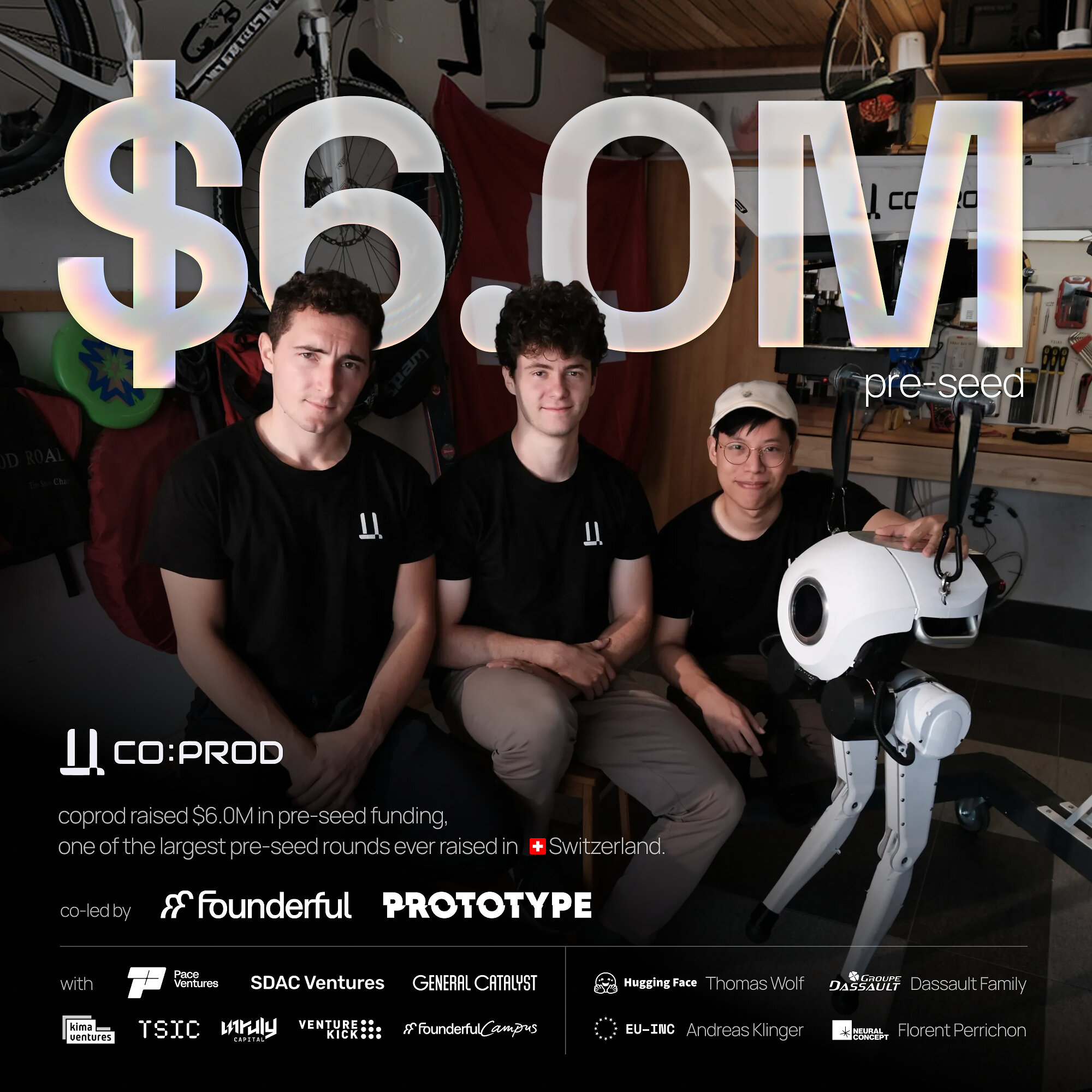
coprod, a robotics hardware company headquartered in Lausanne, Switzerland, closed a US$6 million pre-seed financing round on November 23, 2026, led by venture firms Founderful and PROTOTYPE. The round also brings in General Catalyst, Pace Ventures, Tiny Supercomputer Investment Company, Kima Ventures, SDAC and Unruly Capital, alongside angel investors Thomas Wolf, the co-founder of Hugging Face, the Dassault family and Florent Perrichon.
Founded in late 2024 by three graduates of the École Polytechnique Fédérale de Lausanne (EPFL), coprod builds modular robotics hardware under a single software stack it calls co:system. Its co:power, co:battery, co:sensor and co:motion modules share one real-time EtherCAT control plane and a single programming interface in C++ and Python, so engineering teams can swap a component without rewriting the control code around it. Co-founders Loïc Delineau, who serves as chief executive, Vincent Nguyen and Matthias Schuller started the company by building a bipedal robot demonstrator in a garage in the Swiss Alps, a detail investors now cite as proof the team understands the hardware problems it is trying to solve from direct experience rather than a slide deck.
The Line Item Robotics Teams Don't Talk About
Every physical-AI company eventually runs into the same unglamorous cost center: the price of changing the hardware after the first prototype fails. coprod puts that figure at US$5,000 to US$25,000 per design iteration once a team accounts for custom brackets, wiring harnesses, motor drivers and the engineering hours spent making a one-off control board talk to a new sensor. A robotics program rarely nails its mechanical and electrical design on the first pass; most run through four, five or more iterations before a robot is stable enough to demonstrate to a customer, let alone sell.
That arithmetic matters more to buyers than it sounds. A robotics team that redesigns its hardware five times before shipping has effectively paid a second company's worth of nonrecurring engineering costs just to reach a first customer. For a venture-backed startup racing a runway clock, or an industrial buyer evaluating which automation vendor will still exist in two years, the hidden cost of hardware churn is often a better predictor of survival than the headline specifications on a data sheet. coprod's pitch to investors, and implicitly to the robotics teams it wants as customers, is that this cost is a tooling failure rather than an unavoidable tax on building physical machines.
The alternative most robotics companies choose today is vertical integration: hire a mechanical team, an electrical team and a firmware team, and own every layer of the stack so no supplier failure can stall a product. That approach works for well-capitalized humanoid robot programs that can staff all three disciplines in-house, but it is a difficult path for a smaller industrial automation vendor or a university spinout trying to reach a first paying customer on a limited budget. coprod is betting that a large population of robotics builders would rather buy a qualified, pre-integrated module than hire the specialized engineers needed to build and certify one from scratch, the same calculation that pushed most electronics manufacturers toward standardized components decades ago rather than custom silicon for every product.
For a procurement team evaluating automation suppliers, that trade-off has a practical implication: a vendor built on commodity, interchangeable hardware modules can often ship a fix or a new variant faster than one running a fully custom stack, but it also depends on coprod's own roadmap holding up. If the qualification and certification milestones described below slip, every robotics company that has designed around coprod's modules inherits that delay.
coprod's round lands inside a broader wave of capital returning to physical hardware rather than only to the artificial intelligence models that control it. Investors who spent the past two years funding humanoid robot demonstrations and foundation models for manipulation are increasingly asking what happens once a team has a working algorithm and still cannot source or integrate the actuators, sensors and power electronics needed to put it in a real machine.
One Control Plane, Four Modules
The technical answer coprod is selling is standardization at the hardware layer, something software companies take for granted and robotics companies rarely get. Each of its four module families, power delivery, battery management, sensing and motion, is designed to work alone or as part of a larger system, and all of them answer to the same EtherCAT-based real-time bus. A team building a mobile manipulator does not need a separate firmware stack for its battery monitor, its torque sensors and its drive motors; it writes against one API in C++ or Python and lets coprod's control plane handle the timing guarantees that real-time robotics demands.
A front-end configuration tool lets engineers wire components together and standardize how they communicate before any physical build begins, catching integration mismatches on a screen instead of on a bench. With part of the new capital, coprod is opening a full-stack prototyping facility in Lausanne equipped with CNC lathes, mills, lasers and electronic test equipment, built specifically to compress the iteration cycle described above. The company's internal target is to cut the elapsed time between a design change and a working prototype from roughly two weeks down to 24 hours, a tenfold reduction that would turn hardware iteration from a scheduling event into something closer to a software build.
Why European Capital Is Backing Precision Hardware Again
The round is also a bet on geography. Alex Stöckl, a general partner at lead investor Founderful, has pointed to Switzerland's existing base of precision manufacturing talent, the same machinists and instrumentation engineers who supply the country's watch and medical-device industries, as a reason the firm expects Swiss founders to produce category leaders in robotics hardware rather than just robotics software. That argument runs against the more common venture narrative, in which physical-AI capital chases humanoid robot demonstrations in the United States and China while treating component supply as a solved problem to be outsourced later.
coprod's investor roster reflects that split bet. Hugging Face's Thomas Wolf writing a personal check signals that at least one prominent figure from the software side of artificial intelligence sees hardware standardization, not another foundation model, as the near-term bottleneck for embodied AI. PROTOTYPE and General Catalyst, both active across the broader robotics and physical-AI funding cycle this year, are effectively underwriting the view that whoever controls the integration layer between sensors, actuators and compute captures outsized value as robot deployments scale, regardless of which company's brand sits on the finished machine.
The Manufacturing Math Behind the Roadmap
coprod's own roadmap puts real deadlines against that thesis. The company plans a commercial launch of its first component line in early 2027, with the full product family qualified and certified by the end of that year, a timeline that gives buyers a concrete point at which to evaluate whether the modules perform outside a demo environment. Production is set to scale in Shenzhen and in Texas, a dual-sourcing decision that keeps coprod inside the two manufacturing regions most robotics integrators already depend on for components, while the company insists its headquarters, core engineering team and research and development stay in Switzerland.
That split between where the intellectual property is created and where the hardware is actually built is now close to standard practice for European and American physical-AI startups, and it carries its own risk: a modular control architecture is only as defensible as the firmware and tooling layered on top of it once the physical design is replicable at scale. For procurement teams watching the robotics supply chain, coprod's qualification and certification milestones at the end of 2027 will be the first real test of whether a fresh round of capital converts into shipped hardware on the stated schedule, rather than another extended prototyping phase.
The timeline also sets an implicit clock on coprod's fundraising runway. A pre-seed company planning dual-region manufacturing, a certification process and a new physical facility in Lausanne is making commitments that typically consume capital faster than a software-only startup of the same size, which raises the odds that a follow-on round becomes necessary well before the full module line reaches certified, shippable status at the end of 2027. How coprod sequences that spending, and whether its first commercial customers materialize on the stated early-2027 launch date, will do more to validate the model than the size of this pre-seed round on its own.
Chief executive Loïc Delineau has framed the company's goal as removing unnecessary friction from robot building, letting engineering teams concentrate on the mechanical and software problems unique to their application instead of re-solving power delivery and sensor timing from scratch on every project. Andreas Klinger of PROTOTYPE has made a similar case from the investor side, arguing that founders burn disproportionate time and capital on integration problems that have already been solved dozens of times across the industry, time that could otherwise go toward the customer-facing capability that actually differentiates one robotics company from another.
Set against that backdrop, the number worth tracking out of this round is not the US$6 million itself but the 24-hour prototyping cycle coprod says its new Lausanne facility is built to deliver, down from the roughly two weeks a comparable hardware change costs most robotics teams today.
This analysis synthesizes company statements and public market activity surrounding coprod's funding announcement. This article is for general information purposes only and does not constitute investment, financial, or legal advice.