Goldman Sachs Projects Korea Will Produce 74,000 Humanoid Robots by 2030, Representing 30 Percent of Global Output
Goldman Sachs has released a report projecting that Korea will produce 74,000 humanoid robots by 2030, equivalent to 30 percent of global humanoid production, based on the country's automotive component manufacturing expertise and its position in the Boston Dynamics supply chain. The projection comes as Korean parts makers including Halla Cast and SL pivot production lines to robot components following the US FCC ban on Chinese robots.

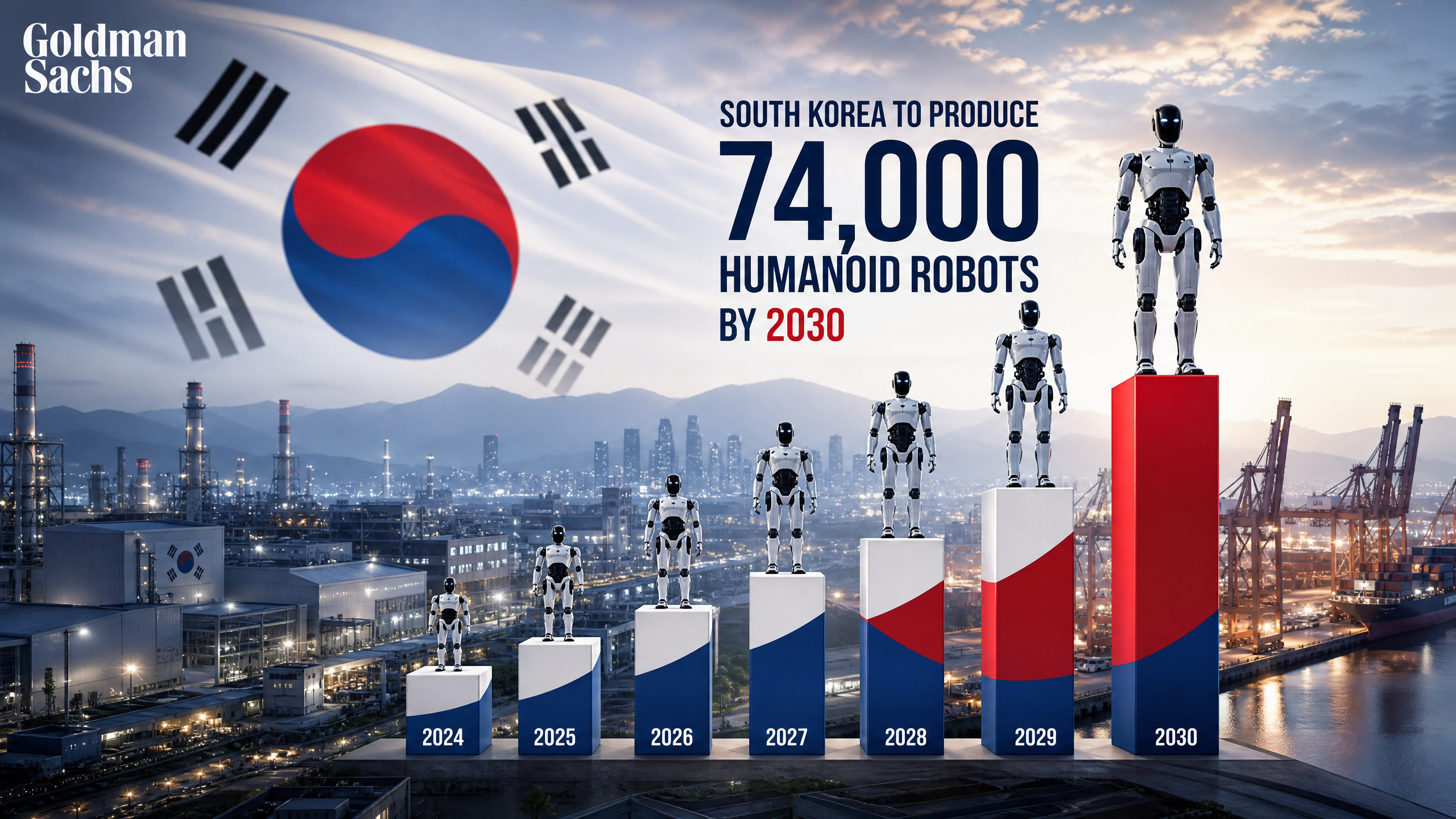
Goldman Sachs has published a projection that Korea will produce 74,000 humanoid robots by 2030, equivalent to approximately 30 percent of global humanoid robot output at that date. The projection, cited by the Seoul Economic Daily on August 3, is based on Korea's established position in the automotive component supply chain, its existing relationships with Boston Dynamics and Hyundai's robotics division, and the structural shift in the North American market created by the US Federal Communications Commission's ban on new Chinese robot imports.
The 74,000-unit figure is not a forecast of Korean robot sales -- it is a forecast of Korean robot production, meaning robots manufactured in Korea for both domestic and export markets. The distinction matters because it implies that Goldman Sachs expects Korea to become a significant manufacturing hub for humanoid robots, not just a consumer of them. At 30 percent of global output, Korea would be the second-largest humanoid robot producing country in the world by 2030, behind China but ahead of the United States, Japan, and Germany.
The Automotive Analogy and Its Limits
Goldman Sachs' projection rests on an analogy between the automotive supply chain and the humanoid robot supply chain. Korea's automotive component industry -- which supplies Hyundai, Kia, and through them the global automotive market -- is one of the most sophisticated in the world. It has demonstrated the ability to manufacture precision components at scale, maintain tight quality tolerances, and respond quickly to design changes. These capabilities are directly relevant to humanoid robot manufacturing, which requires similar precision, similar quality management, and similar supply chain coordination.
The analogy is compelling but not perfect. The automotive supply chain took decades to develop, and the components it produces are largely standardized across vehicle platforms. The humanoid robot supply chain is still in its early stages, and the components required vary significantly across robot platforms. A leg actuator designed for Boston Dynamics' Atlas is not interchangeable with one designed for Unitree's H1, which means Korean suppliers cannot simply produce a single component and sell it to all robot manufacturers. They need to develop relationships with specific robot makers and adapt their components to each platform's requirements.
The automotive analogy also glosses over the software and AI content of humanoid robots, which is substantially higher than in conventional vehicles. A humanoid robot's value is increasingly determined by its AI capabilities -- the models that enable it to perceive its environment, reason about tasks, and execute complex movements. Korean automotive component makers have no established position in AI software, which means the 74,000-unit production projection assumes that Korea's role will be primarily in hardware manufacturing rather than in the higher-value AI and software layers.
The Boston Dynamics Connection
The most immediate driver of Korean humanoid robot production is the Hyundai-Boston Dynamics relationship. Hyundai completed its full acquisition of Boston Dynamics in August 2026, acquiring SoftBank's remaining stake and taking 100 percent ownership of the company. Hyundai has set a production target of 30,000 robots per year by 2028, and a significant portion of that production is expected to be manufactured in Korea using Korean components.
SL Corporation has already secured a contract to produce the leg module for Boston Dynamics' Spot quadruped robot, with full-scale mass production beginning in Q3 2026. Halla Cast is doubling its Incheon production line to supply heat-dissipation cases for a North American robotics client. These are not speculative future contracts -- they are current production agreements that are already generating revenue.
The Boston Dynamics production ramp is the most concrete near-term driver of the Goldman Sachs projection. If Hyundai achieves its 30,000-unit annual production target by 2028 and Korean suppliers provide a significant share of the components, that alone would represent a substantial portion of the 74,000-unit 2030 projection. The question is whether Korean companies can also secure positions in the supply chains of other humanoid robot manufacturers beyond the Hyundai-Boston Dynamics ecosystem.
The FCC Ban as a Catalyst
The US FCC ban on new Chinese robot imports has accelerated the timeline for Korean companies to establish positions in the North American robot supply chain. Before the ban, Chinese robot manufacturers had a significant cost advantage in the North American market, which made it difficult for Korean suppliers to compete on price. The ban removes that advantage for Chinese manufacturers and creates a window for Korean suppliers to establish relationships with North American robot companies before Chinese manufacturers find ways to restructure their supply chains.
The window is real but time-limited. Chinese robot manufacturers are already exploring options including manufacturing partnerships with non-Chinese companies, supply chain restructuring to reduce Chinese content, and lobbying for regulatory adjustments. The FCC ban is unlikely to be permanent in its current form, and Korean companies that do not establish durable supply relationships during the current window may find that the opportunity has passed when the competitive environment normalizes.
The Conditions Required to Reach 74,000 Units
Achieving 74,000 units of Korean humanoid robot production by 2030 requires several things to go right simultaneously. First, the global humanoid robot market needs to grow to a size where 74,000 units represents 30 percent of total output -- implying global production of approximately 247,000 units per year by 2030. That is an aggressive growth trajectory from the current base of a few thousand units per year globally.
Second, Korean companies need to secure production contracts with multiple robot manufacturers, not just Hyundai-Boston Dynamics. Diversification across customers is essential for reaching the 74,000-unit target, and it requires Korean suppliers to develop capabilities that are relevant across multiple robot platforms rather than optimized for a single customer's requirements.
Third, the Korean government needs to maintain and expand its support for the robotics supply chain transition. The Ministry of Trade, Industry and Energy's current programs provide some support, but the scale of investment required to build a 74,000-unit annual production capacity is substantially larger than what current programs provide. Government support will need to scale with the ambition of the projection.
The Goldman Sachs projection is a scenario, not a certainty. It describes what Korea could achieve if the market develops as expected and Korean companies execute effectively. The actual outcome will depend on execution quality, market development speed, and competitive dynamics that are difficult to predict four years in advance. What the projection does establish is that the opportunity is large enough to justify significant investment and strategic commitment from Korean companies and the Korean government.
Disclaimer: This article is for informational purposes only and does not constitute financial or investment advice.