DoorDash Wins FAA Certification to Fly Its Own Delivery Drones
DoorDash has secured a Federal Aviation Administration (FAA) Part 135 air carrier certificate, launching its in-house drone delivery program, DoorDash Air. The San Francisco-headquartered company, known for its vast network of independent delivery drivers, is now one of only eight drone operators in the United States to hold this critical regulatory clearance. The certification allows DoorDash to operate commercial air delivery beyond visual line of sight at scale, shifting its drone strategy from vendor partnerships to owned logistics capacity. Initial operations will focus on pilot programs around Dallas-Fort Worth, Texas, targeting the three-to-five-mile delivery radius that accounts for more than 20 percent of its total order volume. In this specific distance band, drones offer a faster and cheaper alternative to car-based delivery. The move positions DoorDash to capture better unit economics in suburban markets while navigating the complex regulatory and operational hurdles that have historically slowed the expansion of commercial drone delivery networks.
DoorDash received a Federal Aviation Administration (FAA) Part 135 air carrier certificate on July 29, 2026, launching its in-house drone delivery program called DoorDash Air. The regulatory clearance makes the San Francisco-headquartered logistics platform one of only eight drone operators in the United States authorized to run commercial air delivery beyond visual line of sight at scale. The certification follows a rigorous five-stage approval process and marks a structural shift in how the company approaches automated fulfillment. While DoorDash has partnered with Alphabet's Wing since 2022 to test aerial delivery, holding its own air carrier certificate transforms drone operations from a vendor-dependent experiment into owned logistics capacity.
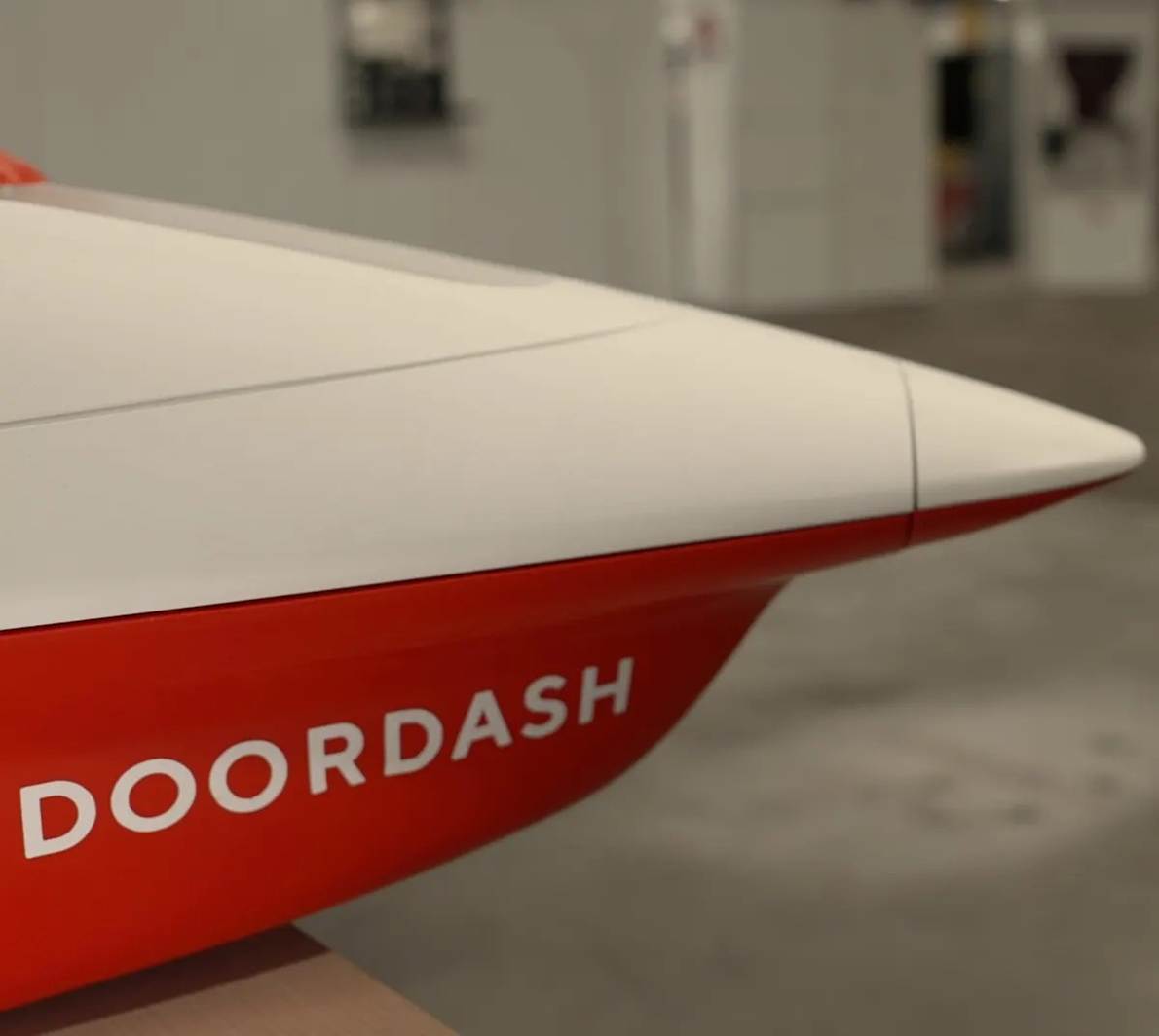
The launch of DoorDash Air, led by Harrison Shih, targets a specific operational inefficiency in the current food delivery model. According to the company, more than 20 percent of all DoorDash orders travel distances of three to five miles. In this specific distance band, drones are demonstrably faster and cheaper to operate than passenger vehicles driven by human couriers. During pilot programs conducted in 2025, DoorDash drones achieved an average delivery time of 25 minutes. Participating merchants reported that order volume rose by approximately 30 percent during the nine weeks following the introduction of the service.
Initial operations for DoorDash Air will focus on pilot programs in the Dallas-Fort Worth area of Texas, a region that has become a primary testing ground for commercial drone networks due to its sprawling suburban layout and favorable regulatory environment. The company plans to expand the service nationally, with more detailed operational and financial metrics expected at the Dash Forward event scheduled for September 2026.
The Economics of the Three-to-Five-Mile Radius
The strategic rationale for DoorDash Air rests entirely on the unit economics of suburban delivery. The three-to-five-mile order band represents a significant portion of the company's total volume, yet it is often the most challenging segment to serve profitably using traditional car-based logistics. Human couriers face traffic congestion, parking difficulties, and the inherent inefficiency of moving a two-ton vehicle to deliver a two-pound meal.
By deploying drones for these specific routes, DoorDash aims to compress delivery times and reduce the marginal cost per order. The 25-minute average delivery time achieved during the 2025 pilots is not merely a convenience for the consumer; it is a critical factor in maintaining food quality, which directly influences customer retention and merchant satisfaction. The reported 30 percent increase in order volume for participating merchants suggests that faster, more reliable delivery unlocks latent demand in suburban markets.
However, the transition from pilot programs to a national network requires massive capital investment and operational expertise. DoorDash must build and maintain a fleet of aircraft, establish launch and recovery infrastructure, and integrate complex air traffic management software with its existing consumer and merchant applications. The decision to design and build its drones in the United States, using mostly American-made components, aligns with Washington's hardening stance on Chinese technology, particularly the restrictions placed on manufacturers like DJI. This domestic sourcing strategy mitigates geopolitical risk but likely increases upfront manufacturing costs.
What Does Part 135 Certification Actually Mean for DoorDash?
A Part 135 air carrier certificate is the regulatory mechanism that allows an operator to run commercial air delivery beyond visual line of sight at scale in the United States. It is the same classification used by charter airlines and air taxi services, requiring the operator to demonstrate rigorous safety, maintenance, and training protocols to the Federal Aviation Administration (FAA). For DoorDash, holding this certificate means it is no longer legally reliant on third-party operators like Wing to fly packages to consumers, granting the company direct control over its aerial logistics network and the associated unit economics.
The certification process is notoriously slow and demanding. Since UPS Flight Forward became the first operator to receive Part 135 clearance in 2019, only seven other companies have achieved the same status. The list includes Alphabet's Wing, Amazon Prime Air, and Zipline. DoorDash's entry into this exclusive group signals its intent to compete directly in the automated logistics space, rather than merely serving as a demand generation platform for other drone operators.
The company has stated that it will continue its existing partnership with Wing, suggesting a hybrid approach to aerial delivery. In markets where Wing already has established infrastructure, DoorDash may continue to route orders through the Alphabet subsidiary. In new markets, or areas where DoorDash wants tighter control over the customer experience and delivery economics, it will deploy its own DoorDash Air fleet.
The Reality of Scaling Aerial Logistics
While securing Part 135 certification is a necessary milestone, it is not sufficient to guarantee commercial success. The fact that only eight operators have been certified in seven years highlights the immense friction in the regulatory pipeline. More importantly, as Amazon Prime Air's decade of limited scale demonstrates, regulatory clearance does not automatically solve the physical and economic challenges of drone delivery.
Operators must contend with weather disruptions, complex airspace integration, and the high cost of establishing launch infrastructure. The unit economics of drone delivery remain largely unproven at a national scale, particularly when the subsidies associated with pilot programs are removed. DoorDash will need to prove that its domestic manufacturing strategy and targeted focus on the three-to-five-mile radius can generate sustainable margins in a highly competitive market.
The integration of drones into the existing DoorDash ecosystem also presents significant technical challenges. The company must seamlessly route orders between human couriers, sidewalk robots like the Dot system introduced in 2025, and the new aerial fleet. This requires sophisticated dispatch algorithms capable of evaluating weather conditions, payload weight, battery life, and airspace restrictions in real time.
When a consumer places an order, the system must instantly determine the most efficient mode of transport. If the destination is within a dense urban core, a human courier on a bicycle might be the best option. If the delivery is a short distance on a college campus, a sidewalk robot could be deployed. But for that critical three-to-five-mile suburban route, the drone becomes the optimal tool, bypassing traffic lights and road congestion to drop the package directly in the customer's yard. This multi-modal approach is essential for maximizing efficiency across diverse geographic environments.
Domestic Sourcing and Geopolitical Risk
DoorDash's emphasis on domestic manufacturing for its drone fleet is a calculated strategic decision. By designing and building the aircraft in the United States with mostly American-made components, the company insulates its logistics network from the growing regulatory pressure on foreign technology providers.
The federal government has increasingly scrutinized the use of Chinese-manufactured drones, citing national security concerns related to data privacy and critical infrastructure. Restrictions on companies like DJI have forced commercial operators to seek alternative hardware solutions. DoorDash's domestic sourcing strategy not only ensures compliance with current and potential future regulations but also positions the company favorably for government contracts or partnerships that require secure supply chains.
This approach, however, comes with trade-offs. The domestic drone manufacturing ecosystem is less mature than its overseas counterparts, potentially leading to higher production costs and slower iteration cycles. DoorDash will need to leverage its significant capital resources to build a robust supply chain capable of supporting a national fleet.
The Eight Operators Cleared to Fly
The commercial drone delivery market is currently defined by a small group of certified operators, each pursuing distinct operational strategies and target markets. The table below outlines the current market of Part 135 certificate holders and their respective focus areas. This comparison is also available as a downloadable spreadsheet and image.
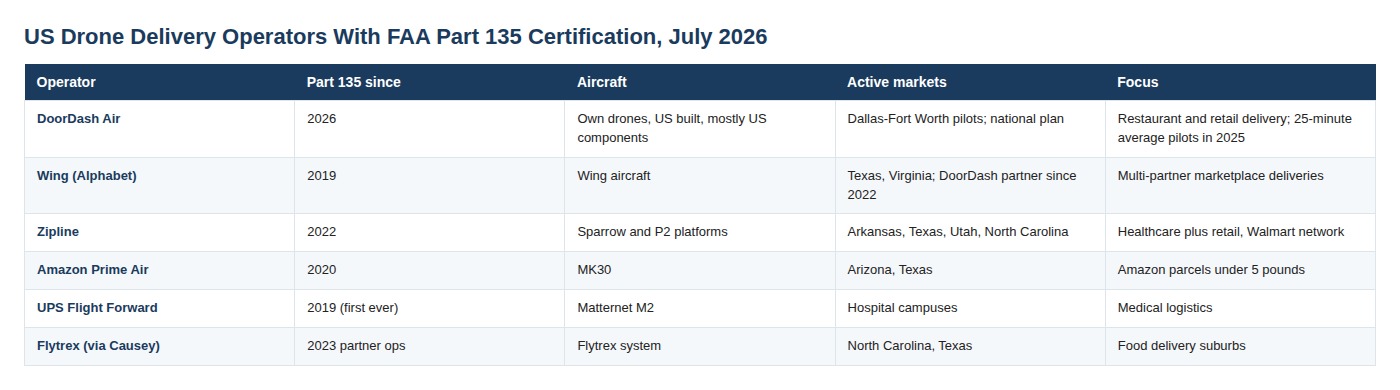
The data illustrates the diverse applications of commercial drone technology, ranging from medical logistics to retail parcel delivery. DoorDash's entry into this space with a specific focus on restaurant and retail delivery within the three-to-five-mile radius adds a new dimension to the competitive field.
As the company prepares to share more details at the Dash Forward event in September 2026, the industry will be watching closely to see how DoorDash plans to scale its operations and achieve profitability in a sector that has long promised revolution but delivered slow, incremental progress. The success of DoorDash Air will depend not just on the technology, but on the company's ability to integrate aerial logistics seamlessly into its massive existing network of merchants and consumers.
Disclaimer: This article is for informational purposes only and does not constitute investment advice, endorsement, or verification of any claims made by the companies mentioned.