Changzhou AI final backs vision-language-action robot project
The 2026 China Artificial Intelligence Plus Innovation and Entrepreneurship Challenge concluded in Changzhou with an embodied-intelligence robot taking the intelligent-manufacturing first prize. Beijing-based Wanjing Qianxun combined an end-to-end vision-language-action model with high-precision force-control joints. The event attracted 337 applications and gives winners access to incentives, computing support and local test scenarios. The award signals policy support for manufacturing-focused AI, not yet commercial proof of the winning robot.

Changzhou hosted the decisive round of China’s 2026 Artificial Intelligence Plus Innovation and Entrepreneurship Challenge on August 11, marking the national programme’s first final in the city. Beijing-based Wanjing Qianxun Technology won the intelligent manufacturing first prize with an embodied intelligence robot using a vision-language-action model and force-control joints.
Regional policy aims at factory deployment
The event gathered 337 applications from more than 20 provincial-level regions and narrowed that group to 30 finalists. The program spanned AI plus intelligent manufacturing, healthcare and new energy. The final field ranged from robots that act in the physical world to brain-computer interfaces, drug-discovery systems, energy-storage tools and low-carbon computing projects. The first prize in intelligent manufacturing went to Wanjing Qianxun for an embodied robot that pairs an end-to-end vision language action model with high-precision force control in its joints. Other first prizes recognized a new-energy project from Qingpeng AI and a domestic surgical robot platform from Shenzhen Liuyedao Robot.
Changzhou has promoted a large set of industrial scenarios and companies to match such projects. Changzhou says its local inventory includes over 300 companies across the AI supply chain, in excess of 1,500 manufacturing use cases and 184 applications filed under its AI Plus programme. Awarded projects are positioned to receive cash awards, matching with industry investors, computing subsidies and access to local deployment scenarios. The package points toward a staged path from prototype to pilot inside city-backed production cells.
That combination of recognition and support sends a clear signal. National initiatives are directing AI projects toward use cases that matter to plant managers, process engineers and line supervisors. A strong presence in embodied intelligence and robotics fits Changzhou’s industrial base and the needs of its supplier networks. The result is a public conduit that connects early-stage AI control methods to materials, fixtures, and repetitive work instructions inside existing factories. That is where the technology will proof will have to prove itself.
"A prize signals policy priority, not production proof."
For procurement and operations leaders, the headline is not only who won. The headline is where winners will be asked to show results, how quickly pilots can convert to routine work orders, and whether line-level metrics move in the right direction. The announced benefits reduce friction for those first steps, but production acceptance still rests on measurable improvements that survive shift changes and supply swings.
VLA control paired with measured force
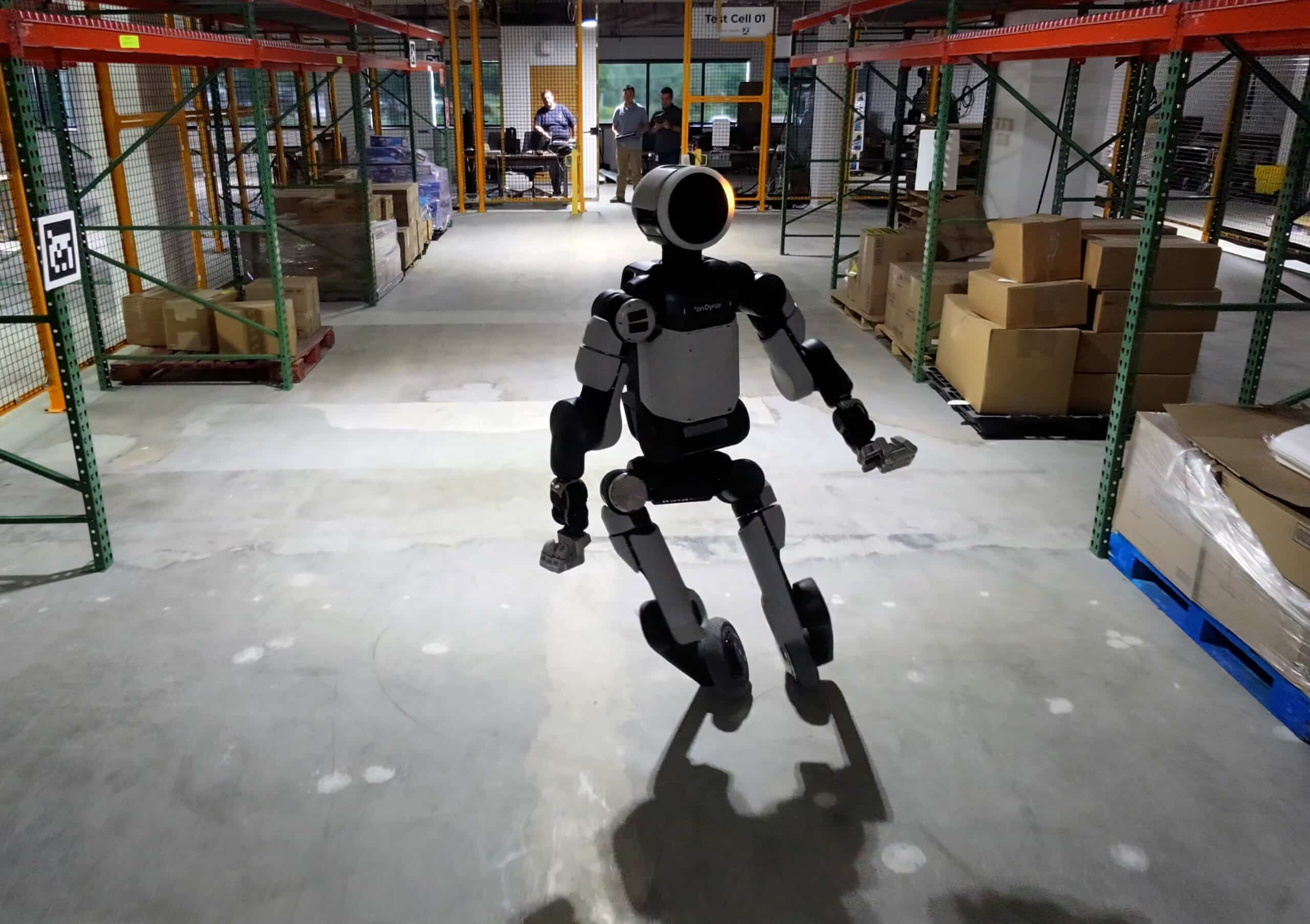
Wanjing Qianxun’s entry combined a vision-language-action control stack with joints that can sense and regulate force with high precision. VLA means vision language action. In plain terms, the robot takes camera input, parses natural language or structured prompts, and outputs motion plans that are executed through actuators that can feel how hard they are pushing. In a controlled manufacturing cell, this setup can blend perception, instruction and motor control to handle tasks that are sensitive to part variation or require gentle alignment.
A simple analogy helps describe what this offers. Think of a careful technician learning a new fixture by watching, listening, and then trying a few light touches before tightening fasteners. The technician uses eyes to find features, words to understand intent, and fingers to feel resistance. A VLA system with force-control joints aims to capture that loop. It sees, interprets, and then applies just enough force to seat a part or guide a tool without stripping threads or bruising surfaces.
End-to-end control is attractive because it can reduce manual scripting and hand-tuned parameters. If the VLA model can generalize across similar tasks, the time from spec to workable program may shrink, and forklifts of jigs may not be required for every variation. Force-control joints can also reduce damage rates in insertion, polishing, or press-fit steps where traditional position-only control can stall or skip. The two pieces meet where real factory work often fails traditional automation, which is in the corridor between rigidity and adaptability.
None of this negates the need for standard industrial safeguards. Any vision-driven motion must respect light curtains and interlocks. Language prompts require approval workflows so that only tested skills run on the live cell. Force thresholds must align with both product and fixture limits. Latency between perception and action needs to be low enough to meet takt time without sacrificing safety. If the robot shares space with people, certified speed and separation monitoring or physical guards are compulsory. These items are not exotic, but they demand discipline and documented procedures during deployment.
A broader question for VLA systems is data fitness. The model’s ability to read a new scene and pick actions depends on how well it was trained and how much it is adapted to the plant. If the model expects glossy surfaces and the line feeds matte black parts covered with fine dust, performance may degrade. If the language layer learns a skill in a lab, but shop-floor slang and shorthand change the phrasing of commands, misinterpretation can creep in. That argues for data collection in the target environment, careful curation, and a loop that ties failed trials back into model updates without risking production continuity.
Wanjing Qianxun builds for factory realism
Wanjing Qianxun Technology is a Beijing-based robotics developer focused on embodied intelligence for manufacturing uses cases. The company couples an end-to-end vision language action model with precision force-control actuators and presents that pairing as a path to handle variable parts and tasks that need tactile feedback. The competition win raises its profile and offers access to local pilots through announced support channels.
For a lesser-known company, a concise profile matters for buyers who do not yet know what it builds. Wanjing Qianxun positions itself as a provider of AI-first robot control that interacts with real materials and fixtures rather than narrow simulation-only setups. The core proposition is that a trained model can digest visual cues and language goals, then produce reliable motions across a class of tasks while the hardware measures contact forces to avoid damage and to adapt in real time. The approach appeals to users who face changeovers, mixed SKUs, or geometries that defy hard tooling.
The company will be judged by its ability to convert this technical story into quiet shifts that hit numbers. That means integrating with standard PLCs and supervisory systems, respecting plant IT constraints, supporting fixture design, and showing a path for operators and maintenance teams to adopt the product without mounting a second project to run the first. It also means clarity on service windows, spare parts stocking, and the plain question of who answers calls when a tool sticks mid-cycle on a weekend shift.
The competition did not disclose production deployments, unit pricing, or benchmark scores for the entry. That is normal for a showcase event. The absence of such details does not disqualify the work. It sets the stage for due diligence. Buyers will ask for off-line trials, controlled cell pilots, and side-by-side cycles against current methods. Sustained results over weeks, not minutes, will decide whether the technology exits the demo zone.
Procurement math demands staged validation
Procurement teams face crowded claims in embodied robotics. A measured path reduces risk without blocking upside. The following steps help convert interest into grounded validation and commercial terms.
- Start with a single repeatable task and a clear defect definition. Select a step where touch matters, such as press-fit assembly or delicate insertion. Define pass and fail in objective terms and agree on how to count rework.
- Demand a scoped off-line test that uses the real part and a representative fixture. Require filmed trials and logs of force and motion. Disqualify a system that only works with parts laser aligned on a clean desk.
- Nail the plant integration plan before the robot arrives. Confirm electrical standards, PLC drivers, MES hooks, naming conventions and acceptable network zones. Ask for a wiring diagram, a software bill of materials and a cybersecurity posture that fits factory rules.
- Insist on safety artifacts that match the chosen cell. Require a risk assessment, a guarding plan if needed, and proof of safe stop and restart functions. If the cell is collaborative, ask for the method used to set safe speed and separation.
- Set acceptance metrics that tie to your P and L. Cycle time, first-pass yield, and downtime are the minimum three. Define how each will be measured. Agree on a shortfall remedy and on what counts as root cause when results slip.
- Verify the support model. Ask where parts ship from, how fast they ship, and who can repair joints and cameras. Get a maintenance schedule that line teams can perform without a vendor on site.
- Probe the data model path. Confirm that training and fine-tuning happen with your approval and that production data does not leave agreed boundaries. Ask for a method to freeze a model that meets your spec and a process to roll back from a bad update.
- Grade changeover cost. Show how the system learns a second and a third related task. Count the person-hours and fixtures needed for each change.
- Benchmark against today’s best manual or semi-automated process, not yesterday’s. If a skilled operator can hit the same numbers with a jig and a torque-limiting tool, the robot must beat that in a fair test.
- Write contracts that tie payment to performance milestones. Consider paying for pilots as services with an option to convert to capex once acceptance metrics are met. Keep the right to audit logs that determine milestone achievement.
A steady way forward is to treat this win as a marker of potential supply and then run a standard industrial gauntlet. Invite Wanjing Qianxun and peers to a bake-off in a safe off-line cell. Measure twice and pay once. Lock in performance-based terms. If the numbers survive full shifts and varied lots, scale. If not, park the idea and revisit when model quality and actuator reliability improve. Public prizes can help you spot candidates for pilots, but your acceptance gates protect your line.
This analysis is provided for informational purposes only and does not constitute investment, legal, or procurement advice. RobotAIGeek does not endorse specific vendors or guarantee the performance of early-stage technologies.