Baemin Deploys Faster Dilly X3-R 1.4 as Seoul Delivery Robot Orders Triple Year on Year
Woowa Brothers has deployed the Dilly X3-R 1.4 delivery robot in Seoul's Gangnam district, featuring an expanded polypropylene foam body that cuts weight below the 15 kg legal threshold for the faster speed class, enabling a 50% speed increase and a 240% year-on-year demand surge. The deployment comes as Baemin's parent Delivery Hero faces acquisition by Uber.
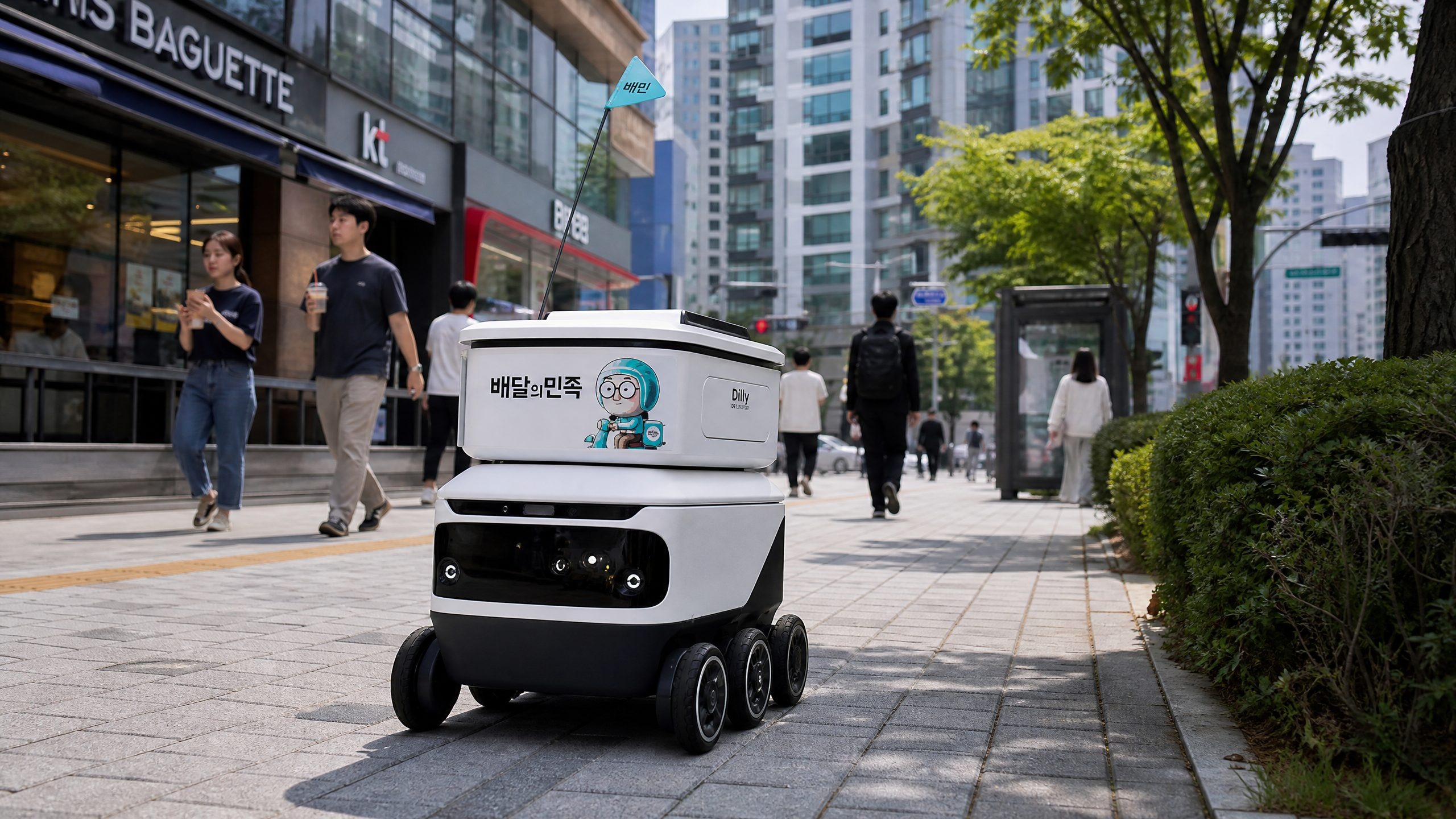
Woowa Brothers, the Seoul-based operator of South Korea's Baemin food delivery platform, deployed its upgraded Dilly X3-R 1.4 sidewalk delivery robot at its B Mart Gangnam Nonhyeon fulfillment center on August 3, 2026. The new model operates at a top speed of 15 km/h -- a 50% increase over the 10 km/h ceiling that applied to its predecessor -- after a single material change dropped the robot's weight below the 100 kg threshold that determines speed classification under Korean regulatory standards. The deployment comes as B Mart robot delivery orders have grown 240% year-over-year, with demand accelerating sharply in recent months.
The speed gain was not achieved through a new drive system or motor upgrade. It was achieved by replacing the robot's plastic shell with expanded polypropylene foam -- the same closed-cell material used in automotive bumper cores and food-delivery insulated containers -- which reduced the robot's mass by approximately 8% and moved it into a faster legal speed class under the Korea Institute for Robot Industry Advancement's operational safety certification standards.
The Regulatory Mechanism Behind the Speed Increase
South Korea's Intelligent Robots Act, amended by the National Assembly in May 2023 and enforced beginning November 17, 2023, classifies certified outdoor mobile robots as pedestrians rather than vehicles, allowing them to use sidewalks, obey traffic signals, and stop at crosswalks. The amendment was the regulatory change that made the entire Dilly program commercially viable -- before it took effect, outdoor delivery robots were classified as vehicles and barred from sidewalks entirely.
Within the pedestrian classification, the Act applies a weight-based speed ceiling. Robots above 100 kg (220 lbs) are capped at 10 km/h (6.2 mph). Robots below that threshold qualify for the higher tier and may operate at up to 15 km/h (9.3 mph). The original Dilly sat above 100 kg and was legally capped at the lower speed. The X3-R 1.4, with its foam shell, sits below it.
KIRIA, the government body under the Ministry of Trade, Industry and Energy that certifies commercial robots, granted the X3-R 1.4's operating license in July 2026, clearing the way for the August 3 deployment. The certification process evaluates safety, navigation reliability, and operational parameters before a robot is authorized for public sidewalk use.
Why the Material Choice Does Three Jobs at Once
Expanded polypropylene is a closed-cell bead foam manufactured from polypropylene resin expanded under high pressure. In the automotive industry, it is the standard material for bumper cores, chosen for its ability to absorb multiple impacts without permanent deformation and its negligible weight contribution. It is also food-contact approved and provides strong thermal insulation, which is why it is widely used in food-delivery containers and insulated coolers.
For a sidewalk delivery robot, that combination is multiply useful. The lighter body weight moves the robot into the faster legal speed class. The thermal insulation helps maintain food temperature during delivery -- relevant for both hot meals and the chilled grocery items that Dilly handles at B Mart. And the impact resistance provides a more forgiving shell if the robot makes contact with a pedestrian or obstacle at 15 km/h (9.3 mph). Woowa Brothers' robotics lab head Kim Byoung-oh described the material swap as "a key, allowing us to consider the environment while improving Dilly's overall performance."
The X3-R 1.4 also ships with an expanded sensor package -- a rear-view camera added to the existing array, paired with an upgraded central processing unit and enhanced environmental sensors. The rear camera was added specifically to improve the robot's ability to detect vehicles approaching from behind on Seoul's busy sidewalks.
Eighteen Months of Operational Data
The deployment record provides context for evaluating what the upgrade changes in practice. Dilly operates from B Mart's Gangnam Nonhyeon branch, one of roughly 70 proprietary micro-fulfillment centers Woowa Brothers operates nationwide. When customers select the robot delivery option, Dilly picks up goods and carries them within a 1.2-mile (2 km) service radius, delivering to ground-floor residential buildings and commercial addresses, with elevator access available for upper-floor customers.
Across all deliveries since the February 2025 launch, Woowa Brothers reported a 99% autonomous completion rate, with human operators intervening in fewer than 1 in 100 runs. The average delivery takes approximately 25 minutes. The robot operates through adverse weather conditions, including Seoul's summer heatwaves and monsoon rains, without interruption.
Demand has grown sharply since the initial pilot. In June 2026, B Mart recorded a 40% month-over-month jump in robot delivery usage and a 240% year-over-year demand increase -- roughly 3.4 times the year-ago volume. Whether the 50% speed increase translates into materially faster delivery times will depend on Seoul's sidewalk conditions, pedestrian traffic density, and the distance profile of specific delivery routes. At 15 km/h, the robot is still slower than a bicycle courier, but it operates autonomously, at all hours, in any weather, without labor cost.
The Quick Commerce Context and the Uber Acquisition
The Dilly program sits inside a broader pattern. South Korea has emerged as one of the world's most active testing environments for commercial delivery robotics, in large part because of the 2023 regulatory change. The country's quick-commerce sector -- where Baemin B Mart competes alongside GS Retail, Coupang, and Naver -- is projected to reach approximately US$7.54 billion by 2029, up from roughly US$5.45 billion in 2024. For platforms operating in that market, last-mile automation is increasingly a margin lever rather than a futuristic experiment.
That economic logic has added urgency for Woowa Brothers following the announcement in July 2026 that Uber agreed to acquire Delivery Hero -- Baemin's German parent company -- for approximately US$14.8 billion. The transaction, expected to close in the second half of 2027 subject to regulatory approvals, would make Baemin an indirect subsidiary of Uber and bring it into direct proximity with Uber's global delivery and mobility infrastructure. Against that backdrop, the Dilly program represents more than a technology demonstration -- it is live evidence that B Mart's last-mile unit economics can improve at scale, a data point that will matter to Uber as it evaluates the asset it is acquiring.
Woowa Brothers has stated plans to expand Dilly's service area beyond the existing Gangnam Nonhyeon base and to deploy the robot at a second B Mart location before the end of 2026. The company's stated goal for the second half of the year is to introduce robot delivery at other B Mart branches. The X3-R 1.4 is the platform on which that expansion will run, and its 99% autonomous completion rate and 240% demand growth are the commercial credentials that justify the investment.
Korea's Delivery Robot Ecosystem and What It Demonstrates
South Korea's experience with sidewalk delivery robots is the most advanced of any country in the world, and the Dilly program is its most commercially mature example. The regulatory framework that makes it possible -- the 2023 amendment to the Intelligent Robots Act classifying certified robots as pedestrians -- was the result of deliberate policy design rather than regulatory accident. Korea's Ministry of Trade, Industry and Energy, working with KIRIA, created a certification pathway that allows commercial operators to deploy robots on public sidewalks while maintaining safety standards through weight-based speed limits, mandatory sensor packages, and operational licensing requirements.
The contrast with other markets is instructive. In the United States, sidewalk delivery robots operate under a patchwork of city-level regulations that vary from permissive to restrictive, with no national framework. In the European Union, the regulatory environment for autonomous delivery robots on public pavements remains unsettled, with member states taking different approaches. In China, sidewalk delivery robots are deployed in limited pilot zones under special permits rather than under a general commercial framework. Korea's approach -- a national framework with clear certification criteria -- has produced the fastest commercial deployment of sidewalk delivery robots anywhere in the world.
The Dilly program's 99% autonomous completion rate and 240% year-over-year demand growth are not just metrics for Woowa Brothers. They are data points that regulators, investors, and competing operators in other markets are watching closely. If a sidewalk delivery robot can achieve those numbers in Seoul's dense, pedestrian-heavy urban environment -- one of the most challenging operating conditions for autonomous ground vehicles -- the case for deploying similar systems in less demanding environments becomes substantially stronger. The X3-R 1.4's material innovation and the regulatory mechanism that enables it are, in that sense, a contribution to the global evidence base for commercial delivery robotics.
Disclaimer: This analysis is provided for informational purposes only and does not constitute investment, legal, or procurement advice. RobotAIGeek does not endorse specific vendors or guarantee the performance of early-stage technologies.