Avride Deploys Cloud VLMs as a Safety Net for Autonomous Delivery Robots
Delivery robot operator Avride has integrated cloud based vision language models into its live operations, creating an automated early warning system that flags complex edge cases for remote human assistants without adding latency to the robot's onboard driving stack.
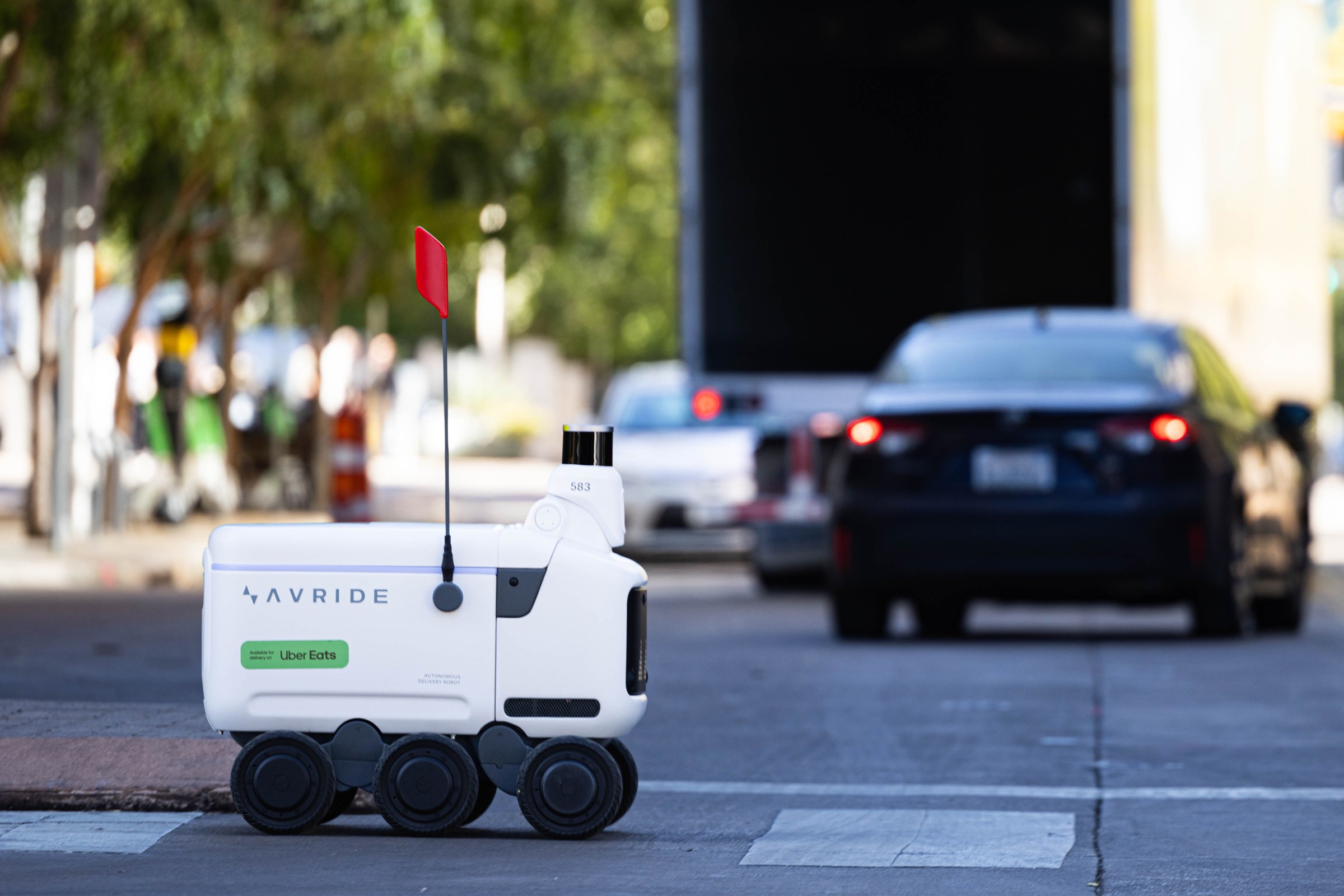
Avride, the autonomous vehicle startup backed by a USD375 million investment from Uber and Nebius Group has detailed a hybrid architecture that uses cloud-based Vision Language Models (VLM) as a safety net for its sidewalk delivery robots. Instead of relying purely on onboard compute, the robots operate autonomously using traditional models but query a cloud VLM when they encounter novel edge cases, such as complex construction zones or unusual pedestrian behaviour. This architecture supports Avride's aggressive expansion pipeline, which now includes over 500 robots across six US cities, a delivery launch in Tokyo with Rakuten, and a concurrent robotaxi rollout in Dallas.
The technical details of Avride's hybrid VLM approach were published this week, shedding light on how the company manages the chaotic reality of sidewalk navigation. Sidewalks are notoriously unstructured compared to roads. A delivery robot might encounter a poorly marked trench, a tangled dog leash, or a group of children blocking a crosswalk. Training a purely onboard model to handle every permutation is computationally prohibitive.
Avride's solution is a watcher architecture. The robot runs its standard autonomous navigation stack locally, ensuring low latency for immediate safety and routing. However, when the onboard system detects an anomaly or its confidence score drops, it captures an image of the scene and sends it to a large VLM hosted in the cloud. The VLM, possessing broad semantic understanding of the world, analyzes the image and returns high level guidance, such as 'wait for the construction worker to wave you through' or 'route around the wet concrete.' This allows Avride to deploy highly capable robots without requiring massive, expensive GPUs on every unit.
Company Background and Differentiator
To understand Avride's trajectory, one must look at its origins. The company's technological journey began in 2017 inside the self driving unit of Russian search giant Yandex. In 2020, the unit was spun off, and following the geopolitical shifts and Yandex's divestiture, the assets were acquired by a new entity outside of Russia. Relaunched as Avride under the umbrella of the Nebius Group, the company is now headquartered in Austin, Texas, led by CEO Dmitry Polishchuk.
Avride's primary differentiator in the crowded autonomous delivery space is its dual stack approach. Unlike competitors that focus exclusively on either sidewalk robots or passenger vehicles, Avride develops both delivery robots and robotaxis using a unified underlying autonomy stack. This shared architecture accelerates learning; an edge case solved by a robotaxi on the road informs the navigation of a delivery robot on the sidewalk, and vice versa. This dual capability was a key factor in securing up to USD375 million in strategic investments and commitments from Uber and Nebius in October 2025.
Partnerships and Pipeline
Avride is aggressively executing on its capital. In the delivery sector, the company has secured major partnerships with the top logistics players. It operates delivery robots on the Uber Eats platform across multiple US cities and partnered with Grubhub in November 2025 to expand beyond college campuses, including a pilot for Wonder's marketplace in Jersey City. Internationally, Avride partnered with Rakuten to launch autonomous deliveries in central Tokyo in February 2025, marking its first deployment in Japan.
On the robotaxi front, the pipeline is equally active. In March 2025, Avride signed an agreement with Hyundai Motor to jointly develop robotaxis using the Ioniq 5 platform. By December 2025, Uber and Avride officially launched a robotaxi service in Dallas, Texas, covering a nine square mile area with plans to expand the fleet to hundreds of vehicles over the next few years.
Global Competitive Field and Benchmarks
The autonomous delivery market is fiercely competitive, splitting into distinct regional ecosystems.
In the United States, Avride's primary competitors are Serve Robotics and Starship Technologies. Starship, founded in 2014 by Skype co founders, operates the world's largest fleet with over 2,000 robots and 8 million deliveries, primarily dominating college campuses. Serve Robotics, backed by NVIDIA and listed on the NASDAQ, has secured a deal to deploy up to 2,000 robots on Uber Eats in cities like Los Angeles and Miami. Serve recently raised USD80 million to target breakeven operations and claims its third-generation robot cuts production costs by roughly 50 percent to an estimated USD16,000 per unit.
In China, the market is dominated by domestic tech giants and specialized startups focusing on larger, road legal delivery vehicles rather than sidewalk bots. Meituan operates its own in house autonomous delivery vehicles and drones. Neolix has secured over 10,000 orders for its L4 unmanned delivery vans, and White Rhino operates road legal delivery vans with Series B plus funding. Alibaba's Xiaomanlv previously operated at scale but has seen strategic shifts.
Pricing in the sidewalk delivery sector is typically bundled into the logistics platform's fees rather than charged directly to the consumer as a premium. Starship deliveries often cost around 2 dollars or less, while Avride and Serve deliveries via Uber Eats carry standard delivery fees that are comparable to or lower than human couriers. None of the major US players sell their robots outright; they operate them as a service.
Why It Matters
Avride's cloud VLM architecture is a pragmatic solution to the deployment bottleneck. The hardest part of autonomous delivery is not driving in a straight line; it is handling the final one percent of weird, unstructured human environments. By offloading the semantic reasoning for these edge cases to the cloud, Avride can keep the unit economics of its robots viable while maintaining a high safety standard. This technical choice, combined with the financial backing of Uber and Nebius, positions Avride as a formidable challenger to Starship and Serve in the race to dominate the last mile.
A cloud based safety net is only as good as the network connection. If an Avride robot encounters a complex edge case in an area with poor cellular coverage, the VLM cannot help it. The robot must either halt and wait for connectivity or rely on a human teleoperator, which degrades the unit economics of the delivery. As fleets scale from hundreds to thousands of robots, the latency and reliability of the cellular network become the ultimate ceiling on true autonomy.
Sources
[1] The Robot Report. How Avride uses cloud VLMs as a safety net for delivery robots. July 6, 2026. https://www.therobotreport.com/how avride uses cloud vlms safety net delivery robots/
[2] Nebius Group Newsroom. Avride secures strategic investment of up to 375 million backed by Uber and Nebius. October 22, 2025.
[3] TechCrunch. Uber and Avride launch robotaxi service in Dallas. December 3, 2025.
[4] Rakuten Press Release. Rakuten Scales Up Autonomous Delivery Service with Advanced Robots. February 26, 2025.