ARC Brings Pilot-Controlled Humanoid Combat to Singapore
ARC staged its Asia debut in Singapore with two fight nights pitting human-piloted EngineAI and Unitree humanoids in live combat, a public durability test for teleoperated hardware that most vendor demo reels cannot replicate.

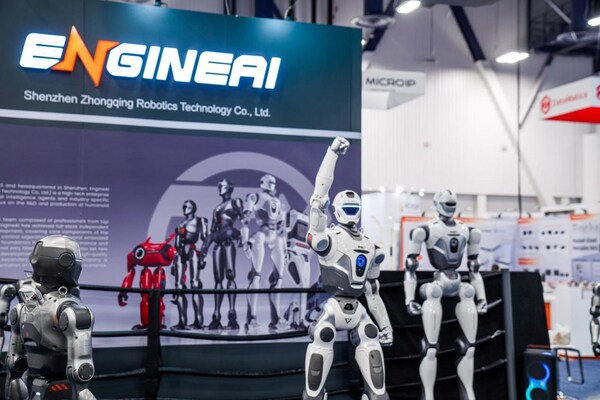
Two full-scale humanoid robots traded punches on a lit stage at *SCAPE on Orchard Road on October 9, 2026, in the Robot Fighting Championship, the headline act of Singapore's AICON 2026 festival. Each machine was a production EngineAI T800, 1.73 meters tall and 75 kilograms, driven in real time by a human pilot wearing a virtual reality (VR) headset and motion controllers rather than by onboard autonomy. The bout ran from 8 pm to 10 pm local time, two nights after the same promotion, ARC, staged its actual Singapore debut at the same venue.
ARC is not a household name outside a small circuit of combat-robotics promoters, and that is the point worth establishing before anything else. It is a pilot-controlled humanoid combat exhibition that previously ran shows in New York and Chicago using Unitree's lighter G1 model, a 1.32-meter, 35-kilogram machine built by the Hangzhou-based robotics maker. Its Singapore heavyweight class instead used the T800, built by Shenzhen Zhongqing Robotics Technology Co., Ltd., the Shenzhen-based humanoid manufacturer better known by its brand name, EngineAI. Its market niche sits at the intersection of live entertainment and robotics marketing: take a commercially available humanoid chassis, strap a competent human fighter into a teleoperation rig, and sell tickets to watch the hardware absorb the kind of repeated, high-force impact that no warehouse pilot or factory integration test was ever designed to inflict. Singapore marked ARC's first appearance in Asia, and its arrival coincided with Formula One week and the second edition of AICON, a consumer AI festival organized under the "AI for Everyone" banner that drew an estimated 5,000 attendees to its first run.
A City Gets Two Fight Nights in the Same Week
The sequence matters for anyone trying to separate promotional noise from a genuine commercial signal. ARC Night, hosted locally by event producer Katena, ran on October 7 at the *SCAPE Ground Theatre from 6 pm to 9 pm, structured as a standalone ticketed show: a lightweight bout on the Unitree G1, a heavyweight bout marking the T800's Singapore debut, a live performance, and a closing session where ticket holders could get hands-on with the robots. Tickets sold on Luma in three tiers, an early-bird rate at US$20 that sold out before the standard allotment of 150 at the same price, and a 20-unit VIP tier at US$399 that was nearly sold through days ahead of the event.
Two nights later, the same T800 platform and much of the same teleoperation format reappeared as the Robot Fighting Championship inside AICON itself, this time positioned as the festival's main draw rather than a standalone gate. Four pilots were named for the AICON bout, and one of them, content creator and entrepreneur Jaze Phua, is also a co-founder of AICON, which says something about how tightly this scene is wired together: the people booking the festival's keynote stage are the same people stepping into the piloting rig. The other named combatants, entrepreneur Eugene Chung and streamer Amie, came from Singapore's creator economy rather than from robotics engineering, continuing the pattern ARC had already set at its own show two nights earlier, where all four pilots were drawn from martial arts and online content rather than robotics labs.
What the Pilots Are Actually Operating
The piloting method is consistent across both nights and worth describing precisely, because it is the actual technology story underneath the spectacle. Each operator wears a full-body motion-capture rig or VR headset with handheld motion controllers; the humanoid mirrors the pilot's limb movement in real time, so a jab or a leg kick in the arena originates as a jab or a kick by the person at the controls, with the robot's own balance and joint-protection logic running underneath to keep the machine upright between inputs. That division of labor, human intent for targeting and timing, machine-side artificial intelligence (AI) for balance and compliance, is the same architecture used in teleoperated logistics arms, remote inspection platforms, and nuclear decommissioning robots, just compressed into a format where failure is immediately visible to a paying crowd instead of buried in an internal test log.
EngineAI's own technical disclosures around the T800, published alongside its CES 2026 global debut, describe a fully integrated, high-torque joint module architecture rated for up to 450 newton-meters of peak torque and 14,000 watts of instantaneous joint peak power, with high-degree-of-freedom structures at the neck, waist, and hands. The company has stated explicitly that the platform is tuned for "high-dynamic scenarios like martial arts and running," which is a notable admission for a robot maker to put in writing: it is designing for impact loads and rapid direction changes, not just the smooth, pre-planned gait cycles that dominate most humanoid demo reels.
A Durability Test That Buyers Cannot Get From a Demo Reel
This is where the Singapore shows become more interesting to an automation buyer than to a combat-sports fan. Most humanoid vendors prove reliability through curated video, a folding-laundry clip, a warehouse tote-pick loop, a parkour sequence shot after dozens of takes. None of that exposes a machine to repeated, off-axis impact loading on its own joints, delivered by an opponent actively trying to find the weak point in its structure, in front of an audience with phones out and nothing to lose by posting a failure. A robot that completes a full fight card on consecutive nights without a joint failure, a fall it cannot recover from, or a visible structural crack has passed a stress test that most procurement due diligence processes cannot replicate cheaply, precisely because it happened in public and the result could not be edited out.
That is a different kind of evidence than a spec sheet, and it speaks directly to the gap between demo performance and deployment reality that has dogged the humanoid category since the first polished investor videos started circulating. A torque rating on a data sheet tells a buyer what the actuator was engineered to survive in a lab; a live fight card, run twice in one week on the same unit class, tells a buyer something closer to what the hardware survives when a human is actively trying to break it. Teleoperation itself is the more durable commercial thread here. The same low-latency control stack that lets a fighter land a clean right hook through a VR headset is the stack that logistics operators, hazardous-site inspectors, and remote-surgery developers are racing to harden, and a combat exhibition is, whether its organizers frame it this way or not, a public reliability benchmark for exactly that control loop, running in a market, Southeast Asia, where the ASEAN deployment gap that separates intention from adoption has made every visible proof point unusually valuable to local integrators weighing whether teleoperated hardware is ready for their own pilots.
The caveat procurement teams should hold onto is that a fight card is not a duty cycle. An eight-to-ten-minute bout, however punishing, tells a buyer little about mean time between failures across an eight-hour shift, about repeatability across thousands of cycles, or about what happens to the same joint architecture after six months of daily use rather than two nights of exhibition. What it does establish, cleanly and publicly, is that the actuators, the structural frame, and the teleoperation link can take a hit, literally, without the kind of catastrophic failure that would end a show early. For a category still arguing with itself over whether humanoid hardware is durable enough to leave the lab, that is a narrower claim than "deployment ready," but it is a real one, and it is more verifiable than most vendor-supplied reliability statistics because it happened in front of an audience with cameras rather than inside a controlled facility tour.
The Business Model Underneath the Spectacle
None of this works commercially unless people pay to watch, and the ticketing structure shows a promotion still calibrating demand rather than one that has found a mass audience. ARC's own Singapore show priced general admission at US$20 and capped it at 150 seats, with a 20-unit VIP tier at US$399 that functioned as the real margin driver. AICON's festival-wide passes, covering the Robot Fighting Championship alongside workshops, keynotes, and an AI for Humanity forum backed by Singtel and other sponsors, ran S$48 for general two-day admission (approximately US$36) and S$98 for the VIP tier (approximately US$73), figures that position the robot fight as one attraction inside a broader festival gate rather than a venue that could sell out on combat alone.
For EngineAI, the commercial logic is more straightforward. A manufacturer with a humanoid platform to sell gets more persuasive marketing from two sold-adjacent nights of a robot absorbing live punches in Singapore than from another studio-lit promotional video, and it gets that marketing at a fraction of the cost of running its own international roadshow. For ARC, the harder question is whether a 150-to-170-seat venue and a handful of VIP passes scales into a touring business, or whether Singapore was a one-off booking that rode AICON's existing audience and Formula One week's tourist traffic rather than building an independent following. The New York and Chicago shows that preceded it suggest a promoter still finding its venue size and price point, not one that has already proven repeatable demand.
What is verifiable now is narrower than the spectacle suggests: a named promoter brought production-spec EngineAI and Unitree humanoids to a named Singapore venue on two confirmed dates, ran them through live, human-piloted combat in front of a ticketed and workshop-driven audience, and the hardware held up across both nights without an incident serious enough to interrupt either card. That is a real, if small, data point in the teleoperated-humanoid durability argument, not a staged viral stunt, and it is a sturdier foundation than most of the category's marketing currently offers. The analysis above synthesizes event organizers' public statements, ticketing records, and the robot manufacturer's own technical disclosures alongside visible market activity around the Singapore shows.
This article is provided for general information purposes only and does not constitute investment, procurement, legal, or engineering advice. Figures reflect the sources listed above as of the stated information cut-off and may change without notice.