A Robot That Grades Its Own Homework Is Beijing's Answer to the Simulation Gap
Beijing-based ShengShu Technology unveiled Motus2, a self-evolving world model that lets robots predict and grade their own actions, reaching 84 percent success across five manipulation tasks.

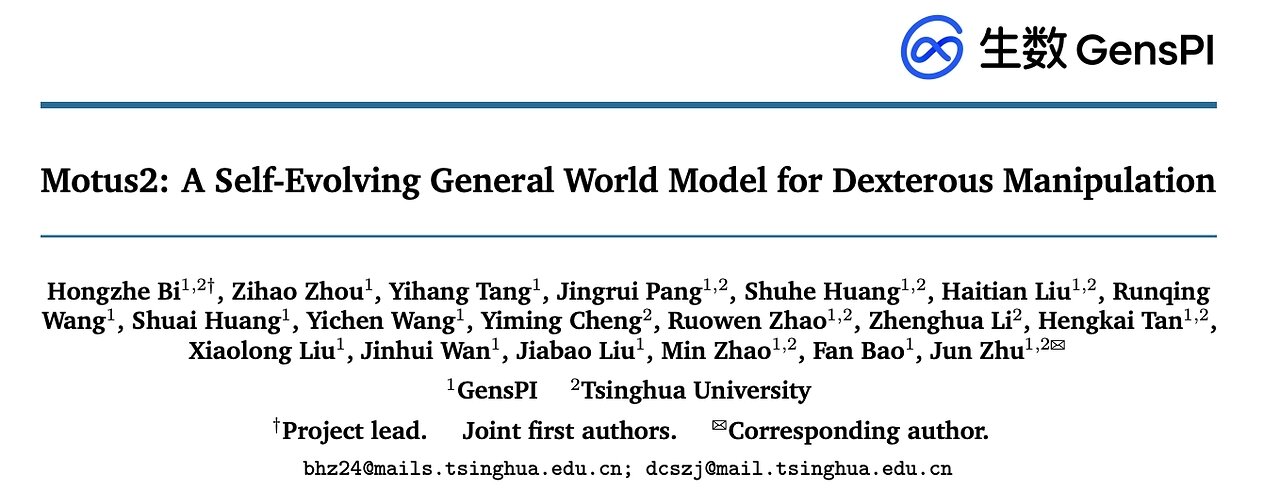
Every robotics lab chasing dexterous manipulation runs into the same wall: a model trained in simulation or on human demonstration video performs well in the lab and then degrades the moment it meets a real object that behaves slightly differently than its training data predicted. Beijing Shengshu Technology, the AI video-generation startup best known for its Vidu model and backed by Alibaba and Ant Group, unveiled a proposed fix on September 10 in Shanghai at the Bund Summit: Motus2, a world model developed with Tsinghua University that does not just predict what a robot's action will do, but evaluates whether that predicted outcome was actually good and updates its own strategy before the arm ever moves.
Founded in 2023 and until now known chiefly for text-to-video generation aimed at design, advertising, and entertainment studios, Shengshu is a newer entrant to embodied artificial intelligence than the humanoid-robot and robot-model specialists it is now competing against, and Motus2 is its clearest bet that the video-generation techniques it built for Vidu transfer directly to predicting how a robot arm's actions will unfold in physical space. In verified real-robot testing across five manipulation tasks, placing a ball, multi-finger manipulation, attaching an eraser, screwing in a light bulb, and placing a phone, Motus2 achieved an average success rate of 84 percent, and the company says a version combining its planning approach with model-based reinforcement learning lifted success on a separate benchmark from a 65 percent baseline to 72.5 percent.
The Loop That Replaces Trial and Error
Most robot learning systems split into two camps: models that predict what will happen next given an action, and separate policies that decide what action to take, with a human researcher or a fixed reward function stitching the two together during training. Motus2 collapses that split into one model with shared parameters that performs three functions in sequence, generating a candidate action, predicting the physical consequence of that action, and evaluating whether the predicted outcome actually advances the task, then feeds that evaluation back into the next action it proposes. Shengshu calls the resulting closed loop recursive self-improvement, and it is the mechanism behind the "self-evolving" label in the model's name: rather than requiring a new round of human-labeled training data every time the robot encounters an unfamiliar object, Motus2 uses its own outcome evaluations as a training signal to refine its next attempt.
That architecture matters commercially because labeled robot demonstration data is the single most expensive input in embodied AI development, and every lab building dexterous-manipulation models is racing to reduce how much of it a system needs per unit of task competence. Motus2's training approach leans on an unusually large but comparatively cheap data source instead: 130,000 hours of human egocentric video, footage captured from a first-person, head-mounted perspective, that Shengshu uses to pre-train the model on how human hands manipulate objects before ever touching a real robot arm. In isolation, a model trained purely on that human video data reached 51 percent task success when transferred to a physical robot. Adding a second training phase that adapts the model to the specific dynamics of the robot's own hardware, what Shengshu calls domain adaptation, lifted that figure to 84 percent, a 33-percentage-point jump that the company positions as evidence its human-video pre-training is transferring real manipulation knowledge rather than memorizing human-specific motion patterns that do not generalize to a mechanical gripper.
Where Touch Closes the Gap Vision Cannot
Motus2's other significant addition is tactile sensing, integrated through lightweight expert modules rather than a full sensor-fusion redesign, layered onto the model's existing camera-based perception. In manipulation tasks that depend on contact force rather than visual alignment, screwing in a light bulb or attaching a small component with tight tolerances, adding tactile feedback improved success rates by 12.5 percentage points over the vision-only configuration. That gain is consistent with a pattern the broader embodied-AI field has converged on over the past year: vision alone tells a robot where an object is, but manipulation tasks that require precise force control, seating a connector, threading a fastener, tend to fail on vision-only systems specifically because a camera cannot tell a controller how hard the gripper is actually pressing. Shengshu deployed Motus2's tactile capability on two dexterous hand platforms, the 22-degree-of-freedom Sharpa Wave and the 20-degree-of-freedom WUJI Hand 2, both of which are higher-complexity end effectors than the simple two- or three-finger grippers still common on most industrial cobots, suggesting Shengshu is positioning Motus2 for the more dexterous, human-hand-like manipulation tasks the humanoid robotics field is racing toward rather than the simpler pick-and-place work already well served by existing automation.
A separate result speaks to a different limitation entirely: memory. Robots operating on tasks that unfold over many steps tend to lose track of earlier context, repeating actions or losing the thread of a multi-stage task once enough time passes between the initial instruction and a later step. Motus2's configuration with what Shengshu describes as full historical memory achieved 57.5 percent success on tasks specifically designed to require long-term context retention, a result the company frames as progress rather than a solved problem, and one that is consistent with memory and long-horizon reasoning remaining among the harder open problems in embodied AI even as manipulation accuracy climbs on shorter tasks.
What This Buys ShengShu Against Better-Funded Rivals
Shengshu frames Motus2 as advancing toward levels three and four of a five-level world-model hierarchy the company has laid out publicly, with the top level representing a model general enough to predict and evaluate outcomes across arbitrary tasks and embodiments without task-specific retraining. That framing is a deliberate positioning move: it invites comparison with the world-model research agendas that larger, better-capitalized labs in China and the United States have made central to their own embodied-AI roadmaps, and it stakes Shengshu's claim to relevance in that race on the strength of a video-generation background that skeptics could otherwise dismiss as adjacent to robotics rather than core to it. Whether a self-evolving world model trained substantially on human video data can scale to the messier, less controlled environments of an actual factory or warehouse floor, rather than the curated five-task benchmark Shengshu has published results against, is the question that will determine whether Motus2 becomes a licensed component inside other companies' humanoid and industrial robot stacks or remains a compelling research result that stays inside Shengshu's own demonstrations.
The Academic Partnership Behind the Claim
Shengshu did not develop Motus2 alone. The model is a joint effort with Tsinghua University, a pairing that matters for how the results should be weighed: a startup publishing benchmark numbers about its own model invites more scrutiny than a university-affiliated research effort with faculty co-authors whose academic reputations are tied to the accuracy of the reported figures. That academic co-authorship is also a recruiting and validation channel that smaller, less capitalized labs increasingly lean on to compete with better-funded rivals, since a university partnership provides access to research talent and independent peer review that a startup operating alone would otherwise have to build in-house at far greater cost. Several of China's fastest-moving embodied-AI announcements over the past year have followed this same pattern, a commercial lab supplying compute, data infrastructure, and product framing, paired with a university lab supplying the underlying research rigor, and Motus2 fits that template closely.
The five-task benchmark Shengshu published is also narrower than the marketing framing suggests, and buyers should read it accordingly. Placing a ball, attaching an eraser, and screwing in a light bulb are useful proxies for dexterity but are a long way from the variable geometry, lighting, and clutter of an actual warehouse pick station or an assembly line handling dozens of stock-keeping units. Shengshu has been transparent that the 84 percent figure comes from this specific five-task set rather than a broader industrial benchmark, which is the right disclosure to make but also means the number should not be read as a general manipulation success rate applicable to arbitrary tasks. The company's own five-level world-model framework implicitly concedes this, placing Motus2 at level three to four rather than claiming it has reached the top tier where a single model handles arbitrary tasks without task-specific tuning.
The model's architecture and research paper are public, and Shengshu has said real-robot demonstration footage is available alongside the technical release, a transparency choice that lets outside labs attempt to reproduce the 84 percent figure rather than take it on faith. For an automation buyer or robot-platform integrator evaluating which world-model approach to build against over the next two years, Motus2's near-term relevance is narrower than its headline claims suggest, it is a research release, not a shipping product, and the path from a 130,000-hour human-video pre-training corpus to a reliable factory-floor deployment still runs through exactly the kind of domain-specific adaptation data that remains expensive to collect. The company's next move to watch is whether it licenses Motus2's world-model core to a hardware partner building humanoid or industrial arms, the step that would signal Shengshu intends to compete as an infrastructure supplier to the embodied-AI stack rather than stay a research lab publishing benchmark results.
This analysis draws on ShengShu Technology's public research release and statements made at the 2026 Bund Summit. It is for general information purposes only and does not constitute investment, financial, or legal advice.
Hero image credit: ShengShu Technology.