How to Buy an Industrial 6 Axis Arm: What Procurement Teams Need to Know
A practical buyer's guide for procuring industrial 6 axis robot arms. Learn how to evaluate payload and reach, the critical questions to ask suppliers, certification requirements like ISO 10218, and how to navigate lead times in 2026.
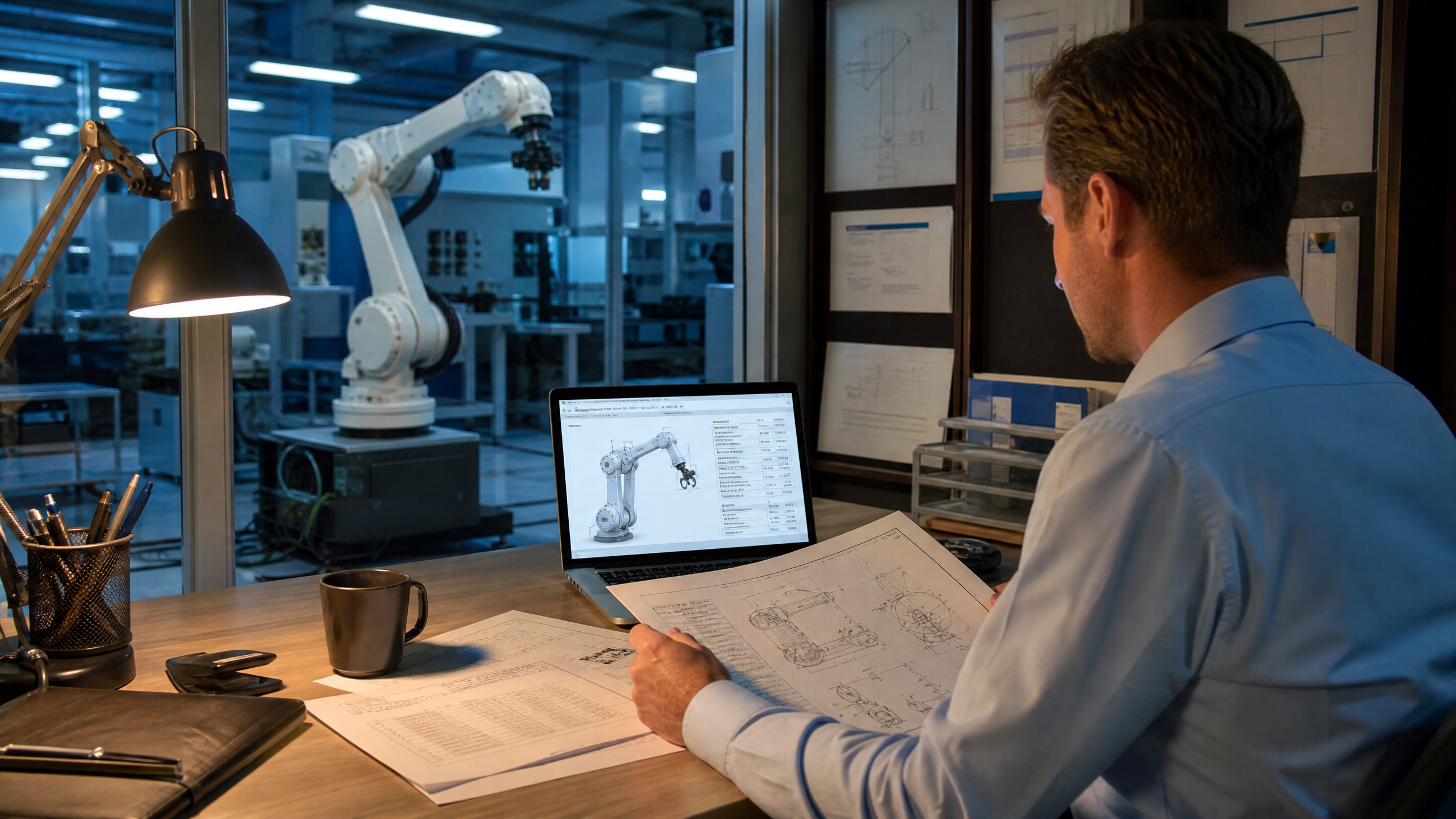
Purchasing an industrial 6 axis robotic arm is rarely a straightforward hardware transaction. For procurement and engineering teams, the robot arm itself is merely the nucleus of a much larger integration project. Making the right purchasing decision requires aligning technical specifications with production realities, while simultaneously navigating a complex landscape of safety certifications and supply chain variables. This guide serves as a practical reference for teams preparing to invest in industrial 6 axis automation in 2026.
Key Specifications to Evaluate
The foundation of any robotic procurement strategy is matching the machine's physical capabilities to the intended task. While modern data sheets are dense with metrics, three primary specifications dictate the viability of an industrial 6 axis arm: payload, reach, and repeatability.
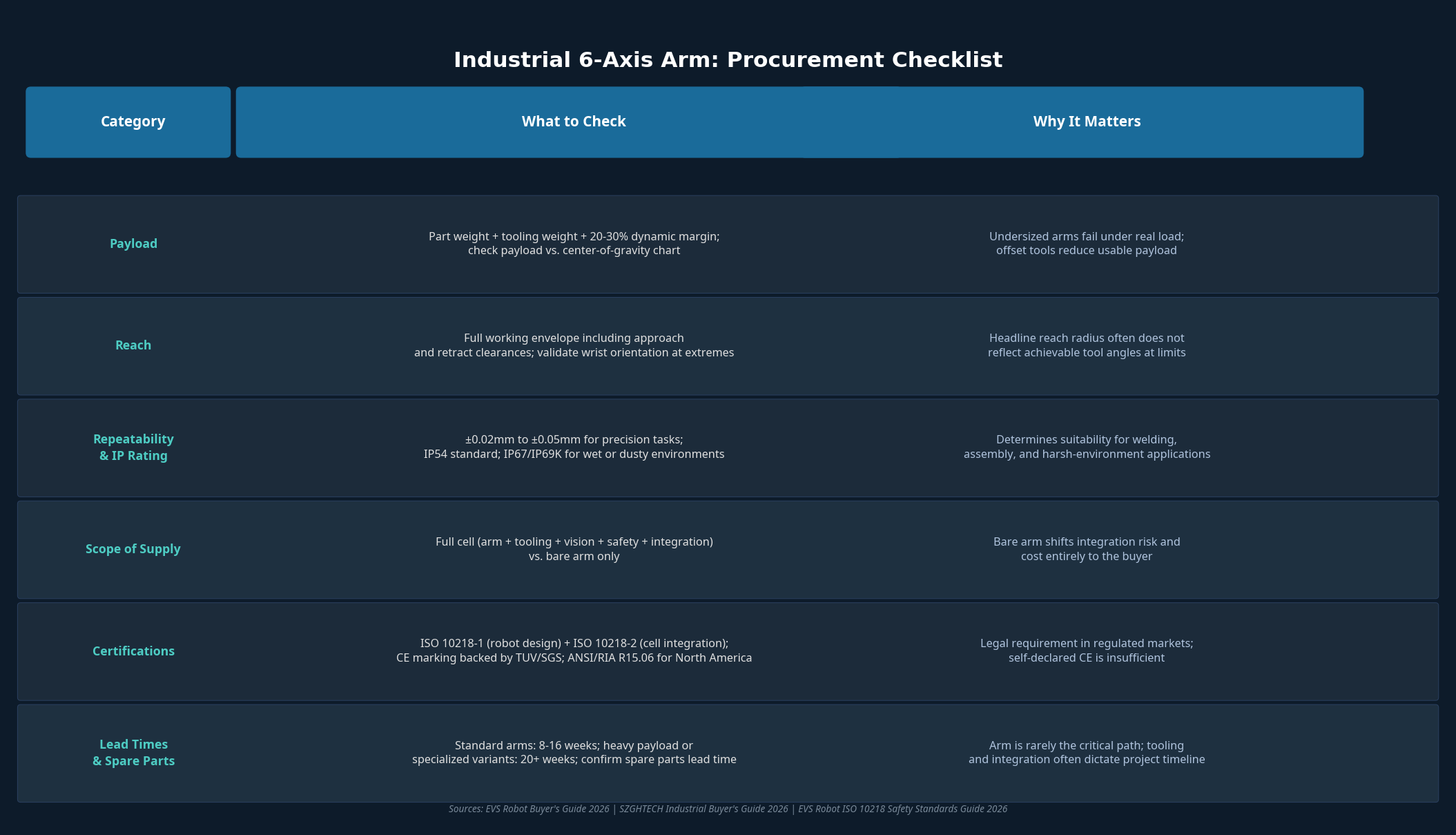
Payload is often the first filter applied by engineering teams. It is crucial to calculate payload not just by the weight of the part being handled, but by adding the weight of the end of arm tooling and any associated cabling or sensors at the flange [1]. Furthermore, buyers must account for dynamic margin. An arm accelerating and decelerating a heavy load requires headroom above its static mass capacity; a 20 to 30 percent margin is a standard engineering recommendation [1]. Additionally, the rated payload is dependent on the load's center of gravity offset from the flange. A long or offset tool reduces the usable payload below the headline number, making the payload versus center of gravity chart a vital document during evaluation.
Reach, or the maximum armspan from the base, must cover every point the tool needs to interact with, including approach and retract clearances [1]. The most common error in evaluating reach is failing to account for wrist orientation near the edge of the working envelope. An arm might be able to position the tool at a distant coordinate, but it may not be able to achieve the required approach angle at that extreme extension [1].
Repeatability, distinct from accuracy, defines how consistently the arm can return to a previously taught position. For tasks like arc welding or precision assembly, repeatability tolerances of plus or minus 0.02 millimetres to 0.05 millimetres are standard [2]. Finally, the IP rating must match the operating environment. Standard arms are typically IP54, but applications involving heavy dust, machining coolant, or washdown procedures will require IP67 or IP69K ratings to ensure long term reliability.
Questions to Ask Suppliers
The relationship with a robotics supplier extends far beyond the point of sale. To mitigate integration risks, procurement teams should present vendors with a rigorous checklist before committing capital.
First, clarify the scope of supply. Ask the vendor explicitly whether they are quoting a full functional cell or merely the bare arm [1]. A bare arm requires the buyer to source grippers, vision systems, safety fencing, and integration services separately, shifting the integration risk entirely onto the purchaser.
Second, inquire about local support and commissioning. An aggressively priced arm loses its financial advantage if the supplier lacks a local field engineering network for installation, operator training, and warranty support [1].
Third, probe the supplier's experience within your specific industry. Ask for reference cases or video demonstrations of their robots performing similar tasks, particularly if the application involves complex processes like continuous path welding or force controlled grinding [3].
Fourth, confirm the availability and location of spare parts. Ask for the guaranteed lead time on critical components like servo motors, harmonic reducers, and controller boards. A machine down waiting for parts shipped from overseas can rapidly erode the return on investment.
Finally, ask about software licensing and upgrades. Determine if the programming software requires an ongoing subscription, and whether future firmware updates that enhance capabilities or security are included or billed separately.
Lead Times and Supply Chain Considerations
The global supply chain for industrial robotics has stabilized significantly since the disruptions of the early 2020s, but lead times still require careful project management. In 2026, the standard lead time for a mainstream industrial 6 axis arm from a major manufacturer typically ranges from 8 to 16 weeks, depending on the specific model and payload class.
However, the arm itself is rarely the critical path item. Custom end of arm tooling, specialized safety guarding, and bespoke integration engineering often dictate the true timeline of the project. Procurement teams must build buffer time into their schedules to account for the design, fabrication, and testing of these cell specific components.
Furthermore, buyers should be aware of the difference between standard models and specialized variants. High payload models exceeding 200 kilograms, or arms requiring specialized cleanroom or explosion proof certifications, often carry extended lead times of 20 weeks or more due to lower production volumes and specialized testing requirements.
Certification and Compliance Standards
Deploying an industrial robot without the proper safety certifications exposes the manufacturer to significant legal and operational liabilities. Compliance is not an aftermarket add on; it must be verified during the procurement phase.
The foundational standard for industrial robot safety is ISO 10218. This standard is divided into two parts. ISO 10218-1 governs the design and manufacture of the robot itself, ensuring the hardware and control architecture meet baseline safety requirements [4]. ISO 10218-2 governs the integration of the robot into a complete workcell, detailing requirements for safeguarding, risk assessment, and safe collaborative operation [4]. It is the responsibility of the system integrator, or the end user if they act as their own integrator, to ensure the entire cell complies with ISO 10218-2.
For buyers in the European Economic Area, CE marking is a non negotiable legal requirement. The CE mark indicates conformity with the Machinery Directive, which requires adherence to harmonized standards like EN ISO 10218 [4]. When sourcing robots, particularly from emerging international manufacturers, buyers must verify that the CE marking is backed by documentation from a recognized third party notified body, such as TUV or SGS, rather than a mere self declaration [1]. For the North American market, compliance with OSHA regulations and ANSI/RIA R15.06 is the equivalent benchmark.
Total Cost of Ownership Preview
While this guide focuses on the mechanics of procurement, it is vital to recognize that the invoice price of an industrial 6 axis arm represents only a fraction of the total investment. The true financial impact is captured in the Total Cost of Ownership.
The sticker price of the hardware is routinely eclipsed by the costs of mechanical installation, software integration, safety guarding, and ongoing maintenance. Furthermore, the hidden costs of operator training and the potential financial risk of unplanned downtime must be factored into the ROI calculation. The subsequent article in this series will break down these hidden costs, providing a comprehensive framework for calculating the true Total Cost of Ownership for industrial 6 axis automation.
References
[1] EVS Robot. "6-Axis Robotic Arm Buyer's Guide: Payload, Reach & China." https://www.evsrobot.com/6-axis-robotic-arm-buyers-guide-payload-reach-china-2026.html
[2] SZGHTECH. "Industrial Robot Arms in 2026: The Complete Buyer's Guide for Manufacturers." https://www.szghtech.com/industrial-robot-arm-complete-buyers-guide-2026
[3] Batesville Products. "6 Questions to Ask a New Supplier." https://batesvilleproducts.com/resource/6-questions-to-ask-a-new-supplier/
[4] EVS Robot. "Industrial Robot Safety Standards Explained: ISO 10218, ISO/TS 15066 and CE Marking (2026)." https://www.evsint.com/industrial-robot-safety-standards-iso-10218-ce-marking-2026/