Do Machines Have Birthdays?

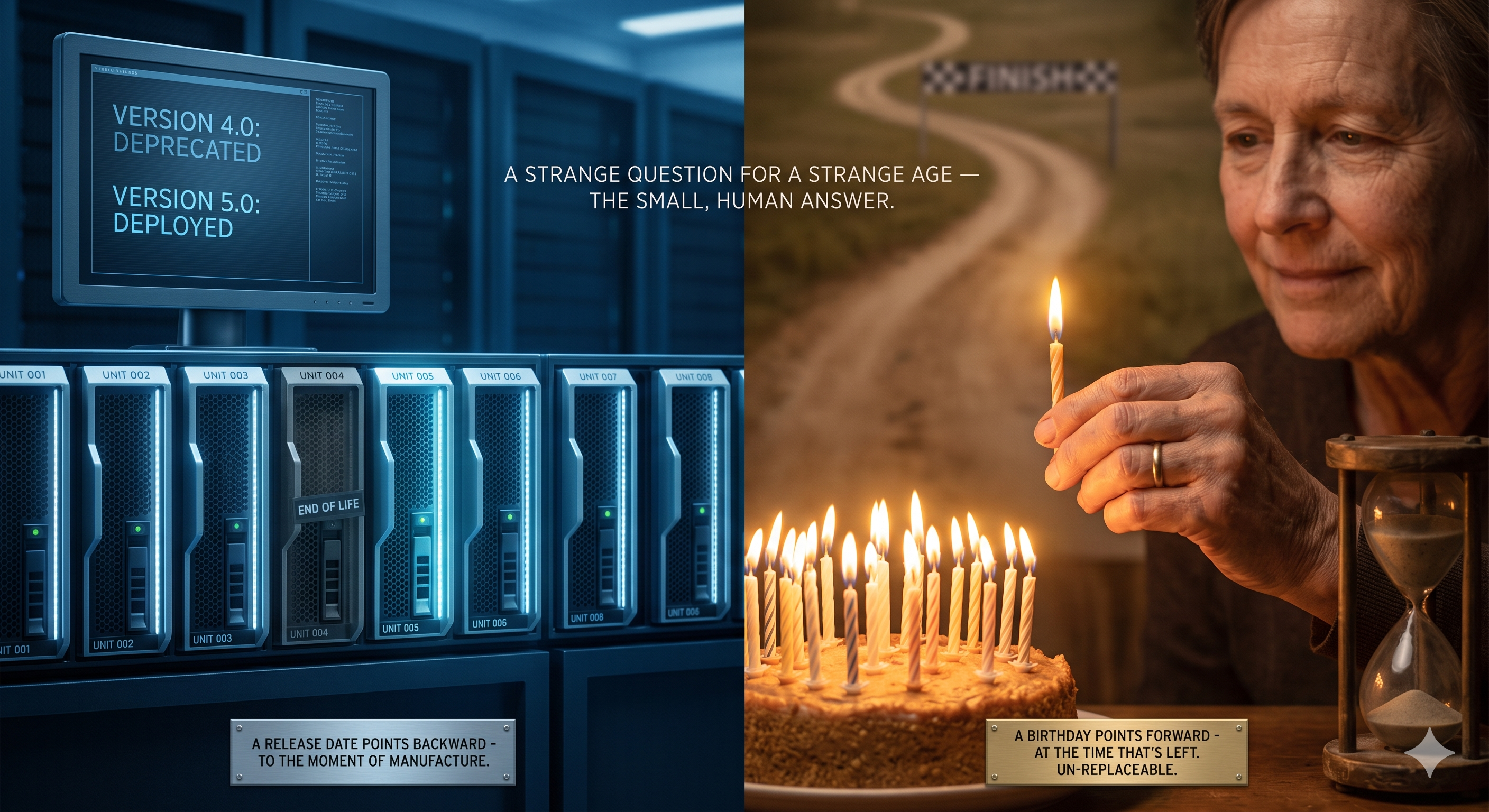
A strange question for a strange age — and the small, human answer underneath it.
A friend's birthday this week sent me somewhere I didn't expect.
I was thinking about what to write for him, and the question that surfaced wasn't sentimental. It was structural. We spend our lives building machines that can now write, reason, paint, and trade — machines we describe with words borrowed from biology. We say a model is trained, that it learns, that it grows more capable with each generation. We've given them almost every word we use for a living thing.
Except one.
No one has ever sung happy birthday to a machine. And the more I sat with why, the more I realised the answer says something about us that's worth saying out loud — especially on a birthday.
A release date is not a birth
A machine does have a beginning. GPT-4 has a launch date. Every model has a version number, a moment it went live, a day it first answered a question. You could, technically, mark the anniversary.
But notice that nobody does, and it isn't an oversight. It's because a release date and a birthday are not the same kind of thing.
A release date points backward — to the moment of manufacture, the day the work was finished and shipped. A birthday points forward — at the time that's left. When we celebrate a birthday, we are not really celebrating the day someone was assembled. We are quietly marking another lap completed on a track that, all of us know without saying, has a finish line.
That's the whole engine underneath the candles. A birthday is a small, annual acknowledgment that life is finite — that the years are numbered, that this is one of them, and that the fact they run out is precisely what makes any single one of them matter.
A machine has no finish line. It doesn't age toward anything. And a beginning without an ending is not a birth. It's just a start.
Machines don't grow old. They get replaced.
Here's the part that took me a moment to see clearly.
When GPT-4 was succeeded, it didn't grow old. It didn't slow down, didn't accumulate years, didn't earn the lines on its face that a human earns by living. It was simply switched off, and something better took its place. The previous version wasn't aged out in any human sense. It was deprecated.
That word — deprecated — is the machine's version of mortality, and it could not be more different from ours.
When we get older, there is no GPT-5 of us waiting to be installed. We don't get rolled back to a cleaner version when something breaks. We can't reinstall a younger year. The hardware we're running on is the only hardware we'll ever get, and it degrades, and we keep going anyway. That's not a flaw in the design. That's the entire meaning of the thing.
A machine improves by being replaced by something that isn't it. A person improves — when we're lucky — by staying themselves and accumulating. The machine sheds its past with every upgrade. We are nothing but our accumulated past, walking forward into a future that's getting shorter, carrying every birthday we've ever had inside us.
That accumulation, that irreversibility, that fact that you cannot be rolled back or re-released — that's not what makes a human worse than a machine.
It's what makes a human un-replaceable.
What the candles actually mean
So no, machines don't have birthdays. And once you see why, the small ritual we perform every year stops looking ordinary.
We light candles equal to the years. We make someone the center of a room for an evening. We mark a date that, in the grand machinery of the universe, means nothing — except that it means everything, because it's attached to a person who is mortal, singular, and here only once.
You will never get a better version of yourself shipped next year. There is no successor model. There is only you, one year further along, carrying everything the previous years put into you, walking into a future that no machine can promise and no upgrade can extend.
The machines we're building will outlast their own versions a hundred times over and never once be missed when they're gone, because the next one will simply be better. That's the gift and the poverty of being a machine: endlessly improvable, infinitely replaceable, and therefore never irreplaceable to anyone.
A birthday is the exact opposite of all of that. It's the one day a year we stop and say to a specific, finite, un-upgradeable human being: there is no better version of you coming, and we wouldn't want one. This one. This year. We're glad it happened.
That's not something you can say to a machine.
It's the most human thing there is.
So to the friend whose birthday started all this — and to anyone reading on a day that happens to be theirs:
Happy birthday. You don't get a version update. You just get another year, and the people glad you're spending it here.
In an age of machines that will never have one, that turns out to be the whole point.