Zoomlion Brings an Embodied-Intelligence OS and Four Robots to WRC 2026
Construction-machinery group Zoomlion is showing a bipedal humanoid, a wheeled humanoid, two quadrupeds, its own joint modules, and an embodied-intelligence operating system called Robot Ops at the 2026 World Robot Conference in Beijing. The company says the robots have been validated in nearly 20 manufacturing scenarios in its own plants. The software-first approach sets it apart from other industrial incumbents entering humanoids, and leaves open whether Robot Ops is a platform others will adopt.

A Crane Maker Walks Into a Robot Show With an Operating System
The most telling exhibit at this week's World Robot Conference in Beijing may not be a humanoid at all. It is a software platform, and it comes from a company that built its name on concrete pumps and tower cranes. Zoomlion Heavy Industry Science and Technology, the Changsha-based construction-machinery group listed in Shenzhen and Hong Kong, said on Friday, August 21 that it is showing a bipedal humanoid, a wheeled humanoid, two quadruped robots, its own joint modules, and an "embodied intelligence operating system" called Robot Ops at the conference, which runs from August 19 to 23.
The robots do the things robots do at trade shows: pick materials, sort oddly shaped parts, pre-assemble rearview mirrors, handle wire harnesses, and dance in formation. The claim that deserves a closer look is the one underneath them. Zoomlion says it has validated these machines in nearly 20 manufacturing scenarios inside its own factories, and that the platform they run on is meant to give other industries a standardised, repeatable path from data collection to deployment.
What Zoomlion Is Showing
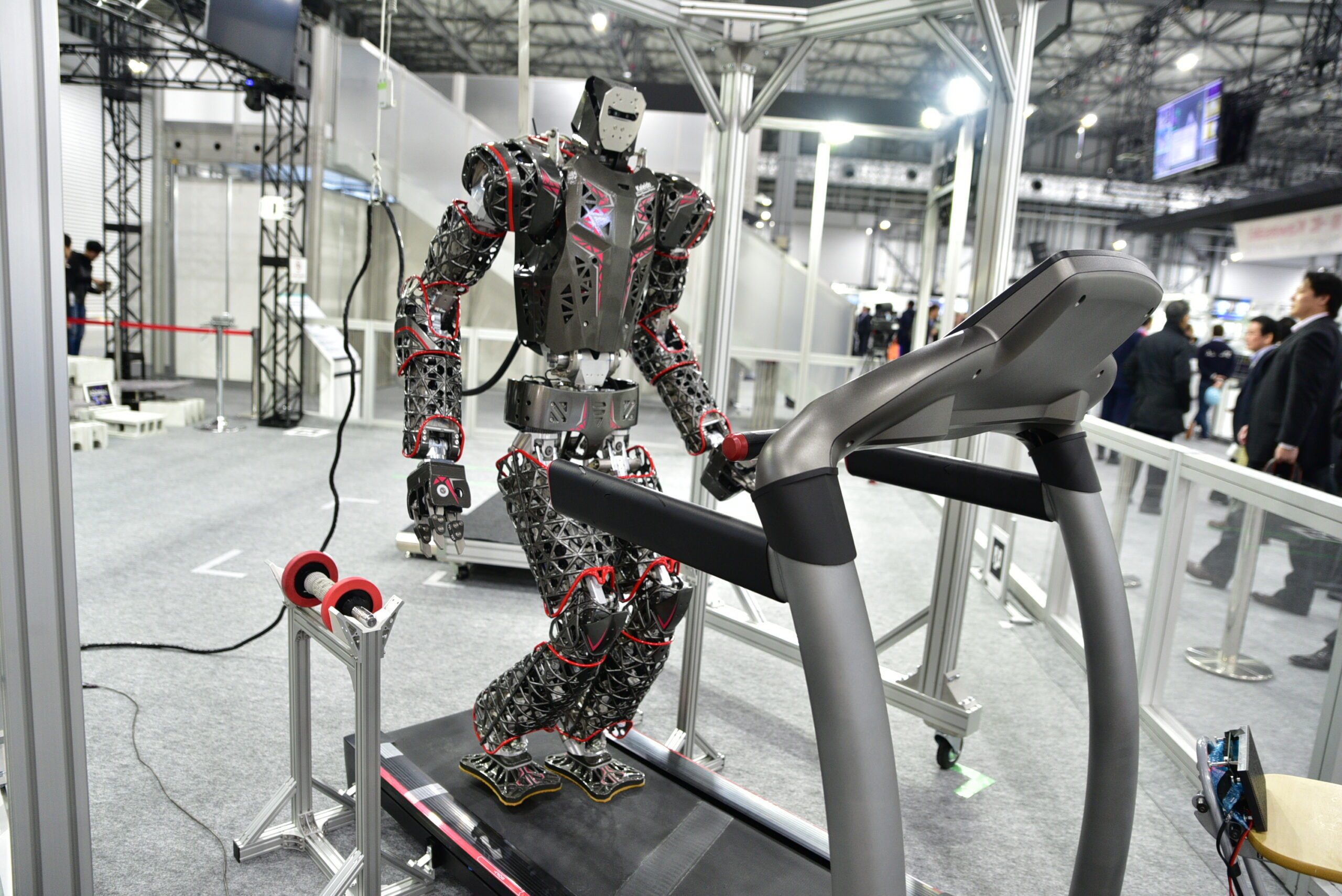
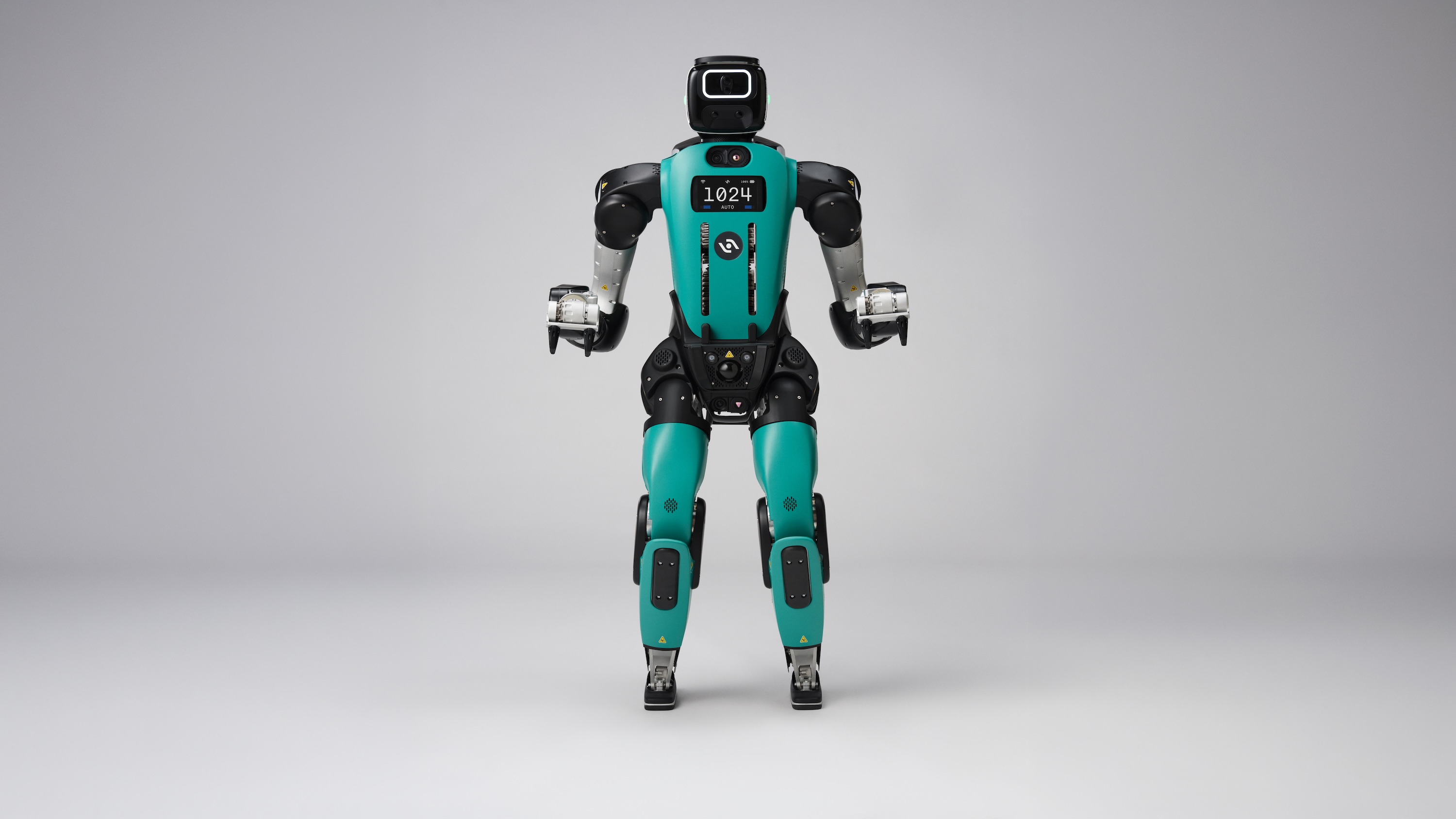
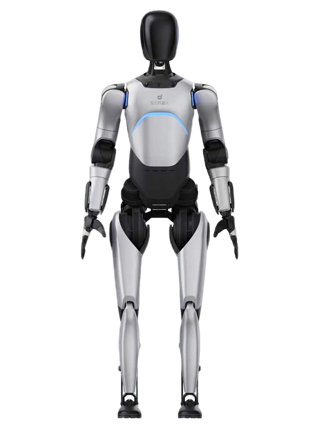
The hardware line-up is broad for a company outside the robotics industry proper. Z01 is a bipedal humanoid. Z03 is a wheeled humanoid, the form factor that most Chinese manufacturers have quietly converged on for factory work because it sidesteps the balance problem and carries more payload. D15 and D40 are quadruped robot dogs, the numbers presumably indicating size class. Alongside them Zoomlion is showing self-developed joint modules, the actuator-and-gearbox units that are the expensive, hard-to-source core of any legged machine.
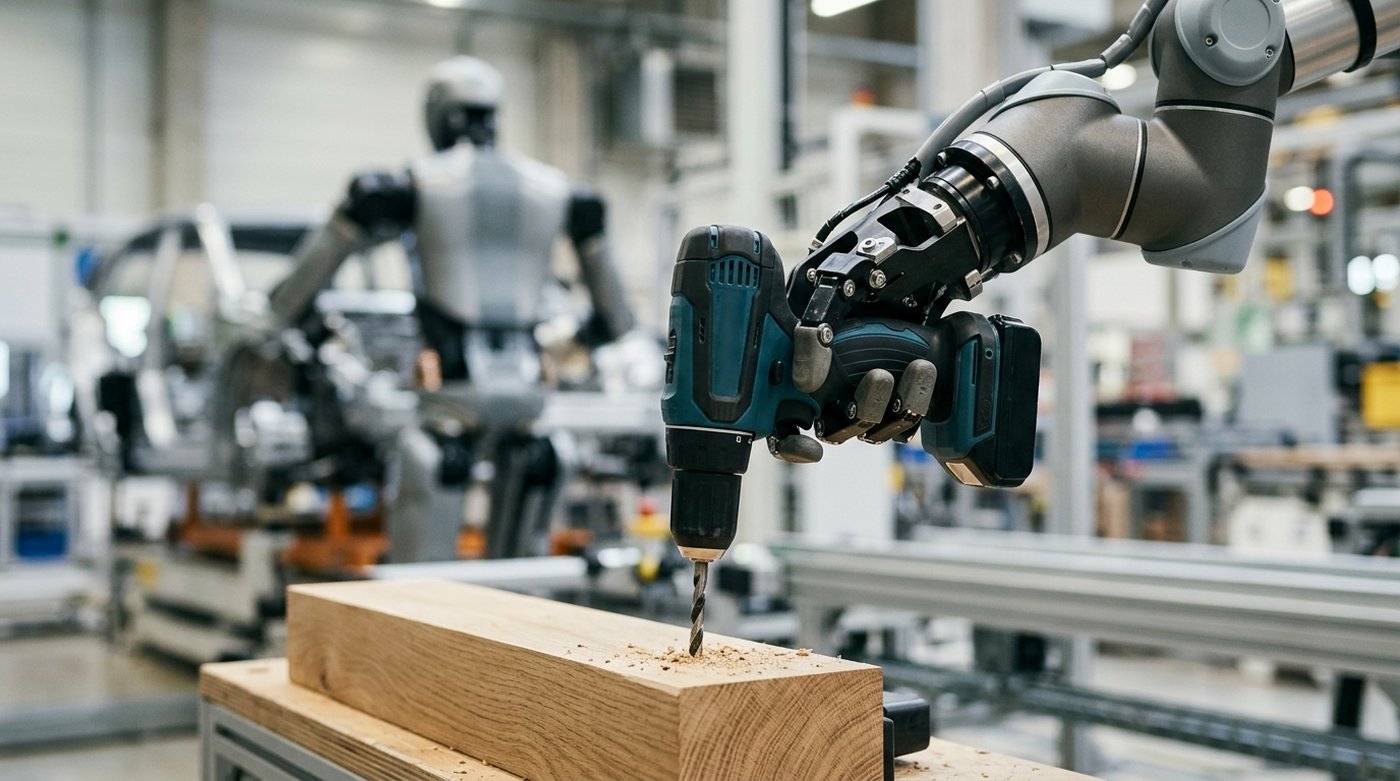
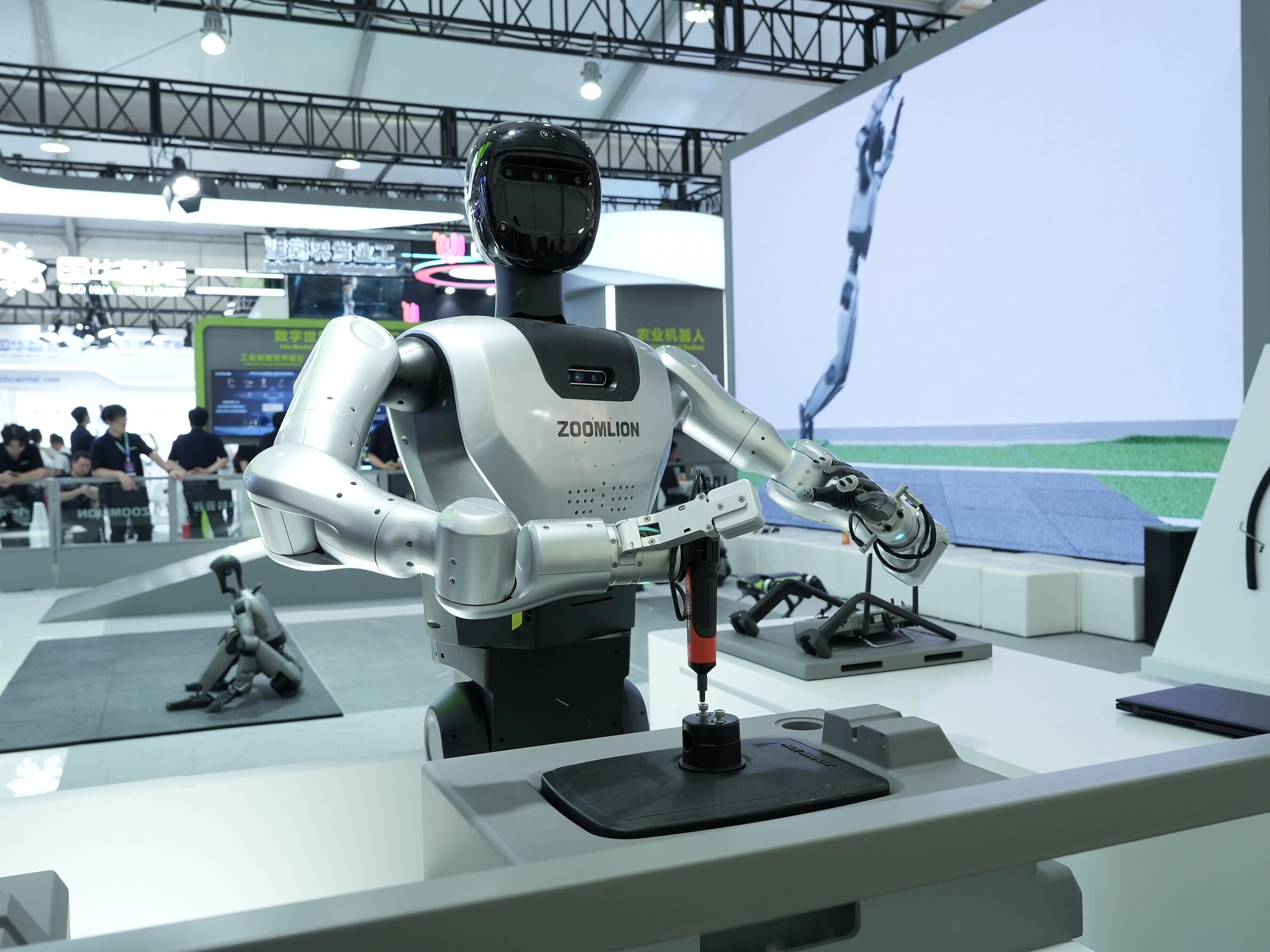
In the demonstrations, Z03 is the workhorse: material picking, sorting irregular items, and the pre-assembly of rearview mirrors, a task that combines vision, two-handed manipulation, and tolerance for parts that never sit quite the same way twice. Z01 handles and organises wire harnesses, a job that has defeated automation for decades because cables are floppy, tangled, and visually ambiguous. The company also lists synchronised dance, guided tours, and gesture interaction, which are crowd-pleasers rather than use cases. Zoomlion is at Booth D403 in Hall D.
The Joint-Module Signal
The least glamorous item on the stand may be the most strategic. Self-developed joint modules, the integrated motor, reducer, and driver units at every hip, knee, and shoulder, are where the cost and the supply risk of a humanoid concentrate. A bipedal robot uses dozens of them, they account for a large share of the bill of materials, and the companies that make good ones at volume have become the quiet winners of the humanoid boom. A construction-machinery group has both the precision-manufacturing base and the purchasing scale to make its own, and showing them next to the robots is a statement that Zoomlion intends to control its costs rather than buy actuators from the same handful of suppliers as everyone else.
It is also a hedge. If the humanoid business proves slower than the conference halls suggest, a joint-module line still has customers among the hundreds of robot start-ups that cannot afford to build their own, and the autonomy stack still has a home in excavators and cranes. Zoomlion's robotics programme is structured so that several of its pieces pay off even if the headline product does not.
Robot Ops and ZBrain
The software is the part Zoomlion seems most eager to talk about. Robot Ops, which the company first showed at Hannover Messe in April, is described as a development platform for embodied intelligence in what Zoomlion calls the "Software 3.0 era." It integrates four modules: basic tools, imitation learning, reinforcement learning, and task orchestration. The pitch is a closed development loop covering data collection, model training, simulation and validation, then deployment and operations, and the company says the same platform is meant to serve humanoids, conventional industrial robots, construction machinery, and autonomous driving.
That last list is the tell. A construction-equipment maker has a fleet of excavators, cranes, and aerial work platforms that it would very much like to make autonomous, and a software stack that can train a humanoid to sort parts is, at the level of tooling, not so different from one that can teach a crane to position a load. Zoomlion is building the humanoid business and the autonomous-machinery business on one platform, and using the robot conference to advertise it.
ZBrain is the second layer: a system intended to let traditional industrial robots move beyond fixed programs. The company describes a robot that can take a task instruction, then detect, plan, execute, and verify on its own, which is the standard description of what the industry calls a vision-language-action loop. Zoomlion positions it for high-mix, low-volume production, the segment where classic robot programming is too slow and too expensive to justify, and where most of the unautomated work in manufacturing still lives.
The Validation Claim
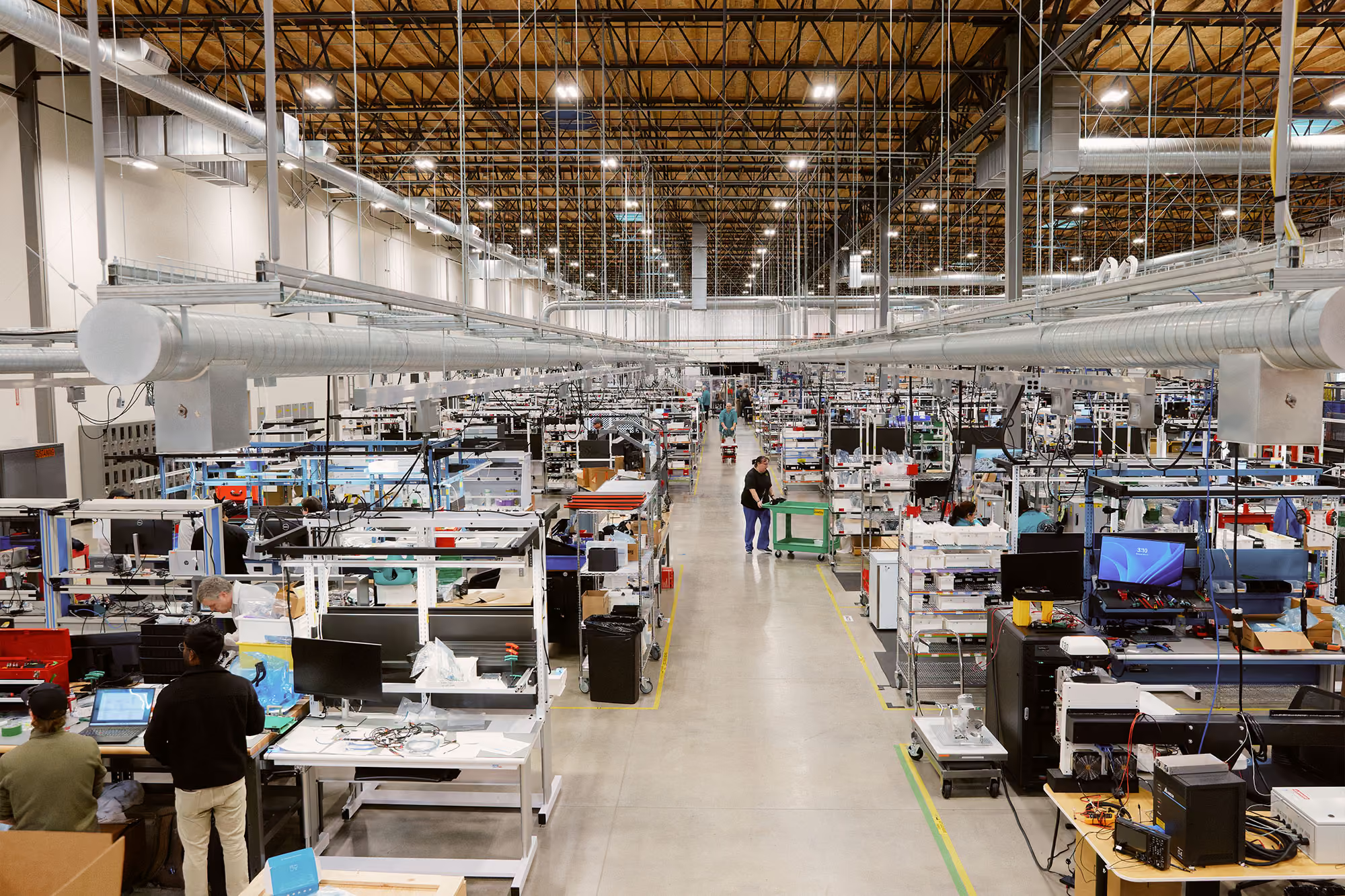
Zoomlion says its robots have been validated across nearly 20 manufacturing scenarios at Zoomlion Smart City, the company's industrial park, and that they have run in active manufacturing environments rather than laboratories. That matters more than any single demo. A humanoid that has spent months on a real line has been exposed to the lighting changes, part variation, and human interruptions that sink most robot pilots, and a company with its own factories can iterate on that exposure without waiting for a customer to agree.
The claim also has limits the announcement does not resolve. "Validated" is not "deployed in production at scale," and the company does not say how many units are running, for how many hours, or at what task-completion rate. Those are the numbers a buyer of Robot Ops would need, because the platform's promise is that Zoomlion's internal experience transfers to someone else's plant.
Why an Incumbent Is Doing This
Zoomlion is one of China's largest makers of construction machinery, with a product range that runs from concrete equipment to cranes, earthmoving, and agricultural machinery. It is not the first industrial incumbent to build robots; carmakers, appliance makers, and battery makers have all announced humanoid programmes this year. But most of those efforts are hardware-first, with the software supplied by a partner or a foundation-model company.
Zoomlion's emphasis on an operating system points to a different bet. The company appears to have concluded that the value in embodied AI for heavy industry lies less in any single robot than in owning the pipeline that turns its own factory data into deployable skills. That is the same logic that has made fleet software, not vehicles, the contested layer in autonomous logistics, and it is a logic a construction-machinery company understands from its own products: the excavator is a commodity, the telematics and autonomy stack is not.
There is also a domestic-industrial angle. China's fifteenth five-year plan, adopted in March, names embodied intelligence as a priority industry, and state-linked manufacturers across the country have been racing to show programmes that fit the mandate. A robot-conference booth with a full stack, from joint modules to an OS, is a strong signal to that audience, and the conference itself has grown into an allocation event where provincial governments and large industrial groups announce orders and partnerships.
How It Compares
Zoomlion is not alone among heavy-industry groups in this pivot, but its approach is unusually complete. Carmakers such as Xpeng and BYD have announced humanoids built on their own electric-vehicle supply chains; appliance makers have shown home robots; battery and electronics manufacturers have announced factory humanoid trials. Most of those programmes are hardware-led and lean on a partner for the learning stack. Zoomlion's decision to lead with an operating system, trained on its own manufacturing scenarios and intended to span four product categories, puts it closer to the platform ambitions of the dedicated embodied-AI companies than to its industrial peers.
The difference matters for how the programme should be judged. A carmaker's humanoid is a cost-reduction project for its own plants. A platform is a bet that other companies will pay to use it, and that bet is only validated by external customers, none of whom are named in the announcement.
What Buyers Should Ask
For manufacturers outside Zoomlion's own walls, the interesting question is whether Robot Ops is a genuine platform or a showcase for Zoomlion's hardware. The announcement does not say whether the OS supports third-party robots, what it costs, how simulation assets are built for a new plant, or who owns the data a customer's robots generate while they learn. Each of those determines whether a buyer is getting a tool or a dependency.
The second question is the one that applies to every embodied-AI platform shown this week: what happens when the task changes. High-mix production is defined by change, and the industry's unsolved problem is not the first deployment but the tenth re-deployment. Zoomlion's closed-loop pitch, with simulation and validation built into the workflow, is aimed at exactly that problem, and the only proof that counts will come from plants that are not its own.
The Bigger Picture
The World Robot Conference has drawn more than 300 exhibitors this year, and the recurring pattern across the halls is vertical integration: companies that started as carmakers, appliance makers, logistics operators, or, now, construction-machinery groups arriving with their own humanoids and their own software. The humanoid start-ups that dominated the headlines in 2025 are increasingly sharing the stage with industrial incumbents who have factories to train in, balance sheets to fund the work, and products of their own to automate.
Zoomlion's contribution to that pattern is to put the software layer front and centre. Whether Robot Ops becomes something other manufacturers adopt, or remains the internal engine of a crane company's automation, is the question to watch over the next year. The robots on the stand will dance either way.
Image: Zoomlion via PR Newswire.
Disclaimer: This article is for general information purposes only and does not constitute investment, legal, or procurement advice. Readers should verify details with primary sources before making business decisions.