Tokyo Artisan Intelligence Prepares Edge AI Chips for Robotics Production
Japan's Tokyo Artisan Intelligence has partnered with Malaysia's Oppstar to mass-produce reconfigurable edge AI chips targeting robotics, railways, and factory automation by 2027.
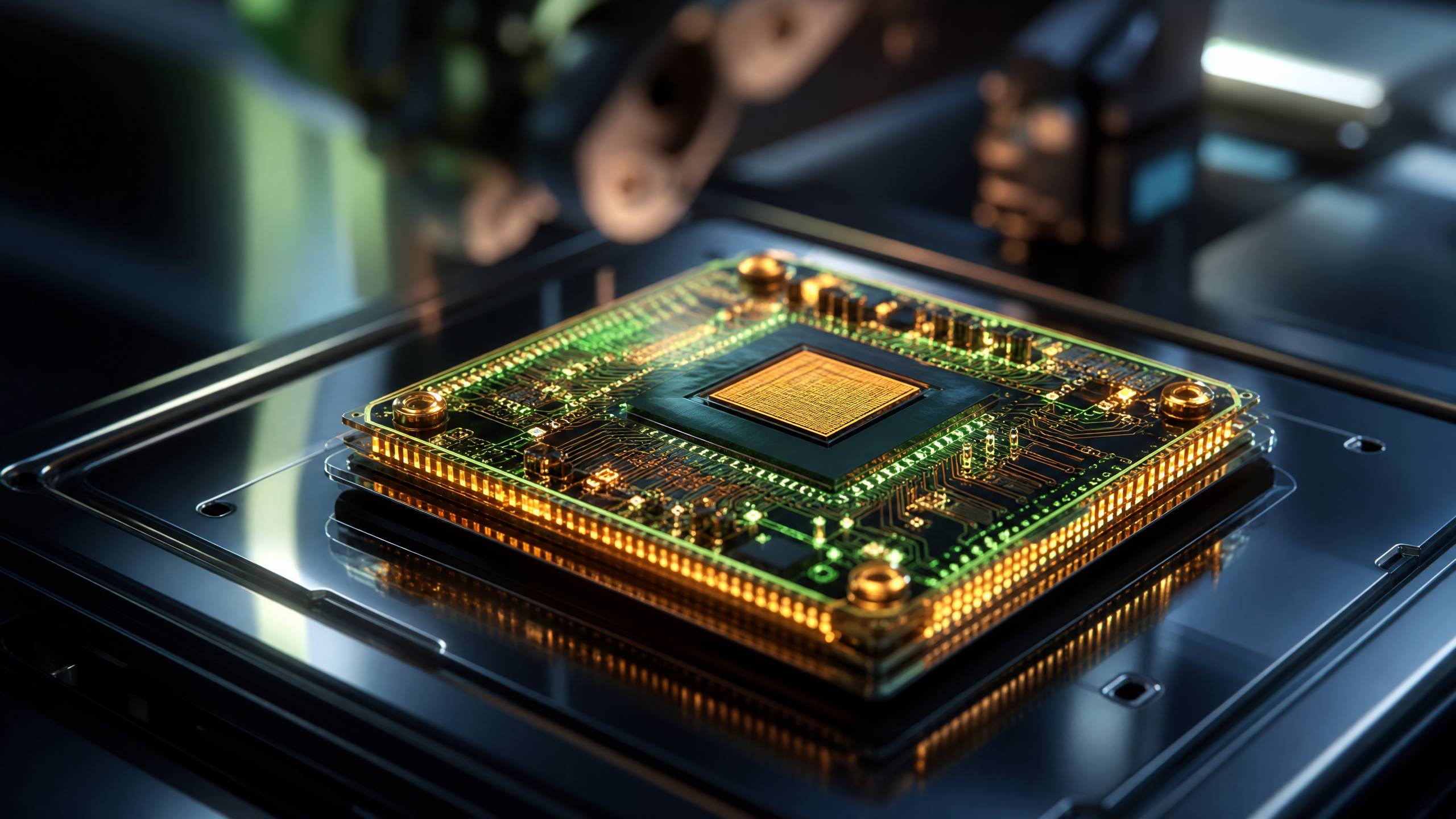
Japan-based edge artificial intelligence startup Tokyo Artisan Intelligence is preparing to mass-produce its proprietary silicon by 2027, targeting specialized applications in robotics, factory automation, and railway infrastructure. The company has partnered with Malaysia’s Oppstar, a Bursa-listed integrated circuit design house, to manage the transition from prototype to commercial production, establishing a new cross-border semiconductor supply chain for physical artificial intelligence.
Tokyo Artisan Intelligence and Oppstar have finalized the evaluation of the "Sting Ray" test chip, moving the project closer to commercial availability. This collaboration provides the necessary engineering scale to move from academic research into mass production, offering robotics manufacturers a low-power alternative to general-purpose compute platforms.
The Shift to Application-Specific Edge Silicon
The agreement between Tokyo Artisan Intelligence and Oppstar, formalized in June 2026 at the Selangor Information Technology and Digital Economy Corporation, marks a critical transition for the Japanese startup [1]. Chief Executive Officer Hiroki Nakahara and Oppstar co-Chief Executive Officer Ng Meng Thai outlined a comprehensive turnkey collaboration that covers chip design, package design, post-silicon validation, and outsourced assembly and testing [1]. This end-to-end support structure allows Tokyo Artisan Intelligence to bypass the massive capital expenditure typically required to build internal manufacturing infrastructure, leveraging Malaysia's established position in semiconductor packaging and testing.
The partnership has already yielded tangible results, with the two companies finalizing the evaluation of the "Sting Ray" test chip [2]. This milestone validates the core architecture and clears the path toward the 2027 mass production target. For Tokyo Artisan Intelligence, which originated from research conducted at the Tokyo Institute of Technology where Nakahara previously served as a professor, the move from academic prototyping to commercial scale represents a significant maturation of its technology stack [3]. The company previously secured 1.11 billion yen in Series B+ funding in June 2025, providing the financial runway to execute this commercialization strategy [3].
The focus on specialized edge silicon reflects a growing recognition that the hardware requirements for physical artificial intelligence differ fundamentally from those of cloud-based large language models. While data center graphics processing units are optimized for massive parallel processing and training massive datasets, edge environments demand strict adherence to power constraints, thermal limits, and real-time latency requirements. By developing field-programmable gate array based solutions, Tokyo Artisan Intelligence aims to deliver reconfigurable, low-power chips that can execute inference tasks directly on the device, eliminating the need for continuous cloud connectivity.
Commercial Rationale for Low-Power Inference
The semiconductor market for artificial intelligence is currently dominated by high-performance data center hardware, but the deployment of autonomous mobile robots, factory inspection systems, and intelligent railway monitoring equipment requires a different architectural approach. In these industrial settings, power consumption and thermal management are critical constraints. A robot operating on a factory floor cannot rely on a power-hungry processor that drains its battery in minutes or requires bulky active cooling systems that add weight and complexity to the mechanical design.
Tokyo Artisan Intelligence addresses these constraints through its focus on field-programmable gate array technology. Unlike application-specific integrated circuits, which are hardwired for specific tasks, field-programmable gate arrays offer reconfigurability, allowing engineers to update the hardware logic after deployment. This flexibility is particularly valuable in the rapidly evolving field of robotics, where artificial intelligence models and sensor fusion algorithms are constantly being refined. By utilizing a reconfigurable architecture, integrators can extend the operational lifespan of their hardware, deploying over-the-air updates that optimize the silicon for new tasks without requiring physical component replacements.
The commercial viability of this approach hinges on targeting specific industrial niches where standard data center silicon is either too expensive, too power-hungry, or physically unsuitable. Railway infrastructure, for example, requires highly reliable, low-latency processing for track inspection and predictive maintenance, often in remote locations with limited connectivity. Similarly, factory automation systems demand deterministic performance to ensure safety and precision on the assembly line. By tailoring its silicon to these specific use cases, Tokyo Artisan Intelligence is positioning itself as a specialized provider in a market that is increasingly segmenting based on application requirements.
Competitive Dynamics in Edge AI Hardware
The emergence of Tokyo Artisan Intelligence as a commercial silicon provider introduces new dynamics into the edge artificial intelligence hardware market, which is currently heavily influenced by general-purpose compute platforms. The Nvidia Jetson series has established a strong foothold in robotics and industrial automation, offering a comprehensive software ecosystem and robust performance. However, the Jetson platform is designed to serve a broad range of applications, which can result in power consumption and feature sets that exceed the strict requirements of highly specialized industrial tasks.
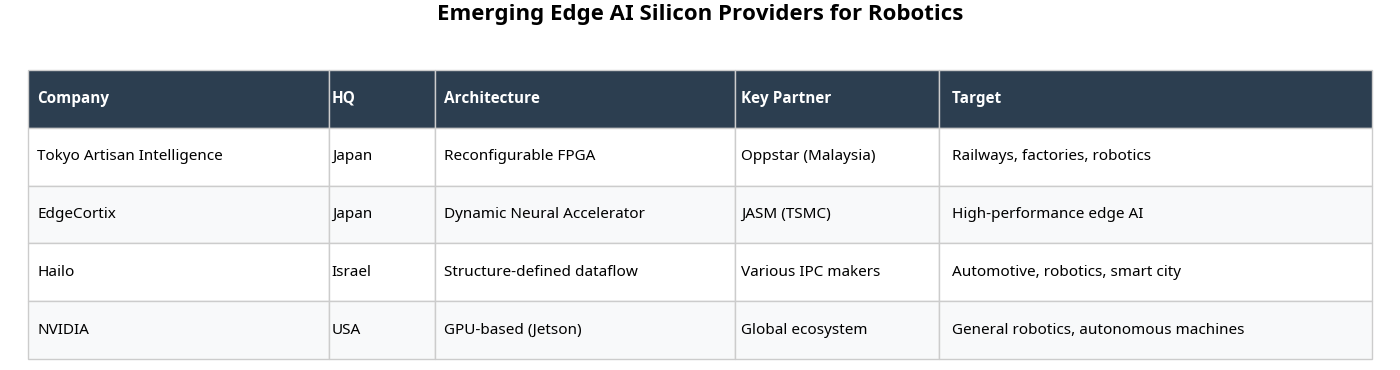
The differentiation for Tokyo Artisan Intelligence lies in its specific architectural choices and its strategic supply chain partnerships. By leveraging field-programmable gate array technology, the company offers a degree of hardware flexibility that contrasts with the fixed architectures of some competitors. Additionally, the partnership with Oppstar establishes a reliable production pipeline that connects Japanese engineering with Southeast Asian manufacturing expertise. This cross-border collaboration is particularly relevant as Japanese robotics and automation companies, including industry leaders like Yaskawa, seek to integrate artificial intelligence capabilities into their legacy systems to maintain competitiveness against rapidly scaling Chinese manufacturers.
The broader context of the robotics market underscores the urgency of this hardware evolution. With global humanoid robot shipments projected to surge, and industrial automation systems increasingly relying on complex sensor fusion and autonomous decision-making, the demand for efficient on-device inference is accelerating. The ability to process data locally, without the latency and security risks associated with cloud transmission, is becoming a baseline requirement for next-generation physical artificial intelligence deployments.
Deployment Realities and Hardware Limitations
Despite the clear advantages of specialized edge silicon, the transition away from established general-purpose platforms presents significant challenges for integrators and procurement teams. The most substantial hurdle is the software ecosystem. Nvidia has built a formidable competitive moat through its CUDA architecture, which provides developers with a familiar, comprehensive suite of tools, libraries, and frameworks for artificial intelligence development. Moving to a proprietary or specialized silicon architecture often requires engineering teams to adapt to new toolchains, potentially slowing down development cycles and increasing integration costs.
Moreover, the theoretical benefits of low-power, reconfigurable silicon must be validated in real-world industrial environments. While the "Sting Ray" test chip has completed evaluation, the leap from a successful prototype to reliable mass production is notoriously difficult in the semiconductor industry. Oppstar’s expertise in post-silicon validation will be critical in ensuring that the final chips can withstand the harsh conditions of factory floors and railway systems, including temperature fluctuations, vibration, and electromagnetic interference.
Operations leaders must also consider the trade-offs between compute power and energy efficiency. While specialized edge chips excel at specific inference tasks, they may lack the raw processing capabilities required for highly complex, multi-modal artificial intelligence models. As robotics applications become more sophisticated, integrating vision, audio, and tactile data simultaneously, the hardware must strike a delicate balance between specialized efficiency and sufficient general compute capacity. The reconfigurability of Tokyo Artisan Intelligence's field-programmable gate array approach mitigates this risk to some extent, but it does not entirely eliminate the fundamental constraints of low-power silicon.
Procurement Implications for Automation Buyers
The commercialization of Tokyo Artisan Intelligence’s edge artificial intelligence chips, targeted for 2027, will require procurement teams to reassess their hardware sourcing strategies for industrial automation and robotics projects. The availability of application-specific, low-power silicon provides an opportunity to optimize the bill of materials for specific deployments, potentially reducing costs associated with over-provisioned general-purpose hardware and complex thermal management systems.
When evaluating edge artificial intelligence hardware, sourcing managers must conduct a rigorous total cost of ownership analysis. This analysis should weigh the upfront hardware costs and energy savings of specialized silicon against the potential software integration expenses and the learning curve associated with adopting a new architecture. The software ecosystem remains a critical factor; hardware efficiency cannot come at the expense of development velocity or system reliability.
Procurement teams should actively monitor the performance benchmarks of the "Sting Ray" architecture as Tokyo Artisan Intelligence moves closer to mass production. Engaging with the company during this pre-production phase can provide valuable insights into the specific capabilities and limitations of the silicon, allowing organizations to determine if it aligns with their upcoming automation roadmaps.
Additionally, the partnership between Tokyo Artisan Intelligence and Oppstar highlights the importance of supply chain diversification. By establishing a production pipeline that leverages Malaysian integrated circuit design and testing expertise, the Japanese startup is building a resilient supply chain that mitigates reliance on single-source manufacturing hubs. For procurement professionals, this cross-border collaboration offers a blueprint for securing specialized hardware components in an increasingly complex global semiconductor market. The shift toward application-specific edge silicon is not merely a technological evolution; it is a strategic procurement opportunity that will define the next generation of industrial automation.
References
1. Nikkei Asia. "Japan AI chip startup taps Malaysia's Oppstar to gear up for production." July 6, 2026.
2. Moomoo. "TAI and Oppstar finalize Sting Ray test chip evaluation." May 2026.
3. IT Business Today. "Tokyo Artisan Intelligence secures Series B+ funding." June 2025.