Medtronic's Hugo Robot Gets Its First FDA-Cleared Energy Instrument
Medtronic won FDA clearance for the LigaSure RAS Maryland instrument on its Hugo surgical robot, its first robotic vessel-sealing tool, though the US approval still trails what Hugo already supports internationally.

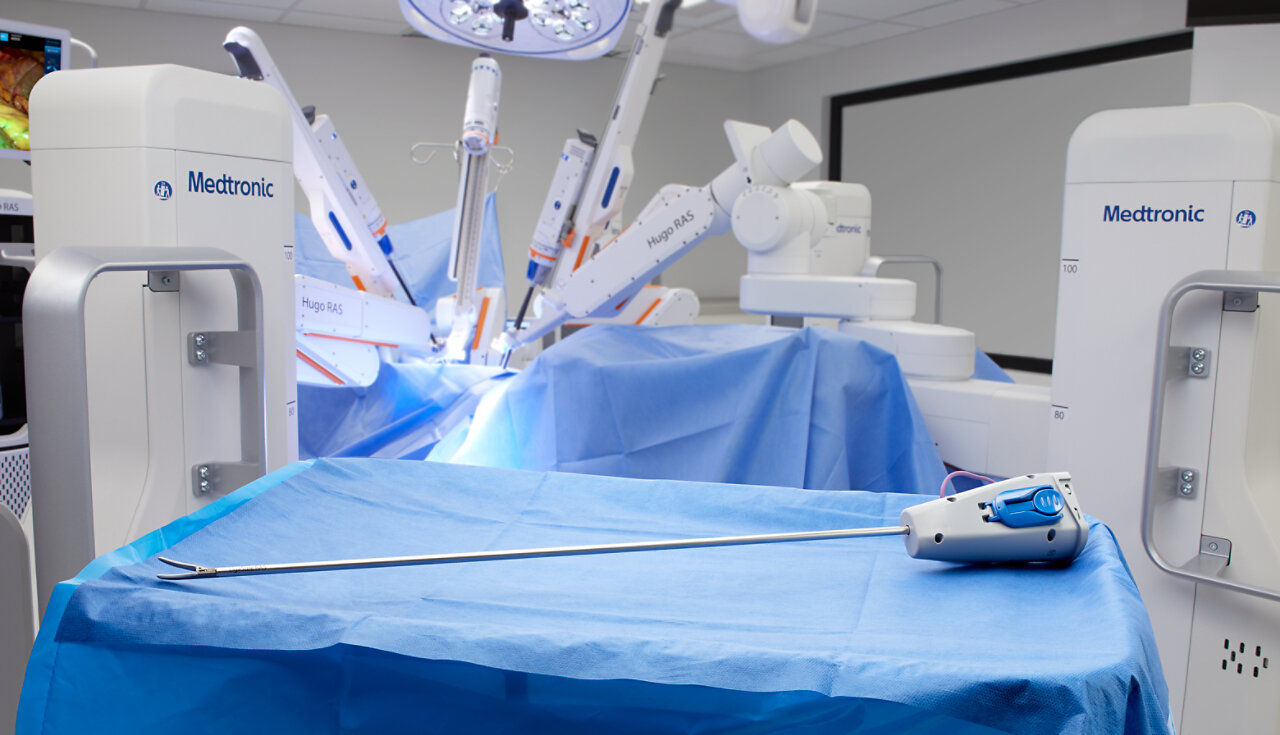
Seven millimeters is the widest vessel Medtronic's new robotic sealing instrument can close in about two seconds, and that single specification is the reason the U.S. Food and Drug Administration's Wednesday clearance matters more than a routine product-line update. Medtronic announced that the agency cleared the LigaSure RAS Maryland instrument for use on the company's Hugo robotic-assisted surgery (RAS) system, marking the first time the vessel-sealing technology behind more than 45 million procedures worldwide has been built directly into a Medtronic surgical robot rather than sold as a handheld laparoscopic tool. The clearance covers urologic surgical procedures in the United States, the narrowest of the indications Hugo already carries in the more than 35 countries where Medtronic sells the platform outside U.S. borders.
For hospital procurement teams and surgeons already running or evaluating Hugo, the clearance closes a specific capability gap rather than opening a new one. Robotic-assisted surgery depends on energy instruments to seal blood vessels and cut tissue without the bleeding that unsealed cuts would cause, and until this week, Hugo operators in the United States could not use Medtronic's own flagship sealing technology on the platform, forcing a choice between a Medtronic robot and a non-Medtronic energy device or workaround instrumentation. Dr. Matthew Kroh, chief medical officer within Medtronic's surgical business, said the update means "surgeons carry the confidence and control they already rely on into their robotic-assisted cases," extending a laparoscopic track record onto the robotic platform rather than asking surgeons to trust an unfamiliar instrument.
A Two-Decade Track Record Now Running Through a Robotic Arm
LigaSure is not a new Medtronic technology being tested for the first time. The underlying vessel-sealing method has been in clinical use for roughly two decades, applied in an estimated 45 million procedures across more than 65 countries, most of that history built through handheld and laparoscopic instrument formats rather than robotic ones. What changed this week is the delivery mechanism, not the underlying physics: the newly cleared instrument seals and divides vessels, thick tissue bundles, and lymphatic structures up to seven millimeters in diameter in approximately two seconds, while limiting the thermal spread that can damage tissue adjacent to the sealed site. That speed and precision profile matters specifically in robotic surgery, where every instrument exchange during a procedure adds operating-room time, anesthesia exposure, and cost, so an energy instrument that performs reliably without frequent swaps has a direct effect on how efficiently a surgical team can run a robotic case list.
The instrument's track record outside robotics is precisely why Medtronic frames this clearance as a confidence transfer rather than a new-technology launch. A hospital's decision to adopt any energy instrument inside a robotic workflow carries real clinical risk if the sealing technology has not already been proven at scale, and Medtronic's pitch to surgeons rests on the argument that the physics have already been validated across tens of millions of open and laparoscopic uses, leaving robotic integration as the remaining engineering step rather than an unproven clinical bet. That is a materially different sales proposition than a competitor introducing an entirely new sealing chemistry or mechanism alongside a new robotic platform, and it shapes how quickly a hospital's value-analysis committee is likely to approve the instrument for its own robotic surgery program.
Why the U.S. Indication Lags What Hugo Already Does Abroad
The most commercially telling detail in this week's clearance is what it does not yet cover. Outside the United States, Hugo already supports more than 50 distinct surgical procedures spanning urology, general surgery, and gynecology across more than 35 countries, while the newly cleared LigaSure RAS Maryland instrument is authorized in the U.S. market for urologic procedures only. Medtronic has said it is pursuing expanded U.S. indications covering general and gynecologic surgery, but until those clearances arrive, American surgeons operating in those specialties will not have access to the same energy-instrument capability their counterparts in Europe, Latin America, and Asia already use on the identical robotic platform.
That gap is a direct consequence of how the FDA evaluates robotic-surgery instrumentation relative to regulators in other major markets, and it is a pattern hospital systems evaluating multiple robotic platforms should watch closely rather than treat as a one-time quirk of this specific clearance. A platform's international indication list is a reasonable proxy for its underlying engineering maturity, but it is a poor predictor of what a U.S. hospital can actually deploy on any given quarter, since FDA clearance proceeds procedure category by procedure category rather than approving a platform's full global indication set in one action. Surgical-services administrators comparing Hugo against Intuitive Surgical's more established da Vinci platform, or against Johnson & Johnson's recently authorized Ottava system, need to weight each platform's actual U.S.-cleared indication list, not its global one, when deciding which specialties a robotic investment can support on day one.
The Competitive Stakes of Matching an Integrated Energy Platform
Robotic surgery has increasingly become a competition over which platform offers the widest menu of compatible, purpose-built instruments rather than which platform has the most capable robotic arms in isolation, because a hospital cannot run a full slate of procedure types on a robot that lacks the instrumentation those procedures require. Intuitive Surgical built its market leadership in part on decades of expanding its own EndoWrist instrument catalog to match nearly every soft-tissue procedure a hospital might want to perform robotically, and any challenger platform, Hugo included, has to close that instrument-breadth gap procedure by procedure to be taken seriously as a full replacement rather than a supplemental system for a narrow set of cases.
This week's clearance is Medtronic's clearest step yet toward treating Hugo as a direct answer to that instrument-breadth competition rather than a robot that requires borrowed or third-party energy devices to function in real operating rooms. A robotic platform that cannot offer its own validated vessel-sealing instrument effectively asks a hospital to either accept a workaround or delay adoption until the gap closes, and either choice slows a health system's return on a robotic-surgery capital investment that typically runs into the millions of dollars once the console, arms, instrument sets, and staff training are included. Removing that friction for urologic cases first is a deliberate sequencing choice, since urology has been Hugo's most established specialty in prior international rollouts and the specialty where Medtronic has the clearest existing base of surgeons already comfortable with the platform.
The Modular Bet Behind Hugo's Design
Hugo's architecture is part of why this clearance carries more weight than a routine instrument approval. Unlike single-cart robotic systems that bundle every arm into one console, Hugo uses a modular design in which separate, independently positioned arm carts surround the operating table, a configuration Medtronic has argued gives hospitals more flexibility to fit the system into operating rooms that were not originally built around a single large robotic tower. That modularity is only useful to a hospital, though, if the instruments running through those arms match what surgeons already trust, which is precisely the argument Medtronic is making with the LigaSure clearance: a flexible robotic chassis is a secondary consideration next to whether the instrument doing the actual cutting and sealing has a track record a surgeon is willing to stake a patient's outcome on. Hospitals already committed to Hugo's modular footprint gain a second reason to stay the course now that the platform's arms can run Medtronic's own validated energy technology rather than a substitute.
A Market Where Instrument Depth Decides Purchasing Cycles
The global robotic-assisted surgery market has drawn a wave of new entrants over the past several years precisely because soft-tissue surgery, long dominated by a single vendor, represents one of the largest remaining pools of procedures not yet performed robotically at scale. Every new entrant into that market, Medtronic included, faces the same adoption bottleneck: hospitals sign multi-year capital and service agreements for robotic platforms, and switching vendors mid-cycle is expensive enough that a health system's choice of platform today effectively locks in which company captures its instrument and service revenue for years afterward. That dynamic is why instrument-level clearances like this one carry outsized weight relative to their apparent scope. A single energy-instrument approval will not by itself move a hospital that has already standardized on a competing platform, but it materially strengthens Medtronic's pitch to the systems still evaluating which robotic vendor to commit to, particularly for urology departments where LigaSure's underlying sealing technology already has an established reputation independent of which robot delivers it.
What Comes Next for Hospitals Building a Robotic Surgery Roadmap
The practical question for any hospital system currently running or budgeting for a Hugo installation is timing: how quickly Medtronic can secure the general-surgery and gynecologic clearances that would bring the LigaSure RAS Maryland instrument's U.S. availability in line with what the platform already supports internationally. Medtronic has not published a specific date for those expanded submissions to clear, and FDA review timelines for additional procedure indications on an already-cleared instrument are typically shorter than a first-in-class submission, but they are not guaranteed, and hospitals building multi-year robotic-surgery staffing and case-volume plans should treat the general-surgery and gynecology timeline as an open variable rather than an assumed near-term certainty.
For surgical teams already operating Hugo in the United States, urology programs get the clearest immediate benefit: a validated, Medtronic-built vessel-sealing option that removes one more reason to default to a competing platform for that specialty. The seven-millimeter vessel diameter and roughly two-second seal time are now the concrete numbers a Hugo urology program can put in front of a value-analysis committee, replacing what had been, until Wednesday, only a promise that Medtronic's most established surgical technology would eventually make it onto its newest robotic arm.
This analysis draws on Medtronic's public announcement of the FDA clearance and related company statements describing the Hugo RAS system's capabilities. It is for general information purposes only and does not constitute investment, financial, or legal advice.
Hero image credit: Medtronic.