Magic Atom Runs Three Live Scenarios at WRC 2026
Magic Atom staged three simultaneous live scenarios at WRC 2026, industrial manufacturing, smart logistics, and a Wuxi police partnership, backing its MagicBot D1 and MagicDog T1 hardware with a new vision-language-action model and over US$153 million in cumulative orders.


Three Stages, One Argument About Scale
At the World Robot Conference in Beijing on Saturday, August 22, Magic Atom set its wheeled humanoids, quadrupeds, and traffic robots loose across three separate live scenarios rather than a single showcase booth, running warehouse picking, factory material handling, and a public-safety patrol demonstration simultaneously through the exhibition hall. The Wuxi-headquartered humanoid start-up, known internationally as MagicLab and founded in late 2023, used the conference not to introduce new hardware but to argue that its existing product line is ready to move past demonstration and into repeatable, revenue-generating deployment.
That distinction matters because Magic Atom's core machines, the MagicBot D1 wheeled industrial humanoid and the MagicDog T1 quadruped, first appeared publicly at the World Artificial Intelligence Conference in Shanghai in July alongside the company's flagship bipedal humanoid, MagicBot X1. What changed in Beijing was not the hardware but the proof: three concurrent working scenarios, a named police-department partnership, and executives speaking in terms of production volume rather than capability records.
The Factory Floor Scenario
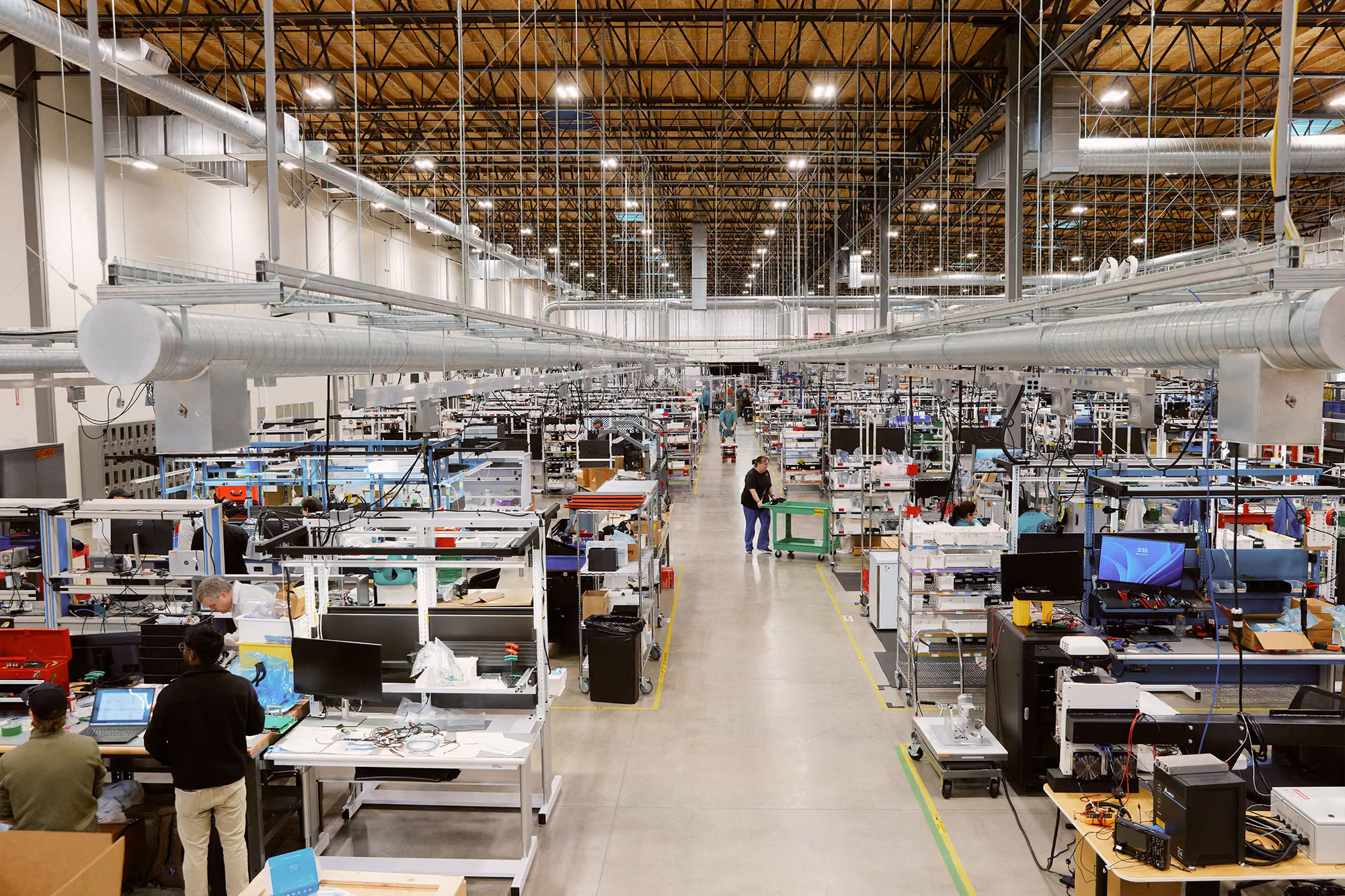
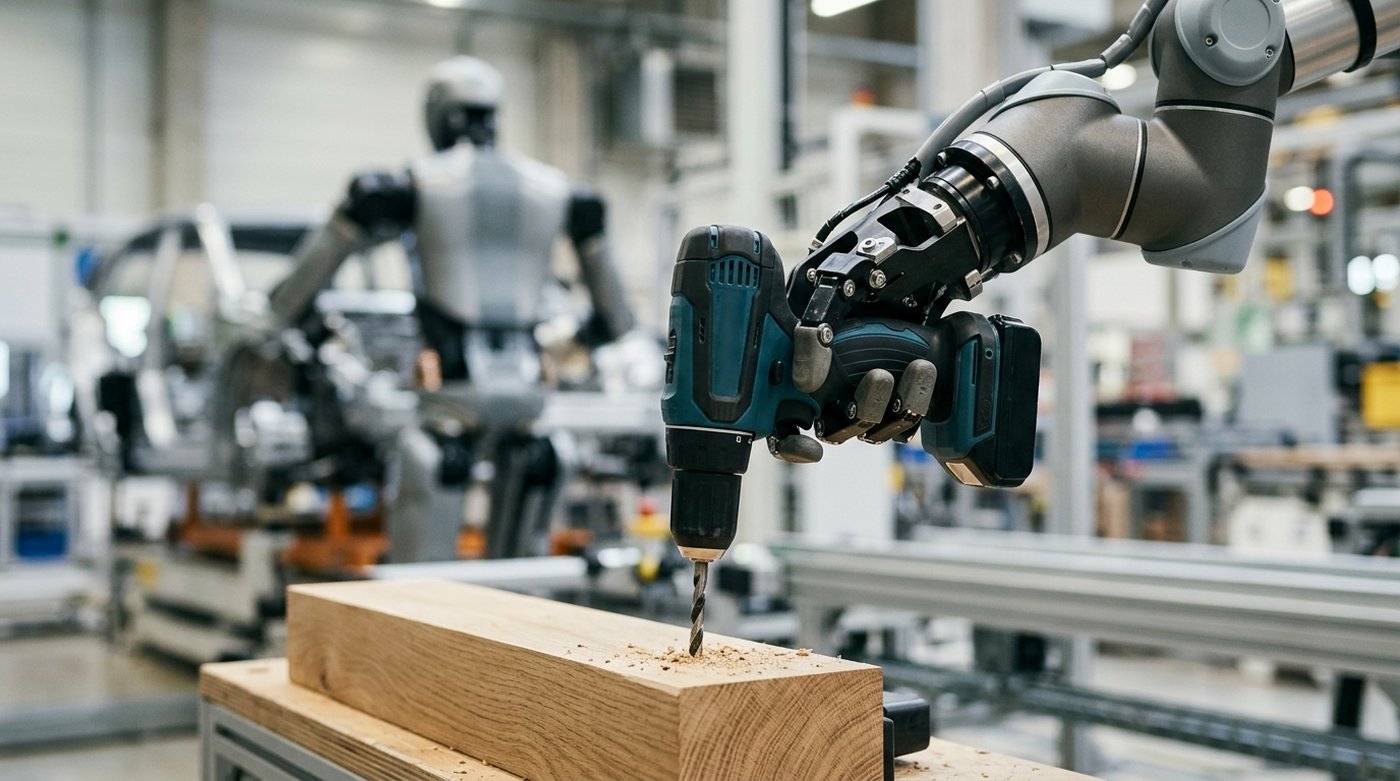
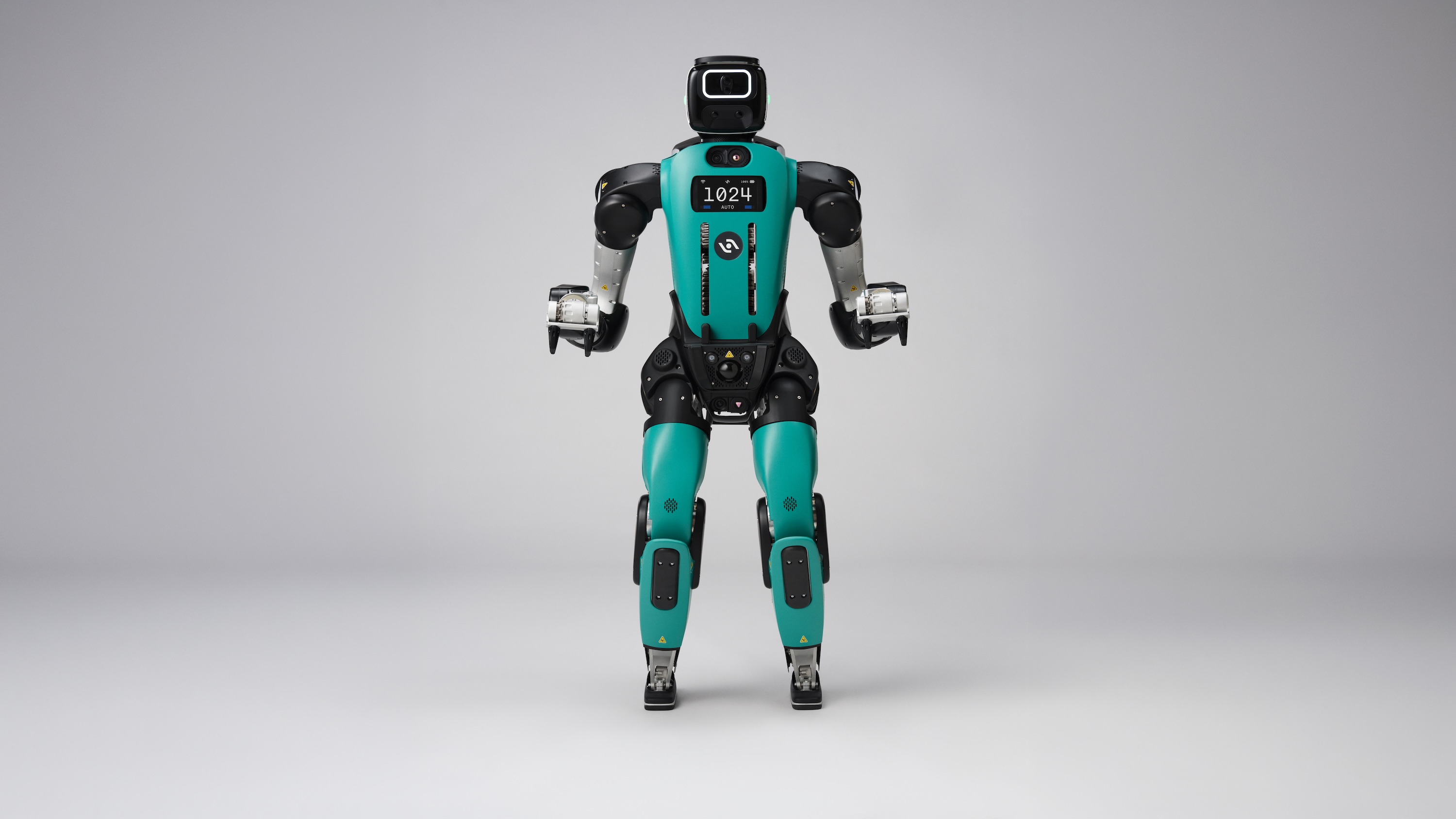
In the industrial-manufacturing bay, MagicBot D1 handled material logistics with a five-kilogram single-arm payload and force-control precision to 0.5 newtons, fine enough to place components without the kind of overcorrection that damages delicate parts, across a working height range of 80 to 230 centimeters that covers most standard factory shelving and workstation heights without requiring a custom rig. The wheeled chassis, the same design compromise most Chinese manufacturers have converged on for indoor factory work, trades a biped's balance complexity for a lower center of gravity and a larger stable payload margin.
Beside it, in the smart-logistics scenario, Magic Atom ran its XGZ1 and HyperBot units through coordinated picking and sorting at speeds up to 2.5 meters per second, with a tool-exchange cycle Magic Atom says takes six seconds, the kind of specification that matters less as a standalone number than as a proxy for how quickly a warehouse operator could reconfigure a line for a different order profile without calling in a technician. Fast tool exchange is the unglamorous variable that determines whether a robot arm earns its keep on mixed-SKU logistics work, where the task changes every few minutes, rather than the single repetitive motion that most industrial-robot marketing still assumes.
A Police Partnership, Not a Product Demo
The third scenario departed furthest from the usual trade-show script. Magic Atom demonstrated traffic-management and emergency-response applications built around a partnership with the Wuxi Police Department, the company's home-city public-security bureau, putting its hardware into a use case that most humanoid vendors avoid because it requires sign-off from a government safety authority rather than a corporate procurement department. A public-safety deployment, even a pilot-stage one, carries a different verification bar than a factory pilot: it needs regulatory approval, liability clarity, and demonstrated reliability under conditions a company cannot fully script in advance, which makes the partnership a more demanding credibility test than either of the industrial demonstrations running alongside it.
Alongside the wheeled humanoid, Magic Atom's MagicDog T1 quadruped worked the show floor for lighter tasks. The 18-kilogram machine carries up to 15 kilograms of payload, reaches 5 meters per second, and runs roughly three hours on a charge, with a modular design that supports single-person deployment and expansion interfaces for mounting a robotic arm, vision sensors, or industry-specific instruments. That modularity is the quadruped's real pitch: rather than selling a fixed-function inspection robot, Magic Atom is positioning MagicDog T1 as a chassis a customer can reconfigure for anomaly detection, equipment monitoring, or site inspection depending on which module gets bolted on.
The Model Behind the Machines
Underneath the hardware, Magic Atom used the conference to detail Magic-VLA K02, its vision-language-action model, with figures the company says come from internal benchmarking: 92 percent accuracy on complex, multi-step tasks, a 5 percent interruption rate requiring human intervention, a 110 percent improvement in throughput over the company's prior model generation, and full adaptation across its different robot chassis without a separate retraining pass per device. That cross-device figure is the more consequential claim of the four. A model that transfers cleanly from a wheeled humanoid to a quadruped to a fixed arm, without per-robot retraining, lowers the marginal cost of adding a new form factor to Magic Atom's lineup and is closer to the software-defined-fleet argument that has become the industry's dominant pitch to buyers this year, echoing the same platform logic that heavy-industry entrants at the same conference are using to justify their own robotics divisions.
Chen Chunyu, Magic Atom's chief technology officer, framed the company's near-term priority around manufacturing discipline rather than model performance: scaling, he said, requires supply chain capability and reliability testing, with the explicit goal of reaching production beyond 10,000 units. Gu Shitao, the company's president, added that ecosystem collaboration, not individual competition, is what determines commercialization success in the sector, a comment aimed as much at Magic Atom's Beijing neighbors on the show floor as at its own roadmap.
What the Numbers Add Up To
Magic Atom said it has accumulated more than RMB 1.1 billion (approximately US$153 million) in orders and now operates in close to 30 countries, a commercialization footprint broader than the one most humanoid start-ups outside the largest, best-funded Chinese players report at this stage. The company was also named to the 2026 Global Embodied Intelligence Benchmark Enterprise TOP100 list, an industry recognition that, on its own, carries limited weight for a buyer, but read alongside the order figure and the multi-country footprint, supports the picture Magic Atom is trying to paint of a company past the single-customer pilot stage.
What the disclosure leaves out is the composition of that order book: how much reflects binding purchase orders against how much reflects letters of intent or pilot agreements that have not yet converted to revenue, a distinction that matters considerably for any buyer trying to gauge the company's actual delivery capacity. Chen's own framing, that reaching 10,000 units is a goal rather than an achieved figure, suggests Magic Atom itself is treating current output as still well short of that target.
Standing Out in a Crowded Hall
Magic Atom's three-scenario format is itself a response to a problem the whole humanoid sector has created for itself this year: after eighteen months of near-identical trade-show demonstrations, dancing robots, choreographed handshakes, single-task picking runs, buyers have grown numb to the format. Running three distinct, simultaneous use cases across two different chassis types is Magic Atom's attempt to signal breadth without diluting any one demonstration into a shorter, less convincing segment, and it puts pressure on competing exhibitors at the same conference to either match that breadth or differentiate on depth instead.
The company's emphasis on cross-device model transfer through Magic-VLA K02 also positions Magic Atom closer to the software-platform ambitions that a handful of larger, better-capitalized rivals at the same show are pursuing, rather than the single-product focus that defines most humanoid start-ups still working through their first commercial deployment. Whether a mid-sized start-up can sustain a multi-chassis, multi-model roadmap at the pace its larger competitors can fund is an open question the order-book figures do not answer on their own, since neither total revenue nor gross margin by product line was disclosed alongside the order total.
The Buyer's Read
For a procurement team evaluating wheeled-humanoid or quadruped vendors, Saturday's demonstration is most useful as a checklist of what to verify before signing, not as a substitute for that verification. The force-control precision and payload figures for MagicBot D1 are specific enough to test against a real task; the six-second tool-exchange claim for the logistics units is worth timing independently on a plant visit rather than accepting from a booth demo; and the Wuxi police partnership, while a genuine credibility marker, says more about Magic Atom's willingness to accept public-sector scrutiny than about how the same hardware would perform on an unrelated customer's floor.
A buyer should also press on the gap between the 92 percent complex-task accuracy Magic Atom reports for Magic-VLA K02 and the 5 percent intervention rate cited alongside it: those two figures describe different failure thresholds, and a vendor's internal benchmark methodology for either one is rarely disclosed in enough detail to compare cleanly against a rival's published numbers. Asking for the task definitions behind both figures, not just the headline percentages, is the fastest way to separate a marketing claim from an operationally useful one.
The single number worth tracking after this week is not another accuracy or speed specification but Magic Atom's actual industrial unit count at its next disclosure, measured against the 10,000-unit target its own CTO named on stage. That comparison, goal against delivered volume, will do more to separate Magic Atom from the dozens of other embodied-AI companies exhibiting in Beijing this week than any of the individual scenario demonstrations running on its own show floor.
Disclaimer: This article is for general information purposes only and does not constitute investment, legal, or procurement advice. Readers should verify details with primary sources before making business decisions.