Livestock Embodied AI Explained: Why Nuwa Just Launched the ELR Robot to Automate the Barn
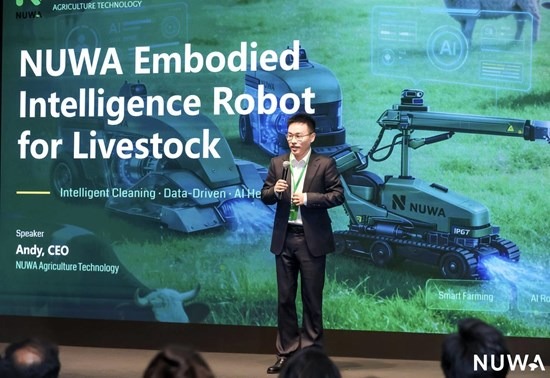
An agricultural technology startup has introduced embodied AI to one of the most challenging physical environments on earth: the livestock barn. Nuwa Agri-Tech launched its ELR livestock robot at the China International Equipment Intelligence (CIEI) 2026 expo in Shanghai, standing out as the only company dedicated to animal husbandry among over five hundred exhibitors. The company is building what it calls a comprehensive livestock embodied AI platform, combining autonomous navigation, risk prediction algorithms, and modular physical tools to handle the dangerous and dirty work of farm management. This article explains what livestock embodied AI is, why the agricultural sector faces a critical labor bottleneck, how Nuwa's approach differs from global agricultural giants like John Deere, and what this deployment signals for the broader physical AI ecosystem.
What Is Livestock Embodied AI
For the past several years, agricultural automation has been defined by crop management, massive autonomous tractors plowing fields, and drones spraying fertilizer from the sky. These systems operate in relatively open, predictable outdoor environments. But they share a fundamental limitation: they cannot handle the chaotic, enclosed, and highly corrosive environment of a livestock barn.
Livestock embodied AI represents a paradigm shift from broad acre farming to precision animal care. Instead of managing a field of corn, a livestock robot must navigate narrow aisles, avoid unpredictable moving animals, and perform specific physical interventions. In essence, it is a mobile farmhand. It is an AI system that can physically clean pens, monitor animal health, and deliver feed or vaccines in an environment filled with dust, humidity, and corrosive ammonia.
The urgency behind livestock embodied AI in 2026 stems from a severe demographic crisis. The agricultural industry has hit a labor wall. Finding human workers willing to perform the physically demanding, dirty, and often dangerous tasks required in animal husbandry is becoming nearly impossible. Training a human to consistently monitor thousands of animals for early signs of disease is expensive and prone to error. Livestock embodied AI offers a solution: deploy ruggedized robots to handle the physical labor and continuous monitoring, allowing human farm managers to focus on high level operational decisions.
Where Livestock Embodied AI Is Already Being Used
The most mature application for robotics in animal husbandry is the dairy sector. Companies like Lely in the Netherlands and DeLaval have successfully deployed automated milking systems that allow cows to be milked on their own schedule. These stationary systems have proven that animals can adapt to robotic interaction. The efficiency gain is substantial, as automated milking increases yield and reduces the physical strain on farmers.
However, the central challenge in 2026 is moving beyond stationary systems to fully mobile, multi task embodied AI. Unlike a stationary milking stall, a mobile livestock robot must actively patrol the barn. Nuwa Agri-Tech is addressing this by developing a platform that can perform multiple tasks simply by changing its physical attachments. The ELR robot is designed to handle barn cleaning and disinfection, twenty four hour AI health monitoring, precision feeding, and even vaccine injection.
Nuwa Agri-Tech: The Newcomer With a Ruggedized Thesis
The Launch Event
On July 2, 2026, the China International Equipment Intelligence expo opened at the National Exhibition and Convention Center in Shanghai. Amidst hundreds of companies showcasing industrial arms and delivery robots, Nuwa Agri-Tech was the sole exhibitor focused exclusively on the livestock sector. The launch of the ELR robot marks a significant milestone for the company, which had previously secured a funding round in the tens of millions of RMB and gained international attention with displays in Times Square and Silicon Valley.
Company Background: From a Tsinghua Incubator to the Barn
Nuwa Agri-Tech, formally Nuwa Agricultural Technology (Shenzhen) Co., Ltd., is one of the youngest companies exhibiting at CIEI 2026. It was founded on December 26, 2025, and incubated by Sky Factory Venture Fund, an investment vehicle connected to the Tsinghua University Sky Factory innovation ecosystem, which continues to provide the company with research support alongside affiliated universities and institutes. The founding team pairs deep agricultural operating experience with industrial robotics engineering. Founder Andy Luo (Luo Hao) previously held management positions at New Hope Group and Zhengbang Technology, two of China's largest agribusiness and pig farming conglomerates, where he built multiple business lines from zero and ran large scale farm operations. Chief Technology Officer Guo Peng came from ABB's discrete automation division and JD Logistics Technology, where he worked on six axis robots, AGV and AMR systems, and intelligent supply chain integration. This pairing of farm operations knowledge and robot engineering is the company's stated formula: understand the barn first, then build the machine for it.
The company moved unusually fast for a hardware startup. Within two months of incorporation, in February 2026, it closed an angel round in the tens of millions of RMB from Xiamen Guosheng Fund, earmarked for core technology development, product engineering, and scaled deployment. In March 2026 it stepped onto the global stage, appearing on the Nasdaq Tower screen in Times Square and holding its first US product unveiling in Silicon Valley, where Luo described the long term vision of building the foundational data infrastructure for animal protein production. The company positions its robot not merely as a cleaning machine but as a mobile data collection node, with a three layer model of hardware, subscription analytics software, and a continuously growing farm dataset. By mid 2026 the company had been named among the most investment worthy enterprises at the Investor China Robot Industry Conference, and the ELR launch at CIEI 2026 marks its first full product debut on home soil.
Technical Architecture: The Six Core Technologies
Nuwa's core thesis is that a standard warehouse robot will fail immediately in a barn. Delivering a functional livestock robot requires an entire system of ruggedized hardware and specialized software. Nuwa's system comprises six core technologies designed specifically for this harsh environment.
The first component is the modular quick change end tool system, which allows the ELR to switch between cleaning brushes, feeding dispensers, and injection mechanisms. The second is a Long Short Term Memory Autoencoder (LSTM-AE) risk prediction algorithm, which analyzes the behavior and appearance of the animals to detect illness before physical symptoms become severe.
The remaining technologies focus on navigation and durability. The ELR utilizes multi sensor fusion for precise positioning in featureless barn aisles, intelligent path planning to avoid moving animals, and a highly durable chassis built to withstand corrosive ammonia and constant moisture. The company claims that by aligning their AI models with specific veterinary data, they can achieve early disease detection rates that surpass human observation, significantly reducing livestock mortality.
Global Competitive Landscape
The agricultural robotics space in 2026 is dominated by massive incumbents, but the specific niche of mobile livestock embodied AI remains open. To understand Nuwa's position, it helps to map the field. At the top tier are global giants like John Deere, which has focused its autonomous efforts heavily on broad acre crop farming. In the dairy sector, Lely and DeLaval hold strong positions with their stationary milking and feeding systems.
In China, Nuwa competes tangentially with companies like XAG and DJI Agras, which dominate the agricultural drone market. However, Nuwa's strategy is to outflank these competitors by focusing exclusively on the indoor livestock environment. By providing a complete, ruggedized physical AI platform for barns, Nuwa avoids direct competition with the outdoor crop automation giants and addresses a specific, acute labor shortage.
What This Means for Robotics Adoption
The deployment of embodied AI into livestock farming proves that physical AI is ready for the real world, not just clean factories and warehouses. Just as autonomous tractors transformed crop yields, mobile livestock robots will transform animal husbandry. Nuwa's launch demonstrates that the market is ready for specialized, ruggedized robots capable of performing complex physical tasks in the most challenging environments.
While some critics may still argue that farms are too unpredictable and harsh for advanced robotics, suggesting that the sensors will constantly fail in dusty, corrosive barns. However, Nuwa's specific focus on ruggedized hardware and multi sensor fusion proves they understand the environment. Startups may try to build cheaper robots, but they lack Nuwa's specific veterinary algorithms and durable chassis design. The race will be decided by who can build a robot that survives the barn, not just the laboratory.