Japan Loses a Third of Its Global Hawk Fleet in a Single Afternoon
One of Japan's three RQ-4B Global Hawk surveillance drones likely crashed off Tottori Prefecture, cutting the ASDF's high-altitude ISR fleet by a third just months after it reached full strength.

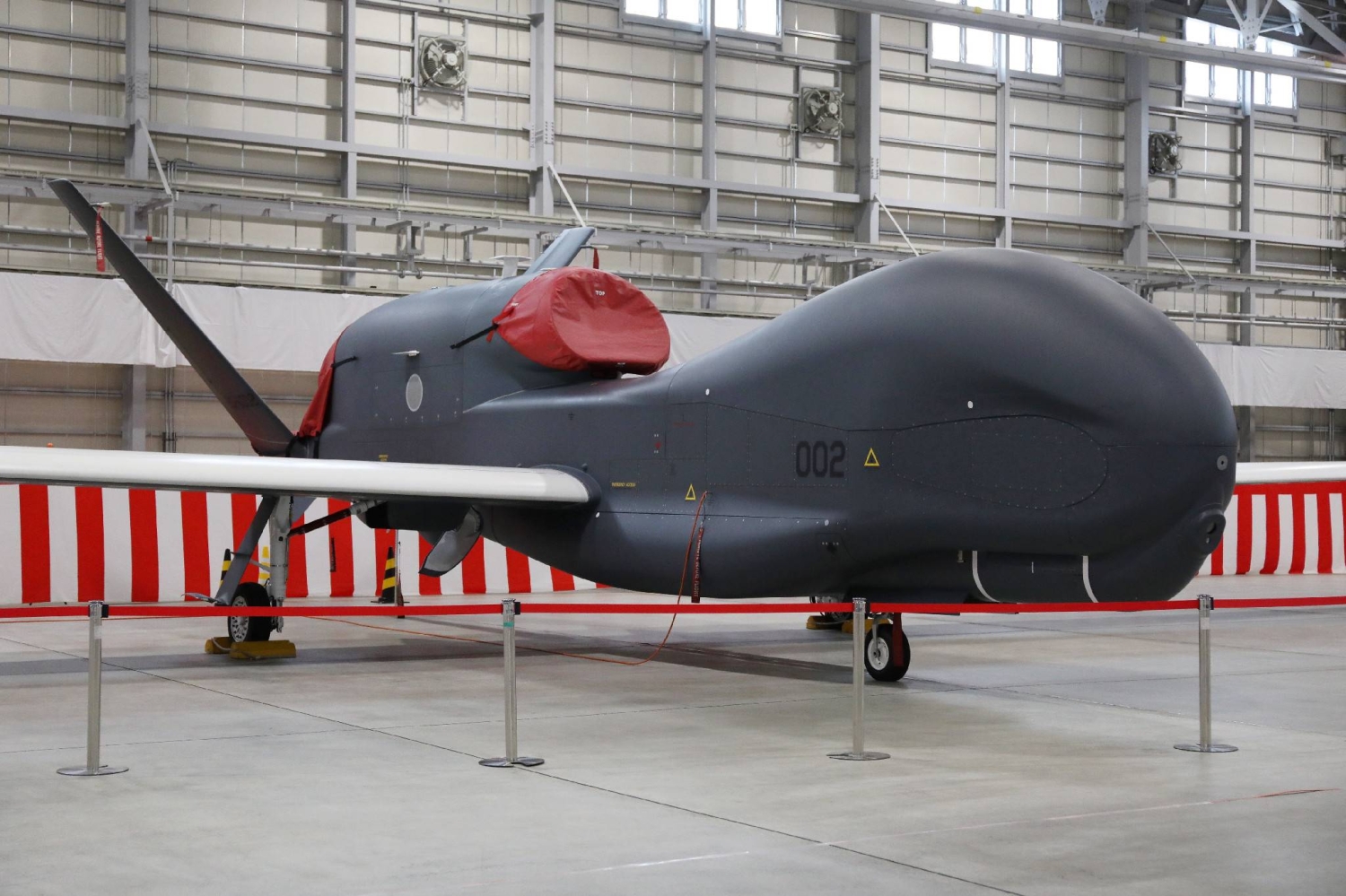
Japan's Air Self-Defense Force said Tuesday that one of its three RQ-4B Global Hawk surveillance drones likely crashed into the Sea of Japan roughly 50 kilometers off the coast of Tottori Prefecture after disappearing from radar around 1 p.m., with debris later spotted floating in the water matching the missing aircraft. The drone had been stationed at Misawa Air Base in Aomori Prefecture alongside Japan's two other Global Hawks, and General Takehiro Morita, the ASDF's top uniformed officer, told reporters the aircraft was not conducting a training mission at the time it went down, leaving both the cause of the crash and the nature of its mission publicly undisclosed. The loss removes one-third of Japan's entire high-altitude, long-endurance surveillance drone fleet in a single incident, a fleet the country spent roughly a decade assembling and did not complete until its third and final unit arrived at Misawa in mid-2026.
That timing detail matters more than it might first appear. Japan achieved what defense planners call its "full complement" of three Global Hawks only months before losing one of them, meaning the ASDF now has to absorb a one-third reduction in its most capable persistent-surveillance asset before that capability had even finished its first complete operational cycle. Replacing a single RQ-4B is neither fast nor cheap: Japan's original 2015 purchase of three aircraft, ground systems, spare parts, and logistical support from the United States carried a price tag of roughly US$1.2 billion, and that figure predates years of subsequent cost growth that has made the Global Hawk one of the more expensive surveillance platforms in service anywhere, a fact that will shape how quickly, and how completely, Japan can restore its ISR capacity to pre-crash levels.
A Drone That Costs More to Fly Than the Spy Plane It Replaced
The Global Hawk's expense is not confined to acquisition. The U.S. Congressional Budget Office found the RQ-4's recurring operating cost averaged approximately US$18,700 per flight hour between 2014 and 2019, a figure that exceeds the operating cost of the manned U-2 spy plane the drone was originally built to replace, an inversion that has embarrassed the program for over a decade and shaped budget debates inside the U.S. Air Force long before Japan's own loss this week. Buyers evaluating any long-endurance ISR drone program, not just Japan's, should treat that cost structure as the central strategic tradeoff: a Global Hawk trades a human pilot's risk exposure for a maintenance and sensor-support burden expensive enough that losing one aircraft creates real budgetary strain, not just a capability gap that can be patched over with a supplemental appropriation.
The aircraft itself is built for endurance rather than agility, measuring roughly 40 meters wide with a wingspan closer to a small airliner than a fighter jet, and capable of flying above 60,000 feet for more than 30 hours at a stretch, altitudes and durations that let a single Global Hawk watch a maritime area the size of a small country continuously through an entire day-night cycle. That capability is precisely why Japan bought the platform in the first place: persistent, wide-area maritime surveillance of the waters around Japan, including the East China Sea and the Sea of Japan, where China has in recent years repeatedly flown its own reconnaissance and surveillance drones, according to Japanese defense officials tracking the activity. Losing a third of that persistent-watch capacity does not just remove one asset from a rotation; it forces the remaining two aircraft to absorb a heavier tasking burden or accept reduced surveillance coverage during whatever maintenance and investigation period follows Tuesday's loss.
Japan Is Not the First Operator to Lose a Global Hawk, and the Pattern Is Instructive
Tuesday's crash extends a documented history of Global Hawk losses that predates Japan's own program. Northrop Grumman's early Global Hawk prototypes suffered several losses attributed to technical failures and maintenance issues during the platform's development years, and in 2019 an Iranian surface-to-air missile destroyed a U.S. Navy RQ-4A near the Strait of Hormuz, an incident that triggered a brief but serious escalation between Washington and Tehran precisely because losing an unmanned, uncrewed aircraft still carries geopolitical weight when the loss occurs in contested airspace. Japan's loss differs from that Iranian shootdown in one crucial respect: nothing in the ASDF's public statement suggests hostile action, and the absence of a training mission at the time of the incident points toward either a technical malfunction or an operational mission whose details the Defense Ministry has not disclosed, rather than an act of interception.
That distinction matters for how Tokyo frames its response. A confirmed mechanical failure invites scrutiny of Global Hawk's maintenance regime and the ASDF's technical readiness to operate a famously maintenance-intensive airframe, while an undisclosed operational mission raises separate questions about what the drone was doing over international waters and why the ASDF has not characterized the flight publicly. Regional defense observers watching China's own expanding drone patrols near Japanese waters will read the incident through whichever lens the eventual investigation supports, and the ASDF's decision to withhold the mission's purpose leaves room for both technical and operational explanations to circulate until an official cause is confirmed.
The Broader Bet Japan Has Already Made on Cheaper Drones
The Global Hawk loss arrives at an awkward moment in Japan's own defense-procurement thinking, which has been shifting toward smaller, cheaper, more numerous unmanned systems rather than doubling down on exquisite, expensive platforms like the RQ-4B. Japan's defense budget planning this year has already signaled a preference for lower-cost drone programs over other exquisite manned and unmanned systems, a hedge against exactly the kind of single-point-of-failure risk that Tuesday's crash just demonstrated in the starkest possible terms: when a surveillance fleet consists of only three aircraft, the loss of one is not a rounding error, it is a structural capability gap. A distributed fleet of dozens of cheaper drones would have absorbed Tuesday's loss without materially changing Japan's overall surveillance posture, whereas losing one of three Global Hawks immediately and visibly reduces what the ASDF can watch and for how long.
That tension between exquisite, expensive ISR platforms and cheaper, more numerous alternatives is not unique to Japan, but the country's Global Hawk fleet is now a live case study in the risk of concentrating a capability in a small number of extremely costly aircraft. Prime Minister Sanae Takaichi's government has separately signaled interest in accelerating both artificial intelligence integration and drone adoption across Japan's military modernization plans, and Tuesday's loss gives that policy push a concrete, uncomfortable data point: the platform Japan already owns and has spent a decade acquiring just demonstrated exactly the fragility that a shift toward distributed, lower-cost drone fleets is meant to avoid.
Recovering the Wreckage Is Its Own Security Problem
A Global Hawk that goes down in open water does not just remove an airframe from service; it leaves classified sensor and communications hardware sitting on or near the seabed until it can be recovered, and the ASDF's own search operation around the debris field off Tottori is as much a security exercise as a search-and-rescue one. The RQ-4B's electro-optical, infrared, and signals-intelligence payloads represent some of the most sensitive technology Japan operates, and a slow or incomplete recovery effort raises the same concern that followed Iran's 2019 shootdown, when Tehran spent months salvaging and reportedly reverse-engineering wreckage from the downed U.S. Navy aircraft. Japan's waters off Tottori are considerably less contested than the Strait of Hormuz, but any delay in securing the debris field still carries a nonzero risk that sensitive components could be recovered by a vessel other than Japan's own before the ASDF completes its own salvage operation, a scenario the Defense Ministry has strong incentive to close out quickly and quietly.
What Comes Next for Japan's Maritime Surveillance Posture
The Defense Ministry has not indicated whether it will seek to replace the lost aircraft, extend the operational tempo of its remaining two Global Hawks to cover the gap, or accelerate whatever cheaper drone programs are already in its planning pipeline as a partial substitute. Any of those three paths carries a different budget and timeline commitment, and the choice Japan makes will be a more reliable signal of its actual ISR strategy than any single policy speech about drone modernization. A decision to fund a fourth Global Hawk would signal continued confidence in the platform despite its cost and Tuesday's loss; a decision to instead accelerate lower-cost drone alternatives would confirm that the ASDF has concluded the concentration risk in a three-aircraft fleet is no longer acceptable. Either way, the investigation into what brought the aircraft down over the Sea of Japan will shape Tokyo's next move more than any existing procurement roadmap does.
This analysis draws on statements from Japan's Air Self-Defense Force and public reporting on the Global Hawk program's cost and operational history. It is for general information purposes only and does not constitute investment, financial, or legal advice.
Hero image credit: JIJI.